
Dostoyevsky on Why There Are No Bad People. Legendary Russian writer Fyodor Dostoyevsky (November 11, 1821–February 9, 1881) is best known as one of literary history’s titans, but he was also a brilliant entrepreneur and pioneer of self-publishing.

Under the auspices of his enterprising wife Anna, Dostoyevsky overcame his ruinous gambling addiction to become Russia’s first self-published author. 15 Great Existential Movies That Are Worth Your Time. Existentialism can be defined by French philosopher Jean-Paul Sartre’s phrase existence precedes essence.

It means that, for existentialism, a man is not his own end, since human existence only happens when it is designed beyond itself. According to the philosophy of existentialism, a man exists before being, and must give his life sense, since he is only what he makes of himself. Existentialism historically flirts with the arts, literature and cinema, Jean-Paul Sartre, dramatist, existentialist philosopher and writer, certainly believed that. Existentialism also has its history linked to protests and reactions against the status quo in the policies of many countries, against fascism and dictatorship, in favor of freedom and free speech.
Kierkegaardphil1reading. Being There: Heidegger on Why Our Presence Matters. The Stone is a forum for contemporary philosophers and other thinkers on issues both timely and timeless.

A cognitive scientist and a German philosopher walk into the woods and come upon a tree in bloom: What does each one see? And why does it matter? To see the full article, subscribe here. When we feel that someone is really listening to us, we feel more alive, we feel our true selves coming to the surface — this is the sense in which worldly presence matters. If attention is how we gain access to things in the world, then staying with an entity would enable a deeper revelation of its nature. Stoicism.
School of Hellenistic Greek philosophy Stoicism is a school of Hellenistic philosophy which was founded by Zeno of Citium, in Athens, in the early 3rd century BC.
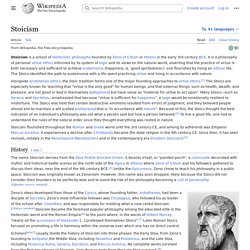
Stoicism is a philosophy of personal ethics informed by its system of logic and its views on the natural world. According to its teachings, as social beings, the path to eudaimonia (happiness) for humans is found in accepting the moment as it presents itself, by not allowing oneself to be controlled by the desire for pleasure or fear of pain, by using one's mind to understand the world and to do one's part in nature's plan, and by working together and treating others fairly and justly. Stoicism flourished throughout the Roman and Greek world until the 3rd century AD, and among its adherents was Emperor Marcus Aurelius.
It experienced a decline after Christianity became the state religion in the 4th century AD.
Dante and the Eternal Quest for Nonreligious Divinity: Physicist Margaret Wertheim on Science and God. Kierkegaard course. Hesiod, Theogony, line 404. 453-506 Hesiod's Theogony. Dualism. 1.

The Mind-Body Problem and the History of Dualism 1.1 The Mind-Body Problem The mind-body problem is the problem: what is the relationship between mind and body? Or alternatively: what is the relationship between mental properties and physical properties? Humans have (or seem to have) both physical properties and mental properties. Physical properties are public, in the sense that they are, in principle, equally observable by anyone. The mind-body problem concerns the relationship between these two sets of properties. The ontological question: what are mental states and what are physical states? Different aspects of the mind-body problem arise for different aspects of the mental, such as consciousness, intentionality, the self. The problem of consciousness: what is consciousness? Other aspects of the mind-body problem arise for aspects of the physical. The problem of embodiment: what is it for the mind to be housed in a body?
Idealist views say that physical states are really mental. The Euthyphro Dilemma. Divine command theory is widely held to be refuted by an argument known as “the Euthyphro dilemma”.

This argument is named after Plato’s Euthyphro dialogue, which contains the inspiration for the argument, though not, as is sometimes thought, the argument itself. The Euthyphro dilemma rests on a modernised version of the question asked by Socrates in the Euthyphro: “Are morally good acts willed by God because they are morally good, or are they morally good because they are willed by God?” Each of these two possibilities, the argument runs, leads to consequences that the divine command theorist cannot accept.
Immanuel Kant and The Categorical Imperative for Dummies. Not just any definition of duty would do for Kant.

He said that ideas for duty must cover all persons at all times. So we have an absolutist theory at work, where universal maxims are applied. Universal moral laws that are logical are the foundation of all life. There are no contradictions. Right and wrong is black and white. Peter Carruthers. Microsoft Word - gettierphilreading.doc - gettier.pdf. Episode 73: Why Do Philosophy? (And What Is It?) Podcast: Play in new window | Download (Duration: 1:14:55 — 68.7MB) Mark, Seth, Wes, and Dylan share what drove them into philosophy and keeps them there.

How is philosophy different than (or similar to) science? Than religion? Art? Philosophia... Plato's Allegory of the Cave: Analysis and Summary. Sharon Salzberg + Robert Thurman on Embracing Our Enemies and Our Suffering. Plato's view of wisdom. In the Apology, Socrates identifies his activity with "wisdom"—"This man among you, mortals, is wisest who, like Socrates, understands that his wisdom is worthless [my emphasis]. " According to Plato, this is best thing for human life, the best way humans can live their lives, the only way human life will be satisfying. "Men of Athens, I am grateful and I am your friend, but I will obey the god rather than you, and as long as I draw breath and am able, I shall not cease to practice philosophy, to exhort you and in my usual way to point out to any one of you whom I happen to meet: Good Sir, you are an Athenian, a citizen of the greatest city with the greatest reputation for both wisdom and power; are you not ashamed of your eagerness to possess as much wealth, reputation, and honors as possible, while you do not care for nor give thought to wisdom or truth, or the best possible state of your soul?
" Three Platonic images of wisdom 1. Fear-and-trembling-johannes-de-silentio. Teaching Children Philosophy. Philosophical Health Test - Error. Formalisation of ancient logics: Dignaga. Kant on Punishment. From Immanuel Kant, Science of Right (1790) Translated by W.

Hastie Judicial or juridical punishment (poena forensis) is to be distinguished from natural punishment (poena naturalis), in which crime as vice punishes itself, and does not as such come within the cognizance of the legislator. juridical punishment can never be administered merely as a means for promoting another good either with regard to the criminal himself or to civil society, but must in all cases be imposed only because the individual on whom it is inflicted has committed a crime. For one man ought never to be dealt with merely as a means subservient to the purpose of another, nor be mixed up with the subjects of real right.
Against such treatment his inborn personality has a right to protect him, even although he may be condemned to lose his civil personality. KANTIAN ETHICS. German philosopher Immanuel Kant (1724-1804) was an opponent of utilitarianism.
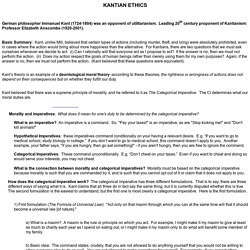
Leading 20th century proponent of Kantianism: Professor Elizabeth Anscombe (1920-2001). Basic Summary: Kant, unlike Mill, believed that certain types of actions (including murder, theft, and lying) were absolutely prohibited, even in cases where the action would bring about more happiness than the alternative. For Kantians, there are two questions that we must ask ourselves whenever we decide to act: (i) Can I rationally will that everyone act as I propose to act?
If the answer is no, then we must not perform the action. (ii) Does my action respect the goals of human beings rather than merely using them for my own purposes? Kant’s theory is an example of a deontological moral theory–according to these theories, the rightness or wrongness of actions does not depend on their consequences but on whether they fulfill our duty. Just Do It!: [PL 431] Kant's formulations of the categorical imperative. Kant gives four formulations of the Categorical Imperative : The Formula of the Universal Law of Nature : "Act as if the maxim of your action were to become through your will a universal law of nature. " The Stone Philosophy Links. The Stone is a forum for contemporary philosophers and other thinkers on issues both timely and timeless. The Stone’s weekly briefing of notable philosophy-related issues and ideas from around the Web. When the mayor of New York, Michael R. Bloomberg, banned the sale of sodas over 16 ounces at many public places last year, many were outraged by what they saw as an infringement on their autonomy.
In a review essay at The New York Review of Books, Cass Sunstein points out that these objectors were doing so on grounds laid out by John Stuart Mill in “On Liberty.” Mill, who believed that each individual is in a unique position to know what’s in her best interest, concluded that government may coerce citizens to refrain only from acts that are hazardous to others, and has no warrant for regulating an individual’s behavior. The Enchiridion by Epictetus. Commentary: A few comments have been posted about The Enchiridion. Download: A 40k text-only version is available for download. The EnchiridionBy Epictetus Written 135 A.C.E. Translated by Elizabeth Carter 1. Arist. Some Main Points of Aristotle's Thought A. Wittgenstein and Philosophy. Gorgias by Plato. Descartes’ Method of Doubt and the Cogito: Part I. In René Descartes’ Meditations on First Philosophy, Descartes creates a whole new method of doubt and skepticism for building a foundation for knowledge.
By John Stuart Mill. Nicomachean Ethics by Aristotle. Commentary: Quite a few comments have been posted about Nicomachean Ethics. Download: A text-only version is available for download. Nicomachean EthicsBy Aristotle Written 350 B.C.E Translated by W. Democritus - The Laughing Philosopher.