Forget Extinct: The Brontosaurus Never Even Existed. Hide captionApatosaurus (right, opposite a Diplodocus skeleton at the Carnegie Museum of Natural History in Pittsburgh), is what paleontologist Othniel Charles Marsh actually found when he thought he'd discovered the Brontosaurus.
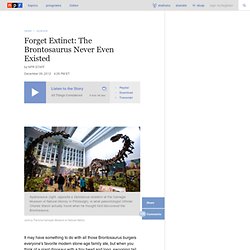
Joshua Franzos/Carnegie Museum of Natural History Apatosaurus (right, opposite a Diplodocus skeleton at the Carnegie Museum of Natural History in Pittsburgh), is what paleontologist Othniel Charles Marsh actually found when he thought he'd discovered the Brontosaurus. It may have something to do with all those Brontosaurus burgers everyone's favorite modern stone-age family ate, but when you think of a giant dinosaur with a tiny head and long, swooping tail, the Brontosaurus is probably what you're seeing in your mind. Well hold on: Scientifically speaking, there's no such thing as a Brontosaurus. Life Science Reference - Biology Online. 'Extraordinary' flies drawn by sodden city. Vinegar Flies.

Photo: University of Melbourne Rain and rotting fruit have contributed to Brisbane's plague of what appear to be tiny black fruit flies. Giant snail appears in Brisbane. The Giant African Snail found in a Brisbane container yard.

Photo: Department of Agriculture, Fisheries and Forestry A snail the size of a cricket ball and posing a serious threat to Australia’s biosecurity has been destroyed after it was found creeping across a Brisbane container yard. Staff called the Department of Agriculture, Fisheries and Forestry after finding the large snail crawling across the cement yard. It was a Giant African Snail. Extinct frog hops back into the gene pool. In what may be considered an early Easter miracle, an extinct species of native frog has begun its rise from the dead.

Australian scientists have grown embryos containing the revived DNA of the extinct gastric-brooding frog, the crucial first step in their attempt to bring a species back to life. The team from the aptly named Lazarus project inserted the dead genetic material of the extinct amphibian into the donor eggs of another species of living frog, a process similar to the technique used to create the cloned sheep Dolly. The eggs continued to grow into three-day-old embryos, known as blastulas. Extict since 1983: The bizarre gastric-brooding frog.
"This is the first time this technique has been achieved for an extinct species," said one of the project scientists, conservation biologist Michael Mahony. Higgs boson. Higgs boson - 'I think we have it!

' Physicists at CERN have declared the particle they discovered last July is without a doubt the long-sought 'God particle' which could help explain the formation of the universe. 15, 2013 The search is all but over for the so-called God particle that is a crucial building block of the universe. An Energy Coup for Japan - ‘Flammable Ice’ Mega eruptions caused mass extinction › News in Science (ABC Science) News in Science Friday, 22 March 2013 Stuart GaryABC Magma wipe-out A mass extinction event 200 million years ago that wiped out half of all species on Earth was caused by volcanic activity, a new study says.

Look mum, no glasses in 3D breakthrough › News in Science (ABC Science) News in Science Thursday, 21 March 2013 AFP 3D breakthrough Fancy watching a movie on your mobile phone, where figures leap out from the screen in 3D, rather as Princess Leia did in the 1970s blockbuster Star Wars?

US researchers say they have moved that vision a pixel closer with the development of a three-dimensional image display that can be viewed without special glasses and is intended for cellphones, tablets and watches. Unlike the holographic projection used in George Lucas' movie fantasy, their small prototype display is flat, backlit and uses a technology called diffractive optics to give 3D images that can be viewed from multiple angles. "For example, if you were to display a 3D image of planet earth with the north pole facing out from the screen, by turning your head around the display, you would actually be able to have a view of any country on the globe," says David Fattal, who led the team at Hewlett-Packard Laboratories in Palo Alto, California.
Effect is limited. Harry Potter meets nano-medicine › News in Science (ABC Science) Hot bodies protect frogs from disease › News in Science (ABC Science) News in Science Wednesday, 27 March 2013 Genelle WeuleABC Saving frogs Higher body temperatures protect frogs from a deadly fungal disease that has decimated amphibian populations around the world, say Australian scientists.

Dr Ross Alford from James Cook University and Dr Jodi Rowley from the Australian Museum studied frogs found in North Queensland's rainforest. The more time that individual frogs spend at 25°C, the less likely they were to be infected with amphibian chytrid fungus they report in Scientific Reports . Squid genes crack secrets of the 'Kraken' › News in Science (ABC Science) News in Science Wednesday, 20 March 2013 Genelle WeuleABC.

Croc extinction led to dinosaur domination › News in Science (ABC Science) News in Science Wednesday, 27 March 2013 Jennifer ViegasDiscovery News Croc wipe out A mass extinction that occurred over 200 million years ago, killed off a slew of huge predators, including hefty beasts that looked like crocodiles and enormous armadillos, according to new research.

Some of the prehistoric predators - animals known collectively as the early pseudosuchians - likely preyed on certain dinosaurs, which later evolved some of impressive characteristics of the ancient pseudosuchians. Those included features like sturdy body armour and strong tails for whacking enemies. "It is likely, therefore, that dinosaurs prospered to some extent as a result of the extinction of most pseudosuchians and many other groups at the end of the Triassic," says co-author Richard Butler, a palaeontologist at Ludwig-Maximilians-Universität. The study shows that during the extinction event 201 million years ago, these animals declined rapidly, with only one lineage surviving into the Jurassic.
Study: Renewable electricity could be competitive. A carbon price of between $50 and $100 per tonne of carbon dioxide would make coal-fired and gas-fired power less economical than renewable electricity. Associate Professor Mark Diesendorf, of the Institute of Environmental Studies at UNSW, said all fossil-fuelled power stations in Australia’s National Electricity Market could be phased out and replaced economically and reliably with commercially available renewable energy technologies by increasing the carbon price to this “medium” level. “This carbon price range is considerably less than Treasury estimates for measures that would achieve far less in terms of cutting greenhouse gas emissions,” he said. The results of the peer-reviewed study by an interdisciplinary team at UNSW are to be published in the journal Energy Policy.
The researchers are Dr Diesendorf, Ben Elliston, of the School of Electrical Engineering and Telecommunications, and Dr Iain MacGill of the Centre for Energy and Environmental Markets. Contacts: Big eyes led to Neanderthal demise › News in Science (ABC Science) News in Science Wednesday, 13 March 2013 Reuters Neanderthals' bigger eyes and bodies meant they had less room in their brains for the higher-level thinking required to form large social groups, a new study says.
The finding could explain why they died out and Homo sapiens conquered the planet. Neanderthals lived in parts of Europe, Central Asia and Middle East for up to 300,000 years but vanished from the fossil record about 30,000-40,000 years ago. Why they disappeared is one of the mysteries of anthropology. Vatican Reveals Recipes for Conclave Smoke. Earthquakes turn water into gold › News in Science (ABC Science)
News in Science Monday, 18 March 2013 Stuart GaryABC Gold rush Gold could be deposited almost instantaneously in the Earth's crust during earthquakes, say Australian researchers. They have found gold is formed when an earthquake widens a fluid-filled rock fracture causing a drop in pressure, which in turn allows gold dissolved in the fluid to rapidly leach out.