
Michael Israel
BCS major at the University of Rochester.
ActivBrain articles science. The Dark Side of Oxytocin, the Hormone of Love - Ethnocentrism. Yes, you knew there had to be a catch.
As oxytocin comes into sharper focus, its social radius of action turns out to have definite limits. The love and trust it promotes are not toward the world in general, just toward a person’s in-group. Oxytocin turns out to be the hormone of the clan, not of universal brotherhood. Psychologists trying to specify its role have now concluded it is the agent of ethnocentrism. A principal author of the new take on oxytocin is Carsten K. Neuropsychology. Neuroscience. Mind and Brain. Transcranial Reprogramming of Action? Induction Problems in ppTMS : Developing Intelligence. With our introduction to paired pulse transcranial magnetic stimulation (ppTMS) out of the way, we now turn to a 2010 PNAS paper by Neubert, Mars, Buch, Olivier & Rushworth in which conditioning TMS is applied to the right inferior frontal gyrus (rIFG) as well as the pre-supplementary motor area (pre-SMA) between 3 and 18ms prior to TMS over the contralateral primary motor cortex (M1).

Note that all of these areas are known to interact in exceedingly complex ways based on the task subjects are performing, the intensity of the magnetic stimulation, the relative intensities of the paired pulses, and the subjects’ proximity to the initiation of movement at the time of conditioning TMS (all described yesterday). Skip the blockquotes unless you want to know about the detailed methods & results (they are actually quite interesting).
The “cognitive-level” take-home is below the block quote. Scientists capture the first image of memories being made. The ability to learn and to establish new memories is essential to our daily existence and identity; enabling us to navigate through the world.
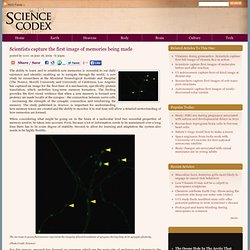
A new study by researchers at the Montreal Neurological Institute and Hospital (The Neuro), McGill University and University of California, Los Angeles has captured an image for the first time of a mechanism, specifically protein translation, which underlies long-term memory formation. The finding provides the first visual evidence that when a new memory is formed new proteins are made locally at the synapse - the connection between nerve cells - increasing the strength of the synaptic connection and reinforcing the memory. The study published in Science, is important for understanding how memory traces are created and the ability to monitor it in real time will allow a detailed understanding of how memories are formed.
(Photo Credit: Science) Capoeira. Everything About Capoeira.
Help.