
Chapter 4, Section 1. Ionic Compounds in Water Recall from Section 2.7 and especially Figure 2.23 that solid NaCl consists of an orderly arrangement of and ions.

When NaCl dissolves in water, each ion separates from the solid structure and disperses throughout the solution as shown in Figure 4.3(a). The ionic solid dissociates into its component ions as it dissolves. Water is a very effective solvent for ionic compounds. And negative ions (anions) are attracted by the positive end. Molecules as shown in Figure 4.3(a). BLB9CH0405. How many milliliters of 3.0 M are needed to make 450 mL of 0.10 M.

Chapter 13, Section 2. The concentration of a solution can be expressed either qualitatively or quantitatively.
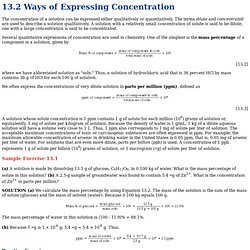
The terms dilute and concentrated are used to describe a solution qualitatively. A solution with a relatively small concentration of solute is said to be dilute; one with a large concentration is said to be concentrated. Several quantitative expressions of concentration are used in chemistry. One of the simplest is the mass percentage of a component in a solution, given by where we have abbreviated solution as "soln. " We often express the concentrations of very dilute solution in parts per million (ppm), defined as A solution whose solute concentration is 1 ppm contains 1 g of solute for each million (106) grams of solution or, equivalently, 1 mg of solute per kilogram of solution. Chapter_11.html: CHM2045 F13 ALL. Boundless. Let’s Revise “Solid State” and “Solutions” Friends, with just a few days left before the examination, you all must be busy completing the final round of revision.

We often get queries from our students that they are finding it hard to cope up with the physical chemistry portion. This makes many of them, skip numericals especially related to solutions and electrochemistry. But you know what, this is the most scoring portion too. You have only five chapters with some laws, postulates, graphs and numericals. Here, we will focuss on the important points of the first two chapters. Let’s proceed…. Unit 1: Solid state (4 marks) Classification of solids based upon conductivities: Conductors, insulators and semi-conductorsClassification of solids based upon magnetic properties: Paramagnetic, diamagnetic, ferromagnetic, anti-ferromagnetic and ferrimagnetic Questions asked in previous years Unit 2: Solutions 5 marks Formulae for numericals.
Wolfram Demonstrations Project. Osmosis involves the selective passage of certain components of a solution through a semipermeable membrane, with exclusion of other components.

It is, of course, of central significance in biological processes. Consider in this Demonstration a membrane permeable only to water, but impermeable to the solute in a water solution. The membrane is represented by a blue disk at the bottom of the U-tube, separating the pure solvent on the left from the solution on the right. Solvent will spontaneously flow through the membrane into the solution, in a (vain) attempt to equalize the concentrations on the two sides.
This gives rise to an osmotic pressure, designated . , where. Chapter 11. Colligative Properties are properties of a liquid that may be changed by the addition of a solute.

They are properties that depend on the numberof particles present in solution. More particles increase the effect. Vapor pressure, melting and boiling points, and osmotic pressure are all examples of colligative properties. Each of these properties ultimately relates to the vapor pressure making it essential to understand what vapor pressure is and how it depends on temperature. Compound that normally exist as liquids at room temperature and pressure have "vapor" associated with them. Consider a beaker filled with a liquid The molecules on the surface are in direct contact with the air and have fewer molecules touching them so fewer molecules with which to share intermolecular forces of attraction. A Boltzman curve is often used to show Kinetic energies.
Presentation "AP Chemistry Notes Solutions & Colligative Properties." Colligative Properties of Solutions. Worksheet - Osmosis Problems - AP level. Worksheet - Osmosis Problems - AP level Go back to Osmosis Equation Return to Solutions Menu Problem #1:

Colligative properties of solutions. The colligative properties that we will consider in this and the next unit apply to to solutions in which the solute is non-volatile; that is, it does not make a significant contribution to the overall vapor pressure of the solution.

Solutions of salt or sugar in water fulfill this condition exactly. Other solutes that have very small vapor pressures, such as iodine or ethylene glycol antifreeze, can often be considered nonvolatile in comparison to the solvent at the same temperature. Solutions in which both components possess significant vapor pressures, such as alcohol in water, will be treated in another section farther on. Colligative property - BOILING POINT ELEVATION - Surfguppy. Definition The RAISING of the normal boiling point of a liquid by adding a non-volatile substance to it.

When you add non-volatile solute to volatile solvent, the boiling point is elevated.This means that the solvent will only boil at a higher temperature.The reason is because the non-volatile substance or solute becomes a hindrance. The solvent particles will need a lot more energy to bounce upwards and push the solute particles out of the way and eventually escape into the atmosphere.In order for the solution to boil, the vapor pressure (upward pressure) has to reach an equal force to the atmospheric pressure (downward pressure).Thus heating the solution to a higher temperature is necessary to bring the solvent to a boiling point. Change in boiling point after a solute has been added ΔTb = Kb • M. Colligative property - FREEZING POINT DEPRESSION - Surfguppy. Osmotic Pressure. The osmotic pressure of a dilute solution is found to obey a relationship of the same form as the ideal gas law: In chemistry texts, it is usually expressed in terms of the molarity of the solution and given the symbol π.

In these relationships, R = 8.3145 J/k mol is the normal gas constant and R'= 0.0821 L atm/K mol is the gas constant expressed in terms of liters and atmospheres. Solutions - Colligative Properties Tutorial. Colligative Properties/Raoult's Law. 1 Vapor pressure of solutions: Raoult's law The colligative properties really depend on the escaping tendency of solvent molecules from the liquid phase. You will recall that the vapor pressure is a direct measure of escaping tendency, so we can use these terms more or less interchangeably.