
Dare to Differentiate - 50 Terrific Teacher Tips! Daretodifferentiate - home. Pre-Assessment. Tips for Writing Instructional Objectives - Bloom's Taxonomy Job Aids. I am so delighted to see this post that includes Bloom's Taxonomy Wheels by ZaidLearn.
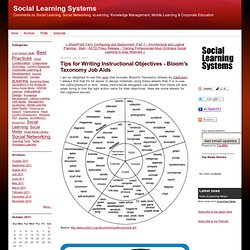
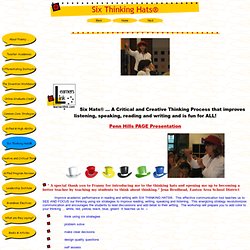
I always find that it's far easier to design materials using these wheels than it is to see the verbs/products in lists. Many instructional designers can benefit from these job aids when trying to find the right action verbs for their objectives. Here are some wheels for the cognitive domain. Source: Source: Source: Bloom’s digital taxonomy. Have fun, designers! Tips for Writing Instructional Objectives - Bloom's Taxonomy Job Aids. Are You Left or Right Brain? Six Thinking Hats® Six Hats® ...
Differentiation. The Best Resources On Differentiating Instruction. My colleague Katie Hull-Sypnieski is leading a February 1st Education Week Webinar on differentiating instruction, and I would strongly encourage people to participate.
Katie’s the best teacher I’ve ever seen…. In addition, Katie and I have co-authored a piece for Education Week Teacher on the topic that will be appearing there soon (it’s appeared: The Five By Five Approach To Differentiation Success), and an upcoming post in my blog there will be talking about it, too (that two part series has also appeared). I also did a second two-part series in Ed Week on differentiation. Also, check out The Best “Fair Isn’t Equal” Visualizations. Given all that, a “The Best…” post was inevitable, and here it is. Here are my choices for The Best Resources On Differentiating Instruction: The Best Places To Get The “Same” Text Written For Different “Levels” Busting Myths about Differentiated Instruction is by Rick Wormeli.
Reconcilable Differences? Using Digital Tools for Differentiation. Direct Address to this Page:
Digital Differentiation. Technology is a tool that can be used to help teachers facilitate learning experiences that address the diverse learning needs of all students and help them develop 21st Century Skills.
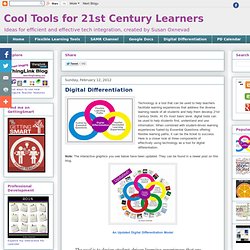
At it's most basic level, digital tools can be used to help students find, understand and use information. When combined with student-driven learning experiences fueled by Essential Questions offering flexible learning paths, it can be the ticket to success. Here is a closer look at three components of effectively using technology as a tool for digital differentiation. Note: The interactive graphics you see below have been updated. They can be found in a newer post on this blog. Differentiation - tools, tips and resources. Differentiation is an important aspect of education.

Students learn differently, have different needs, different backgrounds, different skills, different ability levels, different interests and more. As educators, we try to create engaging lesson activities that provide a variety of learning experiences and allow students to demonstrate their learning in different ways. Differentiation should occur in both how students learn and gain knowledge and skills, and in how they demonstrate and are assessed on what they have learned. “In the practice of education, differentiation is defined as working to address the abilities, interests, and needs (both perceived and real) of individuals. Differentiating Using 21st Century Tools - Mahara. Centers: Effective Structures for Differentiation. Photo by Woodley Wonder Works This article is written by Katie Haydon, founder of Ignite Creative Learning Studio.
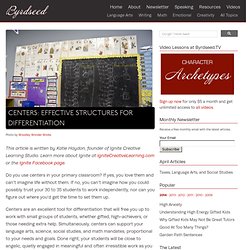
Learn more about Ignite at IgniteCreativeLearning.com or the Ignite Facebook page. Do you use centers in your primary classroom? If yes, you love them and can’t imagine life without them. If no, you can’t imagine how you could possibly trust your 30 to 35 students to work independently, nor can you figure out where you’d get the time to set them up. Centers are an excellent tool for differentiation that will free you up to work with small groups of students, whether gifted, high-achievers, or those needing extra help. Centers, in my opinion, go beyond mundane and standard worksheet tasks. Letsgetengaged - home. Teaching the Gifted and Talented: 33 Websites Where You Can Find Good Resources. I wish the Internet was available to me as a kid in elementary school.
In New York City, where I attended kindergarten through sixth grade, they called the gifted and talented class "SP". I remember being put into a class to learn French, but very little else. I figured out how ahead I was only when I entered junior high school in New Jersey. The French language I had studied for three years allowed me to coast through French class for the next four years. Without anymore "SP" or "G and T" classes, I unfortunately developed a lazy attitude and eventually quit taking French in eleventh grade. Tomlin00. Tomlin00. Tomlinson - Differentiation Central. Differentiating the curriculum. Differentiating Instruction.
Differentiating Instruction ...
One Size Doesn't Fit All Effective Strategies to Improve Student Performance ! We have students in our classrooms who struggle academically and others who learn at an advanced level and accelerated pace. We can meet the needs of all learners by differentiating instruction. This workshop provides an understanding and application of the principles and strategies needed to set up a classroom that provides success and challenge for academically diverse students. Testimonials about the workshops -- Fran McAleer is a valuable contributor to our work, training to create a new and better workplace in our schools. More! Franny McAleer has been providing staff development for teachers in the Berwick Area School District for the last four years, including whole staff workshops with the Six Thinking Hats as well as focused workshops detailing best practices with instructional strategies for gifted and honors students. Differentiating Instruction.