
Connecting Classroom and Community: 7 Strategies to Try (even virtually) By: Kyle Conley We know that last spring left many of our students in crisis and this fall is our chance to reconnect with them.

This is the moment when our students need our reassuring presence (even virtually) and the chance to lose themselves in learning experiences that speak to their whole selves. This is the time to lean into the challenges of delivering deeper learning remotely. Here are 7 ways to ensure your students connect their learning with themselves, their community, and the content in your classroom. 1. 2. 3. 4. 5. 6. 7. Last spring left us all scrambling to adapt to a learning environment that erupted under our feet. Additional Resources: For more, see: Promoting Family Engagement: Ways to Foster More Meaningful Connections — PSLN. It has never been more important to involve families in the education of our students.

The past few months have been a challenging time in the world and for families who are now taking on additional responsibilities as educators, and for educators who are not only educating their students, but also their own children. It requires a lot of patience and flexibility each day. Making those connections and building family engagement is crucial to student success. Beyond just involving families, we need to strive for family engagement and work on creating partnerships between school, home and community. These partnerships, or connections between “stakeholders”, are vital for promoting student well-being and success. First, get to know your families To promote family engagement, we must be intentional in learning about the families in our schools.
ABCs Family Engagement. Promoting Family Engagement: Ways to Foster More Meaningful Connections — PSLN. EdTech Products Archive - Who you know matters. How to Connect Community to Classroom. A catalog of more than 100 tools provide students access to new relationships that supplement teacher-student relationships in myriad, powerful ways.

Leverage a digital tool to help students build their networks: CommunityShare: CommunityShare is a free platform that allows teachers to find individuals, businesses, nonprofit organizations, and higher education institutions who are excited to share their skills, experiences, and passions. The “human library” platform illuminates career pathways for students and brings outside expertise to class projects.
The platform helps teachers and students “go online to go offline,” says creator Josh Schachter. Place-Based Education Archives. HopSkipDrive: Safe Ride Share for Kids 7Shares What if kids could use ride share services to travel to their internship or get home after soccer practice?

HopSkipDrive, a Los Angeles startup, has solved this problem with a safe transportation solution for families and schools. Is the “Place” in Place-Based Learning Enough? 37Shares Place-based learning should be a comprehensive framework and process with clear learning outcomes and curriculum goals to ensure a meaningful experience and support student growth outside the walls of the classroom. Learner-Centered Iowa BIG Propels Jemar Lee 16Shares Emily from the Getting Smart team interviews Jemar Lee, a former student from Iowa BIG, a place-based and learner-centered school in Cedar Rapids and a Next-Generation Learning Challenge and XQ Super School winner.
Why Place-Based Education? 67Shares Learning Gardens Provide Equity, Access and Great Food 71Shares Design Thinking, City as Classroom, Museum as Homebase 269Shares Giving the Gift of Place. Reflections on Becoming More Culturally Responsive. In a demographic change similar to one that’s playing out across the country, the student body in Maryland’s Montgomery County Public Schools (MCPS) has shifted from being 94 percent white 50 years ago to just 30 percent today.
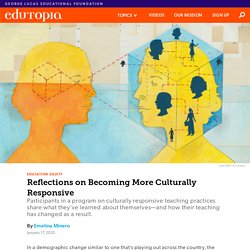
Nationally, students of color now make up about 51 percent of public K–12 students—a figure the U.S. Census Bureau expects to increase over the next several decades. This change in student demographics isn’t reflected in the teacher workforce, however, which is 80 percent white. To bridge cultural gaps between teachers and students, many districts are prioritizing professional development around race and culturally responsive teaching, the idea being that in order to meet students where they are, teachers need to know something about where they’ve been.
We covered EEE two years ago, and recently we checked in with participants to get their perspective on the program. Uncovering Implicit Biases Investigating Systemic Inequity Taking Action. Empowering Community Perspectives in Evaluation Research. What is equitable evaluation?

As funders, government agencies, and service providers become increasingly focused on program evaluation results to make evidence-based decisions, evaluators and other researchers seek to answer this question. In the last 20 years, there has been an increased focus on equitable evaluation, or evaluation that takes into account culture and context. Growing awareness has led to the development of multiple methodologies to guide equitable evaluation practices. These methods include: culturally responsive evaluation, participatory evaluation, collaborative evaluation, and empowerment evaluation.
Recognizing the nuances of a community is essential to collaborating with its members to improve programs aimed at promoting positive changes. Why does equitable evaluation matter? Traditionally, evaluation as a field has neglected to recognize the expertise of those being evaluated and rarely engages community members throughout the program evaluation. 1. 2. Real World Learning - Digital Promise.