
Regex Tester – RegexPal. REGex TESTER v1.5.3 - test/validate regular expressions, online tester. JavaScript RegExp Object - Using Regular Expressions with Client Side Scripting. JavaScript's regular expression flavor is part of the ECMA-262 standard for the language.
This means your regular expressions should work exactly the same in all implementations of JavaScript. In the past there were many serious browser-specific issues. But modern browsers do a very good job of following the JavaScript standard for regular expressions. You only need to make sure your web pages have a doctype that requests the browser to use standards mode rather than quirks mode. JavaScript’s Regular Expression Flavor In JavaScript source code, a regular expression is written in the form of /pattern/modifiers where "pattern" is the regular expression itself, and "modifiers" are a series of characters indicating various options. /g enables "global" matching.
You can combine multiple modifiers by stringing them together as in /regex/gim. Since forward slashes delimit the regular expression, any forward slashes that appear in the regex need to be escaped. Regexp Methods of The String Class. JavaScript Regular Expressions patterns. Regex Tutorial - Round Brackets for Grouping an... By placing part of a regular expression inside round brackets or parentheses, you can group that part of the regular expression together. This allows you to apply a quantifier to the entire group or to restrict alternation to part of the regex. Only parentheses can be used for grouping. Square brackets define a character class, and curly braces are used by a quantifier with specific limits. Parentheses Create Numbered Capturing Groups Besides grouping part of a regular expression together, parentheses also create a numbered capturing group.
The regex Set(Value)? If you do not need the group to capture its match, you can optimize this regular expression into Set(? Color=(? Using Text Matched By Capturing Groups Capturing groups make it easy to extract part of the regex match and reuse the text inside the regular expression (see below), or afterward. The 30 Minute Regex Tutorial - The Code Project... Expresso 2.1C - 328 Kb Learning .NET Regular Expressions with Expresso Did you ever wonder what Regular Expressions are all about and want to gain a basic understanding quickly?
My goal is to get you up and running with a basic understanding of regular expressions within 30 minutes. The reality is that regular expressions aren't as complex as they look. The best way to learn is to start writing and experimenting. What the Heck is a Regular Expression Anyway? I'm sure you are familiar with the use of "wildcard" characters for pattern matching. In writing programs or web pages that manipulate text, it is frequently necessary to locate strings that match complex patterns. A good way to learn the arcane syntax of regular expressions is by starting with examples and then experimenting with your own creations. Let's get started!
Some Simple Examples Searching for Elvis Suppose you spend all your free time scanning documents looking for evidence that Elvis is still alive. The absolute bare minimum every programmer shou... Javascript regular expression. Fun With .NET Regex Balancing Groups. Wednesday, January 23rd, 2008 • Related • Filed Under The .NET Framework's regular expression package includes a unique feature called balancing groups, which is a misnomer since although they can indeed be used to match balanced constructs, that's not all they're good for and really has nothing to do with how they work.

Unfortunately, balancing groups are quite poorly documented. Following is a brief description of their functionality, but this post will mostly focus on examples of using them in interesting ways. Note: If you're reading this in a feed reader or aggregator, see the original post, which uses regex syntax highlighting to hopefully make things easier to follow. (? I'm not a .NET coder, but I recognize the potential of this functionality. First, here's a simple example of using balancing groups outside the context of recursion and nested constructs. ^(? A few notes about the above regex: (? ^(? ReAnimator: Regular Expression FSA Visualizer. Zupancic Perspective (v2.0) - .NET Regular Expr... A few weeks ago I made some updates to my Regular Expression Assembly Builder that I wrote some time back.
These updates have long been requested by users and I finally carved out some time to get them implemented. These are the new features in verion 2.0.0.3: NEW: Added the ability to assign a description to each regular expression. These are stored in the RegexDescriptionAttribute class. UPD: Rearranged the RegexEditor to accommodate the new description, changing some labels in the process, and tab order. Though perhaps a small update, I hope the changes are found to be useful. NOTE: The File menu has two 'Save' options: Save Project and Save Release Version . Also, partially due to my migration to dasBlog , I've not gotten around to updating my little downloader application.
For a history of the application, please check out this post and its links as well. Regular Expression RecipesCompiling Regular... Compiling Regular Expressions Problem You have a handful of regular expressions to execute as quickly as possible over many different strings.
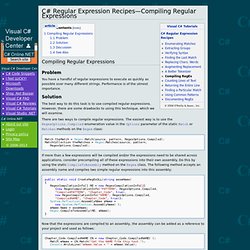
Performance is of the utmost importance. Solution.