
James Watson, Francis Crick, Maurice Wilkins, and Rosalind Franklin. In the video below, Jacqueline Boytim explains how spectrophotometers historically have been used by chemists to understand the structure of atoms.
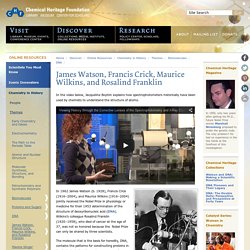
Maurice Wilkins with X-ray crystallographic equipment about 1954. Courtesy King’s College London and Horace Freeland Judson. A Personal Recollection of Rosalind Franklin. Jenifer Glynn: “My Sister Rosalind Franklin”.

Thurs 17th May 2012 at Lucy Cavendish College, Cambridge. As a chemistry undergraduate I was always subliminally aware of Rosalind Franklin, that she made an important contribution to the biological applications of x-ray diffraction but that there was some controversy though I wasn’t quite what it was all about. Doing my PhD at the Laboratory of Molecular Biology in Cambridge I walked past her model of tobacco mosaic virus regularly without actually realising what it was and who made it. So when the opportunity arose to invite her sister Jenifer Glynn to speak about her forthcoming book “My Sister Rosalind Franklin” it was a great opportunity to clarify those myths. Jenifer put paid to those myths and described Rosalind’s character with clarity and obvious affection. 253.full.pdf. My Sister Rosalind Franklin by Jenifer Glynn - review.
On my way to the British Library I pass the future Francis Crick Institute, formerly the UK Centre for Medical Research and Innovation.

A hoarding tells me that Crick "is best known for his work with James Watson, Maurice Wilkins and others which led to identifying the structure of DNA in 1953". And others: despite decades of attempts to redress the injustice done to Rosalind Franklin, in the official corridors of biomedical science hers is still, apparently, the name that cannot be uttered. We like to wrap major discoveries around a single person – it's simpler that way.
So it has to be Darwin's theory of evolution by natural selection, not Darwin and Wallace's. We reluctantly accept that DNA belongs to a two-headed hydra called Watson and Crick (the Cambridge physicist Neville Mott laboured for years under the delusion that a single person called Watson-Crick was behind it all). The most important photo ever taken? The Atomic Power of an Image by Kathleen Sweeney. The discovery of DNA begins with a key photograph.

That is the premise of “Photograph 51,” a compelling new play by Anna Zeigler, directed by Linsay Firman, now in its New York premiere at the Ensemble Studio Theatre. The x-ray print in question, developed by British crystallographer and physicist Rosalind Franklin revealed the double helix structure of DNA, and led to a Nobel Prize Award in 1962. The honorees? James Watson, Francis Crick and Maurice Wilkins. But not Rosalind Franklin. In an elegant portrayal by Kristen Bush, Rosalind Franklin is a focused professional who challenges gender discrimination at a time when women–even those with doctorates–were expected to be lab assistants. The crisp 90-minute play, set in the midst of authentic retro gizmos and vintage test tubes, turns a microscope on Franklin as she holds her own in this circle of ambitious men. Rosalind Franklin and DNA: How wronged was she? The views expressed are those of the author and are not necessarily those of Scientific American.
It’s remarkable what can happen when James Watson isn’t in the room. The Nobel laureate, known for his brilliance as well as his large ego and small superego, was expected to participate in a panel discussion Tuesday night about the play "Photograph 51," which focuses on Rosalind Franklin and her x-ray diffraction work in the early 1950s at King’s College London that contributed to discoveries of the molecular structure of DNA, first published in 1953.
Watson, Francis Crick and Maurice Wilkins received the Nobel Prize in medicine or physiology in 1962 for this work, four years after Franklin’s death of ovarian cancer, possibly induced by her work with x-rays. Nobels are only awarded to living scholars but a handful of researchers and advocates in the past few decades have argued that Franklin deserves more credit than she got for the DNA discovery. During that heady time. The Rosalind Franklin Papers: Biographical Information. Follow Profiles in Science on Pinterest!

"Science and everyday life cannot and should not be separated. Science, for me, gives a partial explanation of life. In so far as it goes, it is based on fact, experience, and experiment. . . . I agree that faith is essential to success in life, but I do not accept your definition of faith, i.e., belief in life after death. In my view, all that is necessary for faith is the belief that by doing our best we shall come nearer to success and that success in our aims (the improvement of the lot of mankind, present and future) is worth attaining. "