
Your source of daily updated funny pictures and gifs. The Original Rainwater Pillow® How do I dry my own herbs such as basil and cilantro? Grow Plants from Cuttings - Best Plants to Grow from Cuttings. Growing a Vegetable Garden at Epicurious. Read the seed packet Most people don't read the instructions and then wonder why the plants don't thrive.

You'll get tips on planting, nurturing, and harvesting your vegetables on better labels. These recommendations come from seed experts who have run trials to determine the best growing conditions for each variety of plant. Try this compost mix to improve your soil Alys Fowler, author of Garden Anywhere (Chronicle Books, May 2009), shares this compost mix for vegetables: 4 parts multipurpose potting soil, 1 part vermiculite, 2 parts composted fine bark, and 1 handful per pot of slow-release organic fertilizer, such as bat guano, sea kelp, or fish manure.
Plant root vegetables with plenty of space The larger the space between them, the bigger the vegetables grow.
Top Ten Most Nutritious Vegetables and How to Grow Them in Your Garden. A perfectly ripe, juicy tomato, still warm from the sun.
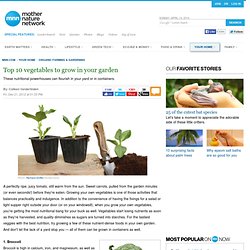
Sweet carrots, pulled from the garden minutes (or even seconds!) Before they're eaten. Growing your own vegetables is one of those activities that balances practicality and indulgence. In addition to the convenience of having the fixings for a salad or light supper right outside your door (or on your windowsill), when you grow your own vegetables, you're getting the most nutritional bang for your buck as well. Vegetables start losing nutrients as soon as they're harvested, and quality diminishes as sugars are turned into starches. Broccoli is high in calcium, iron, and magnesium, as well as vitamins A, B6, and C. How to grow broccoliGrow broccoli in containers: One broccoli plant per pot, pots should be 12 to 16 inches deep.What to watch out for: Cabbage worm. 10 useful plants you can find in the wild: Dogwood trees.
5 Easy to Grow Mosquito-Repelling Plants. As the outdoor season approaches, many homeowners and outdoor enthusiasts look for ways to control mosquitoes.
With all the publicity about the West Nile virus, mosquito repelling products are gaining in popularity. But many commercial insect repellents contain from 5% to 25% DEET. There are concerns about the potential toxic effects of DEET, especially when used by children.
Gifts and projects. Grow plants from your groceries, like ginger root and pineapple! No dig gardens - how to do no dig gardening by gardening the no dig way! U of M: Gardening Information: Information - Landscaping. G6970 Home Propagation of Garden and Landscape Plants. Reviewed by Christopher J.
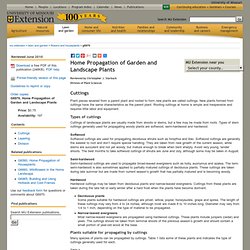
Starbuck Division of Plant Sciences Cuttings Plant pieces severed from a parent plant and rooted to form new plants are called cuttings. New plants formed from cuttings have the same characteristics as the parent plant. Rooting cuttings at home is simple and inexpensive and requires little labor and equipment. Plants That Stop — Even Eat — Mosquitoes. While I’m still gathering feedback on DEET -free repellents I thought you’d appreciate some information on plants that may help keep mosquitoes where they belong–far, far away from you.
(Note: the leaves of the following must be crushed to release the aroma. Otherwise mosquitoes can’t smell them): Photo: NellsWiki Horsemint has a scent similar to citronella and grows wild in most of the Eastern United States, from Mexico, Texas up to Minnesota to Vermont. Try No Dig Gardening for Your Backyard Vegetables. No-Dig Gardening is such a brilliant form of home-based agriculture I was convinced the TreeHugger archives would be rich with its merits.

Was very surprised when I only found one mention, in a post chronicling Leonora's permaculture adventures in New Zealand. So I launched into the following first-person account of No-Dig, only to discover that in North America the same process might be better known as as Sheet Mulching. Blog » 5 Secrets to a ‘No-work’ Garden. It took over 20 years of gardening to realize that I didn’t have to work so hard to achieve a fruitful harvest.

As the limitless energy of my youth gradually gave way to the physical realities of mid-life, the slow accretion of experience eventually led to an awareness that less work can result in greater crop yields. Inspired in part by Masanobu Fukuoka’s book, One Straw Revolution, my family experimented with gardening methods which could increase yields with less effort.
Fukuoka spent over three decades perfecting his so-called “do-nothing” technique: commonsense, sustainable practices that all but eliminate the use of pesticides, fertilizer, tillage, and perhaps most significantly, wasteful effort. Buckets, boxes, bowls, oh my! Growing Your Own Garlic - Planting Growing Harvesting and Storing Garlic. As far as I'm concerned, garlic gets the blue ribbon for growing your own.

It's absurdly easy to plant and care for; it tastes great; it looks beautiful and it takes up so little ground that even those with very small gardens can raise enough to be self-sufficient in garlic for a good part of the year. All you have to do is choose the right varieties; plant at the right time, in the right soil; then harvest when just right and store correctly. 1. Choosing Types of Garlic If you look in a specialist catalog like the one at Gourmet Garlic Gardens, you'll find dozens of varieties of garlic listed. You see where this is going – and you can see a lot more types of garlic on either of those websites, but for general purposes the most important difference is the one between softneck and hardneck.
Gardening Tips - 7 Habits of Successful Gardeners. Originally published January 2009.
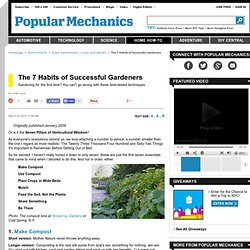
Garden Overview.