
Quantum intelligence. Intelligence. Intelligence is most widely studied in humans, but has also been observed in non-human animals and in plants.
Influence. Anthropology. Hypnosis. Nlp. Epistemology. The 16 Human Needs. Four generations of Harvard University psychologists – William James, William McDougall, Henry A.
Murray, and David McClelland – sought to identify the human needs that make us tick. Abraham Maslow, a Brandeis psychologist, suggested a hierarchy of human needs driven by the overarching goal of self-actualization. Today needs theory has little influence in psychology. What happened? How could the idea of human needs – so obviously relevant to understanding people – be ignored in contemporary psychology? Milton H. Erickson. Milton Hyland Erickson (5 December 1901 – 25 March 1980) was an American psychiatrist and psychologist specializing in medical hypnosis and family therapy.
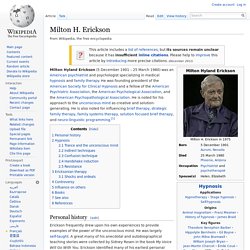
He was founding president of the American Society for Clinical Hypnosis and a fellow of the American Psychiatric Association, the American Psychological Association, and the American Psychopathological Association. He is noted for his approach to the unconscious mind as creative and solution-generating. He is also noted for influencing brief therapy, strategic family therapy, family systems therapy, solution focused brief therapy, and neuro-linguistic programming.[1] Personal history[edit] Erickson frequently drew upon his own experiences to provide examples of the power of the unconscious mind. Erickson grew up in Lowell, Wisconsin, in a modest farming family and intended to become a farmer like his father. At age 17, he contracted polio and was so severely paralysed that the doctors believed he would die. Milton H. Hypnosis[edit]
Piezoelectrical Phenomenon in the Soft Tissue - mjbtech. At the moment of the pressure application Dr.
Fukada and Dr. Yasuda were able to register negative electrical potentials on the compressed side of the bone. These potentials returned to zero as soon as the further increase of pressure ceased but initial pressure was still maintained. At the moment pressure was released and the bone came back to its original form, the authors registered positive electric potentials on the tensed surface of the bone. Why was this discovery so important? Dr. For our discussion it is important to find out what happened after the initial publication of Fukada and Yasuda. As we know bones are composed of two major parts: organic part presented by the collagen fibers and mineral part (Ca, P, etc) forms apatite. The organic part gives the bone elasticity, while the inorganic part gives the bone its firmness and stability. Everything went upside down when in 1961 two American scientists R.O. Anderson J.C., Eriksson C. Science and Technology: Paper : Electricity Generated by Human Body.
As we learned in intro physics, everything is made up of atoms, and atoms are made up of protons, neutrons and electrons.
Protons have a positive charge, neutrons have a neutral charge, and electrons have a negative charge. When these charges are out of balance, an atom becomes either positively or negatively charged. The switch between one type of charge and the other allows electrons to flow from one atom to another. This flow of electrons, or a negative charge, is what we call electricity. Since our bodies are huge masses of atoms, we can generate electricity. When we talk about the nervous system sending "signals" to the brain, or synapses "firing," or the brain telling our hands to contract around a door handle, what we're talking about is electricity carrying messages between point A and point B. Electricity is a key to survival. "A device that produces electricity from blood could be used to turn people into "human batteries".
Principle A thermoelectric generator. Pyroelectricity. Pyroelectric sensor Pyroelectricity should not be confused with thermoelectricity: In a typical demonstration of pyroelectricity, the whole crystal is changed from one temperature to another, and the result is a temporary voltage across the crystal.
In a typical demonstration of thermoelectricity, one part of the device is kept at one temperature and the other part at a different temperature, and the result is a permanent voltage across the device as long as there is a temperature difference. Explanation[edit] Pyroelectricity can be visualized as one side of a triangle, where each corner represents energy states in the crystal: kinetic, electrical and thermal energy. The side between electrical and thermal corners represents the pyroelectric effect and produces no kinetic energy. Although artificial pyroelectric materials have been engineered, the effect was first discovered in minerals such as tourmaline. History[edit] Make your very own solar panel! Here's how! Want to know how to Make a solar panel in your kitchen?
Make a solar cell in your kitchen Our solar cell is made from cuprous oxide instead of silicon.

Cuprous oxide is one of the first materials known to display the photoelectric effect, in which light causes electricity to flow in a material. Thinking about how to explain the photoelectric effect is what led Albert Einstein to the Nobel prize for physics, and to the theory of relativity. Materials you will need. The Future of Free Energy is here now! The end of oil, coal and nuclear pollution! - YouTube.flv. How Radio Works" "Radio waves" transmit music, conversations, pictures and data invisibly through the air, often over millions of miles -- it happens every day in thousands of different ways!
Even though radio waves are invisible and completely undetectable to humans, they have totally changed society. How Television Works"