
Oldest Neanderthal DNA Found in Italian Skeleton. The calcite-encrusted skeleton of an ancient human, still embedded in rock deep inside a cave in Italy, has yielded the oldest Neanderthal DNA ever found.

These molecules, which could be up to 170,000 years old, could one day help yield the most complete picture yet of Neanderthal life, researchers say. Although modern humans are the only remaining human lineage, many others once lived on Earth. Ancient DNA from Siberian boy links Europe and America. 20 November 2013Last updated at 13:00 ET The Mal'ta boy was buried with a variety of artefacts, including a Venus figurine Scientists have mapped the genome of a four-year-old boy who died in south-central Siberia 24,000 years ago.
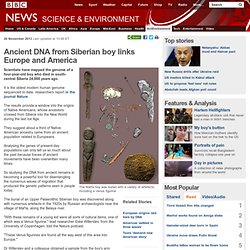
It is the oldest modern human genome sequenced to date, researchers report in the journal Nature. The results provide a window into the origins of Native Americans, whose ancestors crossed from Siberia into the New World during the last Ice Age. They suggest about a third of Native American ancestry came from an ancient population related to Europeans. Is this the stomach-turning truth about what the Neanderthals ate? It was the tell-tale tartar on the teeth that told the truth.

Or at least, that is what it appeared to do. Researchers – after studying calcified plaque on Neanderthal fossil teeth found in El Sidrón cave in Spain – last year concluded that members of this extinct human species cooked vegetables and consumed bitter-tasting medicinal plants such as chamomile and yarrow. These were not brainless carnivores, in other words. These were smart and sensitive people capable of providing themselves with balanced diets and of treating themselves with health-restoring herbs, concluded the researchers, led by Karen Hardy at the Catalan Institution for Research and Advanced Studies in Barcelona. Ape-like feet 'found in study of museum visitors' Scientists have discovered that about one in thirteen people have flexible ape-like feet.

A team studied the feet of 398 visitors to the Boston Museum of Science. The results show differences in foot bone structure similar to those seen in fossils of a member of the human lineage from two million years ago. It is hoped the research, published in the American Journal of Physical Anthropology, will establish how that creature moved. Apes like the chimpanzee spend a lot of their time in trees, so their flexible feet are essential to grip branches and allow them to move around quickly - but how most of us ended up with more rigid feet remains unclear.
Jeremy DeSilva from Boston University and a colleague asked the museum visitors to walk barefoot and observed how they walked by using a mechanised carpet that was able to analyse several components of the foot. Brontosaurus Not Real? Dino Is Actually Apatosaurus & Other Misconceptions Continue. What happened to the Brontosaurus?

The beloved dinosaur has been a part of numerous museum exhibits and a big part of pop culture. But did you know there's no such thing as a Brontosaurus? 'Hobbit' Brain Bigger Than Thought, Homo Floresiensis Researchers Say. By: Charles Choi, LiveScience Contributor Published: 04/16/2013 07:05 PM EDT on LiveScience.

Otzi The Iceman Had Tooth Decay, Cavities & Severe Gum Disease, New Study Shows (IMAGES) Think your last dental check-up was bad?

Pity poor Otzi. The mummified iceman had very severe tooth and gum trouble, according to a new study by researchers at the University of Zurich's Centre for Evolutionary Medicine. Otzi, a well-preserved 5,300-year-old mummy, was discovered in 1991 in the Otztal Alps, near the border between Austria and Italy. His teeth had never been systematically examined before. But now that researchers have taken a close look, they were surprised to uncover periodontal disease, tooth decay, severe abrasion, and dental trauma. In a nutshell: “He had everything," study co-author Frank Rühli, head of the Swiss Mummy Project at the University of Zurich, told Discovery News. North America Geologic History Revised In New 'Subduction Zone' Study.
By: Becky Oskin, OurAmazingPlanet Staff Writer Published: 04/03/2013 02:18 PM EDT on LiveScience It's time to redraw the map of the world during the reign of the dinosaurs, two scientists say.

Picture the U.S. West Coast as a tortured tectonic boundary, similar to Australia and Southeast Asia today. Erase the giant subduction zone researchers have long nestled against western North America. Origin Of Life In RNA? Study Suggests Genetic Molecules May Have Self-Assembled. By Robert F.

Service A pair of RNA-like molecules can spontaneously assemble into gene-length chains, chemists in the United States and Spain report. Parasitic Nematode, Or Roundworm, Called Most Numerically Abundant Animal On Earth. Dinosaur 'Milk' May Have Sped Hatchlings' Growth. How did baby dinosaurs get enough nutrients to grow into giant beasts?

Dinosaur "milk. " At least that's the idea put forth in a new paper by Dr. Paul Else, a professor of health sciences at Australia's University of Wollongong. Did overhunting lead to domestication? Article created on Monday, February 11, 2013. Dinosaur extinction: Scientists estimate 'most accurate' date. 8 February 2013Last updated at 05:10 ET The study revealed a more accurate date for dinosaur extinction Scientists believe they have determined the most precise date yet for the extinction of dinosaurs. Researchers from Glasgow University were part of an international team that has been investigating the demise of the dinosaur. By using dating techniques on rock and ash samples, they established the creatures died out about 66,038,000 years ago - give or take 11,000 years. That date appears to coincide with the impact of a comet or asteroid. Stubby-Tailed Dinosaurs Shook Their Thing.
Evidence contradicts idea that starvation caused saber-tooth cat extinction. In the period just before they went extinct, the American lions and saber-toothed cats that roamed North America in the late Pleistocene were living well off the fat of the land. That is the conclusion of the latest study of the microscopic wear patterns on the teeth of these great cats recovered from the La Brea tar pits in southern California.
Contrary to previous studies, the analysis did not find any indications that the giant carnivores were having increased trouble finding prey in the period before they went extinct 12,000 years ago. Ups and downs of biodiversity after mass extinction. The climate after the largest mass extinction so far 252 million years ago was cool, later very warm and then cool again. Thanks to the cooler temperatures, the diversity of marine fauna ballooned, as paleontologists from the University of Zurich have reconstructed. The warmer climate, coupled with a high CO2 level in the atmosphere, initially gave rise to new, short-lived species. In the longer term, however, this climate change had an adverse effect on biodiversity and caused species to become extinct.
Until now, it was always assumed that it took flora and fauna a long time to recover from the vast mass extinction at the end of the Permian geological period 252 million years ago. According to the scientific consensus, complex ecological communities only began to reappear in the Middle Triassic, so 247 million years ago. Alternate cooler and very warm phases Climate and carbon cycle influence biodiversity. Fossil raindrops probe ancient atmosphere.
4 December 2012Last updated at 10:20 ET By Jonathan Amos Science correspondent, BBC News, San Francisco. For some feathered dinosaurs, bigger not always better. Every kid knows that giant carnivores like Tyrannosaurus rex dominated the Cretaceous period, but they weren't the only big guys in town. Giant plant-eating theropods -- close relatives of both T. rex and today's birds -- also lived and thrived alongside their meat-eating cousins. Now researchers have started looking at why dinosaurs that abandoned meat in favor of vegetarian diets got so big, and their results may call conventional wisdom about plant-eaters and body size into question. Scientists have theorized that bigger was better when it came to plant eaters, because larger digestive tracts would allow dinosaurs to maximize the nutrition they could extract from high-fiber, low-calorie food.
Therefore, natural selection may have favored increasing body sizes in groups of animals that went meatless. Small lethal tools have big implications for early modern human complexity. On the south coast of South Africa, scientists have found evidence for an advanced stone age technology dated to 71,000 years ago at Pinnacle Point near Mossel Bay. This technology, allowing projectiles to be thrown at greater distance and killing power, takes hold in other regions of Africa and Eurasia about 20,000 years ago. When combined with other findings of advanced technologies and evidence for early symbolic behavior from this region, the research documents a persistent pattern of behavioral complexity that might signal modern humans evolved in this coastal location.
Giant pterosaur needed cliffs, downward-sloping runways to taxi, awkwardly take off into air. It weighed about 155 pounds and had a 34-foot wingspan, close to the size of an F-16 fighter jet. A five-foot-long skull looked down from a standing height similar to that of a modern giraffe. Fossils and genes brought together to piece together evolutionary history.