
For Firefox - Eyedropper, Color Picker and much more. Important - new version 3 Due to new Firefox add-on developer requirements and restrictions requiring all future add-on development to be done using WebExtensions technologies, ColorZilla for Firefox has been re-written from the ground up to comply with the new requirements.
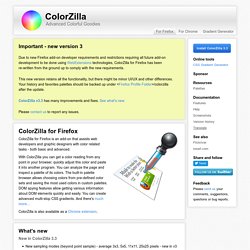
This new version retains all the functionality, but there might be minor UI/UX and other differences. Your history and favorites palettes should be backed up under <Firefox Profile Folder>/colorzilla after the update. ColorZilla v3.3 has many improvements and fixes. See what's new. Please contact us to report any issues. ColorZilla for Firefox is an add-on that assists web developers and graphic designers with color related tasks - both basic and advanced. With ColorZilla you can get a color reading from any point in your browser, quickly adjust this color and paste it into another program.
ColorZilla is also available as a Chrome extension. What's new New in ColorZilla 3.3 New in ColorZilla 3.0. Understand color theory with these 7 facts - = Designer Blog. Color is everywhere – in nature, in cities, in stores, online.
We’re so used to it we often don’t notice it’s even there, until we suddenly come across a black and white movie on TV. Then we remember how good it is that we have such a colorful world. For that reason alone, if not for improving your design skill set, knowing how color works is a good thing to do. So let’s dive in! 1. Might sound strange but it’s true.
Color is created only when our brain tries to make sense from light signals it receives from the outer world. Deprived of color, our world would probably look like a scene from Matrix. Without that, our world is a monochromatic place bathing in electromagnetic radiation of varied intensity and wavelengths. The key takeout? Goethe on the Psychology of Color and Emotion. Color is an essential part of how we experience the world, both biologically and culturally.
One of the earliest formal explorations of color theory came from an unlikely source — the German poet, artist, and politician Johann Wolfgang von Goethe, who in 1810 published Theory of Colors (public library; public domain), his treatise on the nature, function, and psychology of colors. Though the work was dismissed by a large portion of the scientific community, it remained of intense interest to a cohort of prominent philosophers and physicists, including Arthur Schopenhauer, Kurt Gödel, and Ludwig Wittgenstein. One of Goethe’s most radical points was a refutation of Newton’s ideas about the color spectrum, suggesting instead that darkness is an active ingredient rather than the mere passive absence of light.
YELLOWThis is the color nearest the light. It appears on the slightest mitigation of light, whether by semi-transparent mediums or faint reflection from white surfaces. #1Color Theory @ ColorJack. Labs - Multicolr Search Lab. Modern color theory (concepts) A Scientific Theory of Color Vision.
For many centuries, the behavior of color mixtures was difficult to explain because material color, which seemed to be anchored in "real" objects of the external world, was conceptually distinguished from the "illusory" colors in rainbows or prisms. The two types of mixtures behaved differently, but the reason for the difference was unknown. The trichromatic theory provided the clarifying explanation and prediction of all color sensations as arising in the behavior of the eye. Because the L, M and S receptor responses can be predicted mathematically from the summed intensity of all wavelengths in a light stimulus, the additive primaries empirically connect a measurable light stimulus to a measurable (matchable) color sensation — at least, in experimentally restricted viewing conditions. Design Seeds. Mudcu.be.
Colllor. Colourcode. 0to255. Adobe Kuler. Big Huge Labs. Tons of fun stuff...
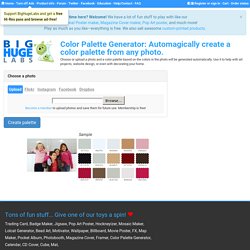
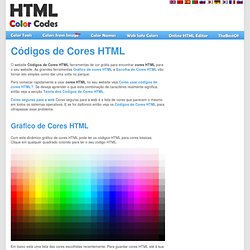
Give one of our toys a spin! Trading Card, Badge Maker, Jigsaw, Pop Art Poster, Hockneyizer, Mosaic Maker, Lolcat Generator, Bead Art, Motivator, Wallpaper, Billboard, Movie Poster, FX, Map Maker, Pocket Album, Photobooth, Magazine Cover, Framer, Color Palette Generator, Calendar, CD Cover, Cube, Mat, I know, right? It's a lot to take in. Go slow. HTML Color Codes. O website Códigos de Cores HTML ferramentas de cor grátis para encontrar cores HTML para o seu website.
Paletton. Color Palette FX. COLOURlovers. ColRD. ColoRotate. ColorHex. COMPUTER: Graphics: color pickers.