
Ohio Trees - Chinquapin Oak. Chinquapin Oak is a spreading tree that is native to the greater Midwest, ranging downward to the deep South and over into the eastern edge of the Great Plains.

In Ohio, it is scattered or absent in the northeastern quadrant of the state, is present in the northwestern and southern counties, but predominates in the southwestern counties that have an abundance of calcareous soils (that is, those high in pH and rich in limestone bedrock). It frequents dry, upland sites, but makes its best growth on rich, deep bottomlands. Its leaves may in some cases be almost lance-shaped and with their crenations pointing forward, somewhat resembling the flint arrows of Native Americans. Quercus muehlenbergii Engelm.
Quercus muehlenbergii Engelm.

Chinkapin Oak Fagaceae -- Beech family Ivan L. Sander. Chinkapin Oak. Family: Fagaceae Native or Introduced to Illinois: native Natural Habit in Illinois: dry limestone cliffs; upland woods Leaf: The single leaves are oblong, 3 to 6 inches in length and 1-1/2 to 3 inches wide, coarsely and sharply toothed.
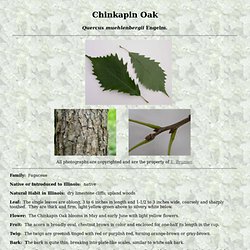
They are thick and firm, light yellow-green above to silvery white below. Flower: The Chinkapin Oak blooms in May and early June with light yellow flowers. Fruit: The acorn is broadly oval, chestnut brown in color and enclosed for one-half its length in the cup. Oak Genus: Common Trees of the Pacific Northwest. Oaks (Quercus) Fruit is an acorn.

Oregon White Oak - Quercus garryana - PNW Plants. Oregon White Oak is best known as a stately deciduous tree that grows from British Columbia south to Los Angeles.

Large mature specimens are wide spreading and very stout in appearance. In its northern range it is often known as Gary Oak. Morphology:Oregon White Oak can easily grow to a height of 90’ and a width of over 125’ forming a broad, rounded crown with a rugged appearance. The limbs are often very crooked especially if the tree is grown out in the open. Young trees often have shrubby appearance. The leaves of Oregon White Oak are arranged in an alternate fashion. Acorns (fruit) are ovate and smooth and approximately 1” long. The mature bark is brownish gray and shallowly fissured in a checker-like pattern. Adaptation:This species prefers full sun and does best where annual precipitation exceeds 30” per year. The Wild Garden: Hansen's Northwest Native Plant Database.
From Homepage August 22, 2002 What could be more noble than the oak tree?

Our northwest native Garry Oak (Quercus garryana) is also called Oregon White Oak, Garry's Oak, or Post Oak. Beloved for centuries, honored in music and poetry, the mysterious beauty of the gnarled branches, the leathery green of the leaves and the magnificent spreading shape like mother nature's welcoming arms is the stuff of which legends are borne. Oregon White Oak (Quercus garryana) Hort.ufl.edu/database/documents/pdf/tree_fact_sheets/quemaca.pdf. Plants.usda.gov/plantguide/pdf/cs_quke.pdf. Shingle Oak (Quercus imbricaria) Description: This tree is 40-80' tall at maturity, forming a single trunk about 1½-3' across and a crown of leafy branches. Young trees have somewhat pyramidal crowns, while older trees have more open crowns that are more or less ovoid. Upper branches are ascending, while lower branches are widely spreading or slightly drooping. Trunk bark of mature trees is gray to brown, rough-textured, and narrowly furrowed with scaly ridges.
Branch bark is gray and more smooth, while twigs are brown and glabrous with scattered lenticels. Alternate leaves occur along the twigs and young shoots; they tend to be more common near the tips of twigs and shoots. Southern Red Oak. Quercus chrysolepis, leaf - margin of upper + lower surface image. Click on image to enlarge © Copyright Steve Baskauf, 2002-2011 Email full-size image and text Click here to send feedback about this page to steve.baskauf@vanderbilt.edu Image/IM/I_SB/0674/320/Quercus_chrysolepis,_leaf_-_margin_of_upper_+_lower_surface,I_SB67434.jpgwidth=320 x height=214 pixels; size=38812 bytesUpdated: 2014-04-17 16:27:56 gmt © Designed by The Polistes Corporation.

The Wild Garden: Hansen's Northwest Native Plant Database. Full Name Report From The Oak ICRA Checklist. Blue Oak - Quercus douglasii. Blue Oak Common Name: Californis Blue Oak, Iron Oak, Mountain White Oak, Mountain Oak Genus: Quercus Species: douglasii savanna to open woodlands with shrubby understories.

Quercus douglasii. Quercus douglasii AUTHORSHIP AND CITATION: Fryer, Janet L. 2007.

Simple alternate leaves, lobed. What kind of leaves does the tree have?

Quercus bicolor. Swamp White Oak (Quercus bicolor) - Guide to Kansas Plants. Plant Search > Swamp White Oak Swamp White Oak (Quercus bicolor) Plant Names (Nomenclature) Origin Growth Characteristics Growth Requirements Images. Swamp White Oak (Quercus bicolor) Swamp White Oak Scientific Name: Quercus bicolor Willd.Synonym: Family: Fagaceae Blooming Habits:Light yellow or greenish flowers. Fruiting Habits:The egg-shaped acorns are 0.8 to 1.2 inches long (2-3 cm), in a mossy-like fringed cup, solitary or in cluster on a long, thin stalk. Sponsors: We do get a small commission out of these sponsors that helps financing the website. Let us know if you are satisfied or dissatisfied of their services, since obviously we are trying to advertise only for reputable garden supply companies.
Trees of Wisconsin: Quercus bicolor, swamp white oak. Io Trees - White Oak. White Oak, native to the entire eastern half of the United States, is found throughout all of Ohio, in habitats ranging from dry forests and fields to mesic woodlands and down slopes. Like many members of the White Oak group, the undersides of its leaves are white-green, and its wood is a light-colored beige that is almost white when freshly cut; hence its common name. It is the most important timber tree of the White Oak group and in fact one of the most important hardwoods, with its hard, heavy, tough wood used as lumber for beams, railroad ties, flooring, barrels, furniture, and many other uses. White Oak - Quercus alba.
White Oak Genus: Quercus Species: alba acorns, they are small oval shaped nuts with a cap and they are mostly eaten by squirrels ,chipmunks and deer. The Oak tree grows in many different habitats. It can grow from seacoasts to high mountain slopes. It also can grow from wet lowlands to dry mesas. When the White oak is only a seedling it produces a taproot. White Oak. Google Image Result for. Overcup Oak. ~Location~ The White oak grows throughout most of the Eastern United States. It is found from southwestern Maine, central Michigan, to southeastern Minnesota; south to western Iowa, eastern Kansas, Oklahoma, and Texas; east to northern Florida and Georgia. The tree is absent in the high Appalachians, in the Delta region of the lower Mississippi, and in the coastal areas of Texas and Louisiana.The west slopes of the Appalachian Mountains and the Ohio and central Mississippi River Valleys have optimum conditions for white oak, but the largest trees have been found in Delaware and Maryland on the Eastern Shore. ~ Habitat ~ The White Oak grows as a dominant species in many communities and as a major dominate species in several cover types.
Ironsides.