
La Fed pourrait mettre fin à son vaste programme d'injection de liquidités. "No more than Federal Express" Buffett Says Federal Reserve Is Greatest Hedge Fund in History. Billionaire investor Warren Buffett compared the U.S.
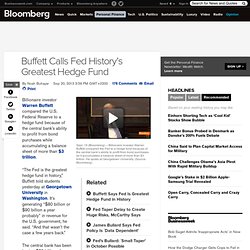
Federal Reserve to a hedge fund because of the central bank’s ability to profit from bond purchases while accumulating a balance sheet of more than $3 trillion. “The Fed is the greatest hedge fund in history,” Buffett told students yesterday at Georgetown University in Washington. It’s generating “$80 billion or $90 billion a year probably” in revenue for the U.S. government, he said. “And that wasn’t the case a few years back.” The central bank has been buying $85 billion of bonds a month to help the U.S. recover as it emerges from the deepest slump since the Great Depression. The Fed remitted $88.4 billion to the U.S. The Fed “is under no pressure, none whatsoever to have to deleverage,” Buffett said.
Warren Buffett, chairman and chief executive officer of Berkshire Hathaway Inc., speaks... Close Open. FedHege Buffet. Forget Libor, Central Banks Are The Real Market Manipulators: Okada. The Real Lie About Libor. MANIPULATING A multitrillion-dollar market via Libor seems par for the course after all the scandals and bad behavior by market participants over the past four years.

Barclays coughed up $450 million in fines to settle allegations that it and other banks kept the interbank rate artificially low during the credit crisis. But aside from all the fees lawyers are certain to make off the scandal, what are the real consequences of this issue? Our firm has managed primarily Libor-based investments for 20 years, so we’ve had an interesting seat at the table. Libor is supposed to measure what it costs big banks to borrow from one another. The rate is set daily through a system of hypothetical averages rather than actual transactions, and this feature proved vulnerable to manipulation. When an interest rate is set too low, savers suffer and borrowers benefit. Ron Paul triumphant: House passes his beloved ‘Audit the Fed’ bill. ABC News paul-backers-abc.

The Evolution Of US And UK Central Banking: An Infographic. Investors once knew: Focusing on assets without understanding monetary matters can get you into trouble.

They have since forgotten this. Ironically, then, there’s great value in remembering it. As “Vermont Ruminator”, Humphrey B. Neill, wrote in The Art of Contrary Thinking: [Money] is a study in itself and one which still confuses the great minds of the world... ...because monetary problems are not comprehended by the public or by the average businessman, “money management” will continually cross up public opinions concerning economic trends... ...If you make it a point to become posted on some of the more common practices of monetary management you will …be able to discern trends that are opposite to those commonly discussed... The Evolution Of US And UK Central Banking. The Fed's Bailout Of Europe Continues With Record $237 Billion Injected Into Foreign Banks In Past Month.
Last weekend Zero Hedge once again broke the news that just like back in June 2011, when as part of the launch of QE2 we demonstrated that all the incremental cash resulting form the $600 billion surge in the Fed's excess reserves, had gone not to domestically-chartered US banks, but to subsidiaries of foreign banks operating on US soil.

To be sure, various other secondary outlets picked up on the story without proper attribution, most notably the WSJ, which cited a Stone McCarthy report adding the caveat that "interpreting the data released by the Federal Reserve is a bit challenging" and also adding the usual incorrect attempts at interpretation for why this is happening.
Another way of showing precisely what we said would happen, and what is happening: in the past month, as $237 billion in cash was being handed over by Ben Bernanke to foreign banks, cash to both small and large domestically-chartered banks declined. Philippe Béchade : La Fed est un casino truqué - 7 mars - BFM : Intégrale Bourse. Wall Street soulagé par Bernanke. Wall Street s'est légèrement appréciée mercredi, apaisée par la réaffirmation, par le patron de la banque centrale américaine (Fed), du maintien d'une politique monétaire très accommodante : le Dow Jones a grignoté 0,12 % et le Nasdaq 0,32 %.

Selon les résultats définitifs à la clôture, l'indice vedette Dow Jones Industrial Average a avancé de 18,67 points à 15 470,52 points, et le Nasdaq, à dominante technologique, de 11,50 points, à 3 610,00 points, un nouveau plus haut en presque 13 ans. L'indice élargi Standard & Poor's 500 (S&P500) s'est adjugé 0,28 % (+ 4,65 points), à 1 680,91 points. Après avoir flirté avec l'équilibre tout au long de la séance, les indices boursiers new-yorkais ont réussi à prendre un peu de vigueur en fin de séance, dans un marché peu volatil.
"Faiblesse des indicateurs économiques" Yahoo! Le géant de l'Internet Yahoo!