
GyroProgrammingforFRCRobots.pdf (application/pdf Object) Mobile accelerometers and gyroscopes explained. Every once in a while I make a point to marvel at the technology now at my fingertips.

Otherwise, I won't appreciate the stuff. For example, pick up a modern mobile phone -- an iPhone or Android device will do -- and think about it for a second. It senses where it is. It knows how to calibrate based on its physical location. I'd have gone catatonic if someone had showed me that kind of handheld functionality ten years ago. Now, before my current bout of wide-eyed wonder turns back into inevitable cynicism, I thought it would be nice to actually learn a thing or two about mobile-based accelerometers and gyroscopes.
What is an accelerometer? Alasdair Allan: An accelerometer is a sensor that measures acceleration relative to a free-falling frame of reference. The original iPhone, and first generation iPod Touch, use the LIS302DL 3-axis MEMS based accelerometer produced by STMicroelectroics. What is a gyroscope? What can these tools do on a mobile device? Related. How Are a Gyroscope and Accelerometer Used Together? Playground - Gyro. This is just a basic code snippet for the time being, but please feel free to contribute more information Gyroscopes measure the rate of change of a particular axis at the current moment in time.
This means that to keep track of our angle, we need to sum all of the rates of change over a given period of time. We're essentially looking for the integral of our gyro data. In the sample code below we'll be looking at just one gyro axis. First off, you'll want to set the voltage of your gyro (typically 3.3v or 5v) for the gyroVoltage variable. Next you'll need to know the zero voltage of your gyro.
The other value you'll need from the datasheet is the sensitivity. The Arduino has 10 bit ADC which can represent a voltage (0-5V) in values from 0 to 1023. /* Keep track of gyro angle over time * Connect Gyro to Analog Pin 0 * * Sketch by eric barch / ericbarch.com * v. 0.1 - simple serial output * */ float currentAngle = 0; //Keep track of our current angle void setup() { Serial.begin (9600);} Software. To communicate the arduino with the processing I used the standard firmata code, the same found inside the arduino's library.

This library automatize the communicate process between the arduino and firmata. So is not necessary any modification at the arduino code. We will gone just edit the processing code according with our desire. The processing code: import processing.serial. Arduino arduino; int ledPin = 13;float value=0;int first_try=1;String stf="";
Guide to gyro and accelerometer with Arduino including Kalman filtering. Hallo everybodyI recently bought this analog 6DOF (six degrees of freedom) IMU board ( from watterott.com.

It uses three gyros and three accelerometers to calculate angles in three dimensions. I looked a while for some code online and how to connect with them. After many hours of research I succeeded of making af precise measurement of angles in two directions. I decided to write a short guide for fellow electronic enthusiasts. The main purpose of this guide is to teach others how to get some useful data from their IMU or just a gyro or accelerometer. Before you begin you have to connect the IMU as follows: Acc_Gyro Arduino3.3V <--> 3.3V GND <--> GNDGx4 X <--> AN0Gx4 Y <--> AN1Gx4 Z <--> AN2Acc X <--> AN3 Acc Y <--> AN4 Acc Z <--> AN5 Also connect 3.3V to the AREF pin on the Arduino for more accuracy.It is VERY important that you do not connect the sensor to 5V - this will destroy the sensor. Now your are ready for reading some data from the sensor. Atan2 has a output range from -? Sources: Accelerometer & Gyro Tutorial. This guide is intended to everyone interested in in using Accelerometers and Gyroscopes as well as combination IMU devices (Inertial Measurement Unit) in their electronics projects We'll cover: What does an accelerometer measure?

What does a gyroscope (aka gyro) measure? How to convert analog-to-digital (ADC) readings that you get from these sensor to physical units (those would be g for accelerometer, deg/s for gyroscope) How to combine accelerometer and gyroscope readings in order to obtain accurate information about the inclination of your device relative to the ground plane Throughout the article I will try to keep the math to the minimum. There are people out there who believe that you need complex math in order to make use of an IMU unit (complex FIR or IIR filters such as Kalman filters, Parks-McClellan filters, etc). A Guide To using IMU (Accelerometer and Gyroscope Devices) in Embedded Applications.
Introduction There’s now a FRENCH translation of this article in PDF.
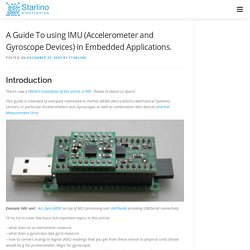
Thanks to Daniel Le Guern! This guide is intended to everyone interested in inertial MEMS (Micro-Electro-Mechanical Systems) sensors, in particular Accelerometers and Gyroscopes as well as combination IMU devices (Inertial Measurement Unit). Example IMU unit: Acc_Gyro_6DOF on top of MCU processing unit UsbThumb providing USB/Serial connectivity I'll try try to cover few basic but important topics in this article: