
Egyptologie. Not Of This Earth - Ancient Egyptian Culture Part 1 / (6) Geography of Ancient Egypt: Ancient Egypt was divided into two realms: Upper Egypt and Lower Egypt.
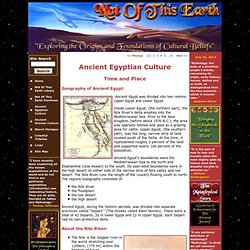
Inside Lower Egypt, (the northern part), the Nile River's delta empties into the Mediterranean Sea. Prior to the New Kingdom (before about 1570 B.C.), the area was sparsely settled and used as a grazing area for cattle. Upper Egypt, (the southern part), was the long, narrow strip of land located south of the Delta. At the time, it represented roughly 3 percent of the land and supported nearly 100 percent of the population. Ancient Egyptian Calendar. By Erin Potter The ancient Egyptian calendar was invented over 5000 years ago.
It was originally based on the lunar cycle of 12 months, which the Egyptians grouped into three seasons of four months each to coincide with the rise and fall of the waters of the Nile. However, although the flooding of the Nile began each year around the end of June, the floods occurred within a range of 80 days and were not accurate enough to base a calendar on. Egyptian Life. Family and Relationship. Giving Birth Sources Our knowledge about the conventions and habits connected to childbirth in Ancient Egypt is not very clear.
We know that the mortality rate was very high both for women and infants, and we know that many spells and prayers to special deities were aimed at getting help and protection in this precarious situation. but what was really happening there among the women concerned, wether in the royal chambers or the simple mud huts when a new child was about to enter life along the Nile? References are vague. Some information can be found in fragments of stories and myths together with illustrations of the 'Divine Birth' rituals carved on the walls of Late Period Birth Houses, so called 'mammisi', at certain temples. Depictions Depictions which deal with the actual practicalities of giving birth are very rare, to say non-existent. Mammisi-Birth House The word 'mammisi' is an artificial Coptic word, meaning 'birth-place' or birth'house.
Deities associated with Childbirth Naming. Medicine mixed with magic was the remedy for ancient Egyptians. Everyday life in ancient Egypt involved beliefs in magic, gods, demons and evil spirits.
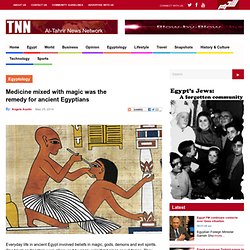
Good luck or disasters were all caused by angry celestial beings or evil forces. They believed that if illnesses and physical and mental disorders were partly caused by supernatural forces, then magic and religion were required to deal with them and treat people. Anthropologists, archaeologists, and medical historians say there did not appear to be a clear difference between a priest and a doctor in those days.
Vie quotidienne Egypte antique. "Femme" en Egypte Ancienne. Women in Ancient Egypt. Women in Ancient Egypt. Women Legal Rights Egyptian Women rights extended to all legal defined areas of society.
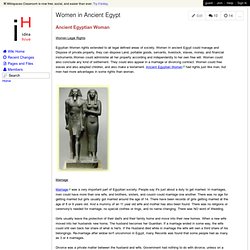
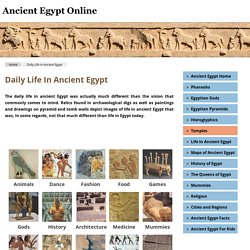
Women In ancient Egypt could manage and Dispose of private property, they can dispose Land, portable goods, servants, livestock, slaves, money, and financial instruments.Women could administer all her property according and independently to her own free will. Women could also conclude any kind of settlement. They could also appear in a marriage or divorcing contract. Women could free slaves and also adopted children, and also make a testament. Mes Parfums d'Egypte. LA MUSIQUE AU PAYS DES PHARAONS par Bernard BECQUART. Daily Life in Ancient Egypt. The daily life in ancient Egypt was actually much different than the vision that commonly comes to mind.
The Egyptians. L'Or des Pharaons. Les céréales en Égypte ancienne. Les outils égyptiens. Ancient Egypt Clothing ~ EGY KING. It is common to the knowledge of historians that Egyptians took immense care in their appearance.
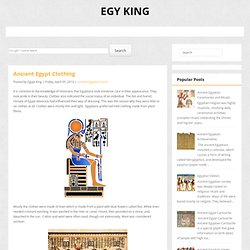
They took pride in their beauty. Clothes also indicated the social status of an individual. Ancient Egypt — Hungry History — Food & Culinary History. Egypte ancienne. Les Fête en Egypte Ancienne: Le Nouvel An Le nouvel an était une fête prisée des Egyptiens de l’antiquité.
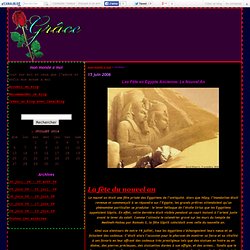
Alors que Hâpy, l’inondation était revenue et commençait à se répandre sur l’Egypte, les grands prêtres attendaient qu’un phénomène particulier se produise : le lever héliaque de l’étoile Sirius que les Egyptiens appelaient Sôptis. En effet, cette dernière était visible pendant un court instant à l’orient juste avant le lever du soleil. Comme l’atteste le calendrier gravé sur les murs du temple de Medineh-Habou par Ramsès 3, la fête Sôptit coïncidait avec celle du nouvelle an. Ainsi aux alentours de notre 19 juillet, tous les égyptiens s’échangeaient leurs vœux et se faisaient des cadeaux. Cet acte était très important pour eux car il apportait à celui qui le donnait la bénédiction divine, et à celui qui le recevait la prospérité personnelle. Ancient Egyptian panorama. Old Kingdom of Ancient Egypt (2575 BC-2450) The author: Professor Yasser Metwally Stunning advances in architecture, art, and technology were made during the Old Kingdom, fueled by the increased agricultural productivity made possible by a well developed central administration.
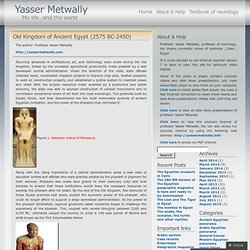
Under the direction of the vizier, state officials collected taxes, coordinated irrigation projects to improve crop yield, drafted peasants to work on construction projects, and established a justice system to maintain peace and order. With the surplus resources made available by a productive and stable economy, the state was able to sponsor construction of colossal monuments and to commission exceptional works of art from the royal workshops. EGYPT AND CRETE IN THE EARLY MIDDLE BRONZE AGE.