
Liquid Battery Electrodes Will Mean Long-Range, Fast-Charging Electric Cars. A new kind of battery stores energy in what researchers are calling “rechargeable fuel”—electrodes in liquid form.

The result can be either recharged like a conventional battery or replaced by pumping in new fuel like gasoline. The materials could theoretically allow an electric car to travel 500 miles on a charge, five times farther than most electric vehicles can now, say the researchers developing the technology, who are based at Argonne National Laboratory and the Illinois Institute of Technology.
Replacing them at a fueling station would take just a few minutes. In contrast, even the fastest charging stations for conventional batteries take an hour to provide a full charge. Limited driving range and long recharging times are two of the biggest challenges for electric cars. Batteries that use liquid electrodes could also be safer than conventional ones, says Ping Liu, a program manager at the Advanced Research Projects Agency for Energy, which is funding the work.
Tough Textile Batteries. [+]Enlarge Fashionable Batteries South Korean researchers fabricated lithium ion batteries on polyester cloth and then sewed them into a hoodie (left) and a watch wristband (right).

The bottom cartoons show the shape of the batteries used in the shirt (left) and wristband (right). Credit: Nano Lett. Polyester Electrode In a new textile battery, researchers fabricated electrodes by electroplating nickel onto polyester fabric (top, center). With the launch of Google Glass and the Samsung Galaxy Gear wristwatch this year, wearable electronics have moved from abstract concepts to tangible products. The battery storage system that could close down coal power. (Editors note: This is part of a series of interviews and stories that will run over the next few weeks looking at Germany’s Energiewende, and the transition of Germany’s energy grid to one dominated by renewable energy.

You can find them all in our Insight section). You don’t have to go far inside the headquarters of German battery storage company Younicos, or even their website for that matter, to find out what they are about. “Let the fossils rest in peace,” the logo suggests. Roadster Technology - Battery. The battery pack in the Tesla Roadster is the result of innovative systems engineering and 20 years of advances in Lithium-ion cell technology.

Tesla's ingenious battery pack architecture enables world-class acceleration, safety, range, and reliability. The non-toxic pack is built at Tesla’s Headquarters in Northern California. The pack weighs 990 pounds, stores 56 kWh of electric energy, and delivers up to 215 kW of electric power. New flow battery could enable cheaper, more efficient energy storage. Public release date: 16-Aug-2013 [ Print | E-mail Share ] [ Close Window ] Contact: Sarah McDonnells_mcd@mit.edu 617-253-8923Massachusetts Institute of Technology CAMBRIDGE, MA -- MIT researchers have engineered a new rechargeable flow battery that doesn't rely on expensive membranes to generate and store electricity.

The device, they say, may one day enable cheaper, large-scale energy storage. University of Maryland. Wood fibers help nano-scale batteries keep their structure COLLEGE PARK, Md. - A sliver of wood coated with tin could make a tiny, long-lasting, efficient and environmentally friendly battery.

Zinc–bromine battery. The zinc–bromine flow battery is a type of hybrid flow battery.

A solution of zinc bromide is stored in two tanks. When the battery is charged or discharged the solutions (electrolytes) are pumped through a reactor stack and back into the tanks. Nanotechnology pushes battery life to eternity. (PhysOrg.com) -- A simple tap from your finger may be enough to charge your portable device thanks to a discovery made at RMIT University and Australian National University.
Quantum entangled batteries could be the perfect power source. Two European theoretical physicists have shown that it may be possible to build a near-perfect, entangled quantum battery.

In the future, such quantum batteries might power the tiniest of devices — or provide power storage that is much more efficient than state-of-the-art lithium-ion battery packs. To understand the concept of quantum batteries, we need to start (unsurprisingly) at a very low level. Today, most devices and machines that you interact with are governed by the rules of classical mechanics (Newton’s laws, friction, and so on). Classical mechanics are very accurate for larger systems, but they fall apart as we begin to analyze microscopic (atomic and sub-atomic) systems — which led to a new set of laws and theories that describe quantum mechanics.
'Paint-on' batteries demonstrated. 29 June 2012Last updated at 04:16 ET The authors painted batteries onto standard bathroom tiles, steel, glass and even a beer stein Researchers have shown off a means to spray-paint batteries onto any surface.
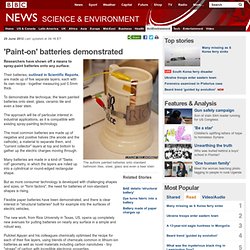
Their batteries, outlined in Scientific Reports, are made up of five separate layers, each with its own recipe - together measuring just 0.5mm thick. To demonstrate the technique, the team painted batteries onto steel, glass, ceramic tile and even a beer stein. The approach will be of particular interest in industrial applications, as it is compatible with existing spray-painting technology. The most common batteries are made up of negative and positive halves (the anode and the cathode), a material to separate them, and "current collector" layers at top and bottom to gather up the electric charges moving through. New system to 'eliminate' batteries. 11 February 2012Last updated at 13:58 The university claims the new system could reduce the number of batteries sent to landfill sites Researchers at the University of Bedfordshire have developed a new technique for powering electronic devices.
The system, developed by Prof Ben Allen at the Centre for Wireless Research, uses radio waves as power. Believed to be a world first, the team claims it could eventually eliminate the need for conventional batteries. The university has now filed a patent application to secure exclusive rights to the technique. 'Spare time' Prof Allen and his team, including David Jazani and Tahima Ajmal, have created a system to use medium wave frequencies to replace batteries in small everyday gadgets like clocks or remote controls.