
Citizen science. Citizen science (also known as crowd science, crowd-sourced science, civic science, or networked science) is scientific research conducted, in whole or in part, by amateur or nonprofessional scientists, often by crowdsourcing and crowdfunding.
Formally, citizen science has been defined as "the systematic collection and analysis of data; development of technology; testing of natural phenomena; and the dissemination of these activities by researchers on a primarily avocational basis".[1] Citizen science is sometimes called "public participation in scientific research. "[2] Definition[edit] The "Green Paper on Citizen Science: Citizen Science for Europe" refers to "the general public engagement in scientific research activities when citizens actively contribute to science either with their intellectual effort or surrounding knowledge or with their tools and resources. Citizen science may be performed by individuals, teams, or networks of volunteers. Alternate Definitions[edit] History[edit] EyeWire - Help Map the Retinal Connectome.
Foldit. Foldit is an online puzzle video game about protein folding.
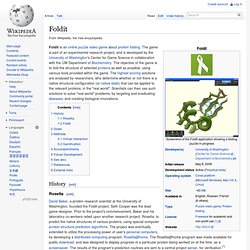
The game is part of an experimental research project, and is developed by the University of Washington's Center for Game Science in collaboration with the UW Department of Biochemistry. The objective of the game is to fold the structure of selected proteins as well as possible, using various tools provided within the game. The highest scoring solutions are analysed by researchers, who determine whether or not there is a native structural configuration (or native state) that can be applied to the relevant proteins, in the "real world". Scientists can then use such solutions to solve "real-world" problems, by targeting and eradicating diseases, and creating biological innovations.
History[edit] Rosetta[edit] Some users of Rosetta@home became frustrated with the program when they realised they could see ways of solving the protein structures themselves but could not interact with the program. Foldit[edit] Goals[edit] Methods[edit] Online gamers have managed to solve a decade-old scientific puzzle. In three weeks. Solve Puzzles for Science. Clumpy - Welcome. Zooniverse - Real Science Online. Click to Cure - Cancer Research UK and Zooniverse Cell Slider. Charity creates world's first citizen science project to speed up cancer research. Cancer Research UK has launched the first ever interactive website - www.clicktocure.net - that will allow the public to delve into real-life cancer data from research archives and speed up lifesaving research, outside of the laboratory.

At the moment, cancer samples are given special stains that highlight certain molecules as part of research. These molecules could reveal how a patient will respond to treatment. But this process is slow and analysis is mostly done by trained pathologists, who are often also cancer researchers. The new website – Cell SliderTM – is the first time real cancer data has been turned into a format that can be analysed by the public. By getting as many people as possible to take part, more samples will be analysed faster and more effectively, freeing up scientists to carry out other cancer research.
“There is information that can transform cancer treatments buried in our data – we just need the manpower to unlock them. Galaxy Zoo. SETILive. Welcome to SciStarter. Reinventing Discovery: The New Era of Networked Science. Reinventing Discovery: The New Era of Networked Science is a book written by Michael Nielsen and released in October 2011.
It argues for the benefits of applying the philosophy of open science to research. Summary[edit] The following is a list of major topics in the book's chapters. appendix - The problem solved by the Polymath Project Reviews[edit] The Financial Times review said that the book was "the most compelling manifesto yet for the transformative power of networked science".[2] References[edit] External links[edit]