
Ms. L's Class (@MsLsClass) SAMENA. SAEnviro (@SAEnviro) Laura Randazzo – Solutions for the Secondary Classroom. Looking to bridge the gap between my students’ obsession with love of social media and my obsession with appreciation of literature, I built an Instagram Challenge for my Quarter Trio groups last week.
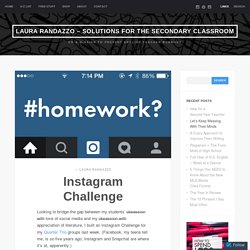
(Facebook, my teens tell me, is so five years ago; Instagram and Snapchat are where it’s at, apparently.) Here’s what the assignment looked like (click on the image to enlarge): And here are some of the best results (click on the image to enlarge), slightly modified to remove identifying info and to make viewing the work easier (in the original posts, you’d have to scroll down to see the captions on a phone): Instagram in the Classroom - Madly Learning. I joined Instagram awhile ago but personally, or professionally didn't quite know what to do with it.

I posted a few pictures of my kids but wasn't really sure how to use it. Fast forward and a few other blogger friends talked me into opening up a Madly Learning Instagram account. Twitter in the Classroom - The Brown Bag Teacher. As a teacher, watching other teachers in action is the most valuable Professional Development I can have.
I love seeing other professionals in their happy place and learn from their classrooms. Realistically, guest teachers are expensive, our schedules are too important, and sub plans take TOO long to write. So, as teachers, we turn to alternative methods to build our professional networks - blogs, Instagram, Facebook, Pinterest, etc. Terry's Teaching Tidbits: Social Media in the Classroom. I’m in my 9th year of teaching and one thing that I’ve learned each year is just how much each year is absolutely nothing like the last.
There’s no such thing as taking out “last year’s plans”, changing the date and coasting through the year. 7 Ways Teachers Use Social Media in the Classroom. Millennials live and breathe on social media, so teachers are learning how to incorporate the medium into the classroom successfully.

In doing so, teachers not only encourage students to engage actively in the material, but they also provide online communities for students that might not exist for them in real life. But how are teachers infusing social media into their everyday lessons? We've highlighted several different examples and offered our own ideas on how to best engage students. 1. Encourage students to share work socially. Anna Divinsky created an iTunes U class at Penn State University called Art 10: Introduction to Visual Studies, which she then adapted into a massive open online course (MOOC) on Coursera. Fifteen Teacher Pages to Follow on Facebook. How I Use Snapchat for Language Learning (+ free downloadable guide!) - Lindsay Does Languages. After a week focused on goal setting, this week we’re turning our attention to social media and how to make the most of it for language learning.
In this post, I’m sharing how I use Snapchat for language learning. Time to get snappy. One thing that’s great about the Internet is what it’s done for language learners. We’re connected. We can share ideas, motivation, and progress with the aim of encouraging each other to keep going. I also love YouTube in particular for this reason. However, the problem with YouTube is that if you want to practise your languages, whatever level they may be, they’re left there in the open, out of context for all the world to see for as long as you wish to keep them public. This is great and you may well get comments of encouragement and motivation.