
Shark Attack Reunion Island - Will France Continue With Its Planned Shark Massacre? Authorities on the Indian Ocean island of Réunion have announced a plan to kill 90 sharks along its coastline, in addition to 24 already killed over the past year, in response to five human deaths from shark attacks there since 2011.
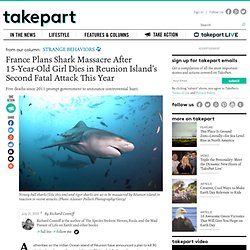
George Burgess, director of shark research at Florida Natural History Museum and an expert on shark attacks, immediately denounced the killing program to GrindTV.com and later, in an interview with TakePart, as “an archaic, knee-jerk reaction that seems more borne of vengeance than of science.” Burgess warned that such revenge killings would do more to hurt the tourism trade on Réunion than the sharks themselves: “This likely will blow up in their faces because most visitors to Réunion have a more sophisticated conservation ethic than the authorities are apparently giving them credit for.” At the same time, the authorities also announced a seasonal ban on surfing across much of the island, according to Surfer magazine, which broke the story. Why Can’t Bison Roam on Public Lands?
From Wildlife Promise Bison are public wildlife, but it’s confusing because some are also owned as private domestic animals.
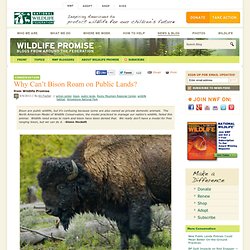
The North American Model of Wildlife Conservation, the model practiced to manage our nation’s wildlife, failed this animal. Wildlife need areas to roam and bison have been denied that. We really don’t have a model for free ranging bison, but we can do it. Threatened Animal Update: The Good, the Bad and, Well, There's a Lot of Bad. With about 1.7 million described species on the planet and about 20,000 new species discovered each year, it's nearly impossible to keep up with how all our fellow Earth-dwellers are faring.
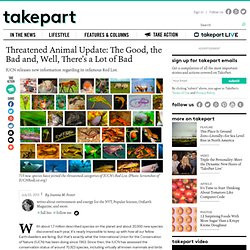
But that's exactly what the International Union for the Conservation of Nature (IUCN) has been doing since 1963. Since then, the IUCN has assessed the conservation status of around 70,923 species, including virtually all known mammals and birds and a healthy dose of amphibians. Now the IUCN has just released its latest update on their well-known Red List, and as might be expected, the results range from hopeful to downright scary. Let's start with the good news. Despite the threats posed to amphibians by a changing climate and the deadly Chytrid fungus, the discovery of several new subpopulations of Costa Rica's Brook Frog and Green-eyed Frog are giving scientists hope that these frogs aren't on their way out after all.
Déclin d'une algue brune sous l'effet du réchauffement climatique. Les grenouilles d'Indonésie menacées par l'appétit des Français.
Wildlife Trade Infographic. Braconnage : news, photos, vidéos, membres. Du nouveau sur la destruction "d'espèces classées nuisibles" Rangers contre AK-47: la lutte inégale face aux trafiquants d'espèces sauvages. Extinction de masse annoncée pour les espèces sauvages. Par: Caroline Albert 28/01/13 - 15h01 © reuters.
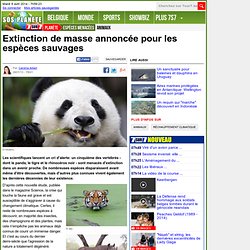
Les scientifiques lancent un cri d'alerte: un cinquième des vertébrés - dont le panda, le tigre et le rhinocéros noir - sont menacés d'extinction dans un avenir proche. De nombreuses espèces disparaissent avant même d'être découvertes, mais d'autres plus connues vivent également les dernières décennies de leur existence. © afp. © getty. D'après cette nouvelle étude, publiée dans le magazine Science, la crise qui touche la faune est grave et est susceptible de s'aggraver à cause du changement climatique.
What is Happening to Agrobiodiversity? Locally varied food production systems are under threat, including local knowledge and the culture and skills of women and men farmers.
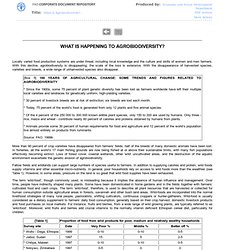
With this decline, agrobiodiversity is disappearing; the scale of the loss is extensive. With the disappearance of harvested species, varieties and breeds, a wide range of unharvested species also disappear. More than 90 percent of crop varieties have disappeared from farmers’ fields; half of the breeds of many domestic animals have been lost. In fisheries, all the world’s 17 main fishing grounds are now being fished at or above their sustainable limits, with many fish populations effectively becoming extinct. Loss of forest cover, coastal wetlands, other ‘wild’ uncultivated areas, and the destruction of the aquatic environment exacerbate the genetic erosion of agrobiodiversity. Fallow fields and wildlands can support large numbers of species useful to farmers. Source: Biodiversity in development (IUCN/DFID, No date) References FAO. 1996.
La biodiversité : un écosystème à préserver. Une étude prédit la fin de notre planète avant l'an 2100. Biodiversité en danger. Le commerce illégal d'espèces menacées. PAN Europe - Campaigns. NEW!
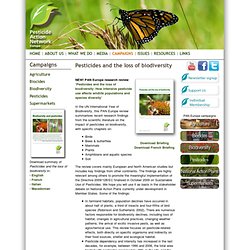
PAN Europe research review’Pesticides and the loss of biodiversity: How intensive pesticide use affects wildlife populations and species diversity’ In the UN International Year of Biodiversity, this PAN Europe review summarises recent research findings from the scientific literature on the impact of pesticides on biodiversity, with specific chapters on: Birds Bees & butterflies Mammals Plants Amphibians and aquatic species Soil The review covers mainly European and North American studies but includes key findings from other continents. The findings are highly relevant among others to promote the meaningful implementation of the Directive 2009/128/EC finalised in October 2009 on Sustainable Use of Pesticides.
We hope you will use it as basis in the stakeholder debate on National Action Plans currently under development in Member States. The European Commission plans to publish a new biodiversity strategy at the end of 2010. Les espèces menacées de disparition. Pour Pâques au Nicaragua, on mange des iguanes et des tatous. Illegal wildlife trade. Les 100 espèces les plus menacées du monde : sont-elles sans prix ou sans valeur ? Tackling the illegal trade in wild animals is a matter of global urgency. Illegal trade in wildlife has now reached a scale that poses an immediate risk to wildlife and to people.
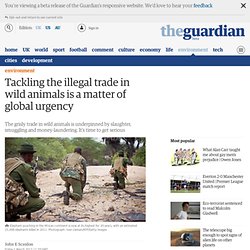
Over the past five years, we have seen a dramatic spike in the poaching and illegal trade in elephants and rhinos. In 2011 an estimated 25,000 elephants were poached across Africa and in South Africa alone 668 rhinos were lost to poachers in 2012. The Convention on International Trade in Endangered Species of Wild Fauna and Flora (CITES) was born 40 years ago on 3 March, 1973 in Washington DC. It sets the global controls for trade in wildlife, and the 177 countries that have joined CITES will meet from Monday in Bangkok, Thailand to take stock of of the situation, step up enforcement efforts and send clear political signals on putting a stop to illegal wildlife trade. Ugly Endangered Animals. Nature is full of gorgeous animals.
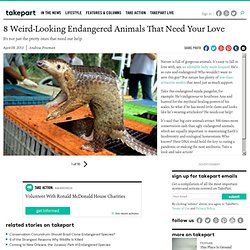
It’s easy to fall in love with, say, an adorable baby snow leopard. He’s so cute and endangered! Who wouldn’t want to save this guy? But nature has plenty of less-than-attractive misfits that need just as much support. Take this endangered sunda pangolin, for example.