National Do Not Call Registry. Stopping Unsolicited Mail, Phone Calls, and Email. Tired of having your mailbox crammed with unsolicited mail, including preapproved credit card applications?
Fed up with getting telemarketing calls just as you're sitting down to dinner? Fuming that your email inbox is chock-full of unsolicited advertising? The good news is that you can cut down on the number of unsolicited mailings, calls, and emails you receive by learning where to go to "just say no. " Consumer Reporting Companies. Two new attacks on SSL decrypt authentication cookies. Researchers have devised two new attacks on the Transport Layer Security and Secure Sockets Layer protocols, the widely used encryption schemes used to secure e-commerce transactions and other sensitive traffic on the Internet.
The Comment Group: The hackers hunting for clues about you. 11 February 2013Last updated at 19:50 ET By Dave Lee Technology reporter, BBC News Clues given out by employees of companies being targeted by hackers are being used to gain access If you had an email that looked like it was from your boss asking how your recent holiday went, would you open it?
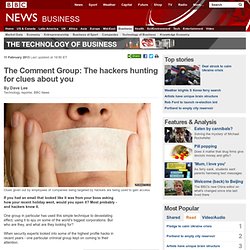
Most probably - and hackers know it. One group in particular has used this simple technique to devastating effect, using it to spy on some of the world's biggest corporations. But who are they, and what are they looking for? When security experts looked into some of the highest profile hacks in recent years - one particular criminal group kept on coming to their attention. The Comment Group, which industry insiders say is based in China, offer hacking for hire - be it for individuals, corporations or governments. U.S. government to fight for warrantless GPS tracking. The Obama Administration is headed to court today to argue that warrantless GPS tracking is just fine.
The administration will present its arguments before a federal appeals court today, despite the U.S. Supreme Court last year ruling that a warrant was needed to attach a GPS device to a suspected criminal's vehicle. According to Wired, which first reported on the story, the government believes that the high court's ruling does not account for all scenarios, and wants to see where its ruling should and shouldn't be held up. The Privacy Blog. Knowledge Center - Hot Topics. Gagging recipients of National Security Letters found unconstitutional. A California federal judge has struck down a key provision of the law governing National Security Letters (NSLs), controversial government subpoenas whose use was expanded by the Patriot Act.
Under current law, the recipient of an NSL can be legally prohibited from disclosing not only the contents of the request but the fact that he received a request at all. That, ruled Judge Susan Illston on Thursday, was inconsistent with the First Amendment. The ruling is a setback for the FBI, which issues tens of thousands of NSLs every year. Judge Illston has given the government 90 days to appeal before it takes effect. Havenco Coming Soon. The World Has No Room For Cowards. It’s not often that one has the opportunity to be the target of a cyber and kinetic attack at the same time.
But that is exactly what’s happened to me and my Web site over the past 24 hours. On Thursday afternoon, my site was the target of a fairly massive denial of service attack. That attack was punctuated by a visit from a heavily armed local police unit that was tricked into responding to a 911 call spoofed to look like it came from my home. Well, as one gamer enthusiast who follows me on Twitter remarked, I guess I’ve now “unlocked that level.” Security reporter tells Ars about hacked 911 call that sent SWAT team to his house (Updated) Update: Krebs has now written about his experience in some detail.
The same people responsible for the DDoS attack carried out yesterday on Krebs' site launched a similar attack on Ars Technica this morning. Original story: Brian Krebs has always been a trailblazer among security reporters. His exposés completely shut down a California hosting service that coddled spammers and child pornographers and severely disrupted an organized crime syndicate known as Russian Business Network. More recently, his investigative journalism has followed the money to the people who sell malware exploit kits, illicitly procured credit reports, and denial-of-service services in underground forums. Now, Krebs has achieved a decidedly more grim distinction. As Senate votes on warrantless wiretapping, opponents offer fixes.
With little fanfare, the United States Senate is poised to re-authorize the FISA Amendments Act, the controversial legislation that gives the federal government broad powers to intercept Americans' international communications without a warrant.
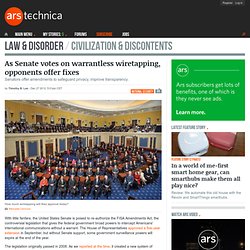
The House of Representatives approved a five-year extension in September, but without Senate support, some government surveillance powers will expire at the end of the year. The legislation originally passed in 2008. As we reported at the time, it created a new system of "authorizations" that allows senior government officials to sign off on international wiretapping schemes. Court: Hijacking ex-employee’s LinkedIn account violates PA law. Last year we covered the case of Linda Eagle, whose former employer, Edcomm, kept control of her LinkedIn account after firing her.
In his October ruling, Judge Ronald Buckwalter of the District Court in Eastern Pennsylvania rejected the theory that taking control of a former employee's LinkedIn account violated the anti-hacking provisions of the Computer Fraud and Abuse Act. View topic - MAC RAT - Keylogger. Re: MAC RAT - Keylogger by centip3de on Sat Sep 22, 2012 4:23 pm ([msg=69537]see Re: MAC RAT - Keylogger[/msg])