
Disaster management: Crisis, what crisis? Governments and businesses around the world have not learned much from the 9/11 attacks, Hurricane Katrina, the Icelandic volcano ash cloud, or the Fukushima meltdown, according to a hard hitting new report from Chatham House, "Preparing For High Impact Low Probability Events" The report says that despite considerable efforts to improve scientific understanding and reform risk management approaches, governments and businesses are still insufficiently prepared to confront HILP (high impact, low probability) crises and effectively manage their economic, social, political and humanitarian consequences.

The report is published a few days before the World Economic Forum releases its annual Global Risks Survey, which in turn is a curtain raiser for the WEF’s widely-reported Davos meeting of global leaders. Part of the problem, Chatham House says, is that current thinking on contingency planning assumes the return of the status quo after a crisis. How vulnerable could your city be to climate impacts?
Climate change is expected to increase the frequency and intensity of river floods and extreme temperature events in many parts of Europe.
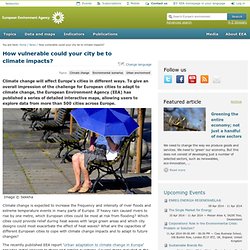
If heavy rain caused rivers to rise by one metre, which European cities could be most at risk from flooding? Which cities could provide relief during heat waves with large green areas and which city designs could most exacerbate the effect of heat waves? What are the capacities of different European cities to cope with climate change impacts and to adapt to future changes?
UN Report: Climate change is driving people from their homes. Africa: Climate Change Threatens Bhutan's Gross National Happiness. Thimphu — Impressive economic and human development gains that contribute to Bhutan's Gross National Happiness are threatened by changing climate conditions with the country's poorest people likely to suffer the worst impact, according to the third National Human Development Report released today in Thimphu.

Building resilience is key to the livelihoods of the one quarter of Bhutan's population who live in poverty and depend on subsistence farming and local natural resources which are vulnerable to changing weather patterns and melting glaciers, says the report titled "Sustaining Progress: Rising to the Climate Challenge. " "Alternative development pathways, such as Gross National Happiness (GNH) that we are promulgating will influence the capacity of communities...to adapt to climate change," said Pema Gyamtsho, Minister of Agriculture and Forests, at the report's launch.