
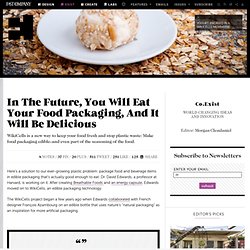
WikiCell bottles are food containers that you can eat. Nature is very clever when it comes to creating packaging for perishable foodstuffs.

Most fruits and vegetables, for example, come pre-wrapped in delicious edible containers. David Edwards, the biomedical engineer who came up with huffable food, is now developing customized edible containers for all kinds of food, from juice to wine to chocolate. The containers, called WikiCells, are membranes made out of a combination of biodegradable polymer and particles of food, held together with electrostatic forces instead of something less appetizing like glue.
Food is now huffable. You know what's old news?

Eating. And if swallowing drinkified food is turning out to be too much work for you, you'll be excited to hear that food is now inhaleable. Literally. Le Whaf is a device invented by a guy at Harvard that takes specially prepared liquid food and vaporizes it. The vapor gets captured in the weird bowl thing in the picture above, and then you can huff it through a glass straw. At first, my mouth feels warm and dry; then, as the droplets in the smoke settle, I can make out the particular flavours. 'Hardly any calories' means that 10 minutes of whaffing is only good for about 200 calories, so it might be a good way of enjoying potentially excessive amounts of dessert without paying for it as long as you don't care about texture. Look for individual Le Whaf units to go on sale this fall for about $135.
Muji Creates Design Exhibit On How To Use Less Packaging. Prompted by the earthquake and tsunami that struck Japan a year ago, Japanese retailer Muji is hosting an exhibit at the London Design Museum that rethinks how design impacts the way we use energy.

Product Fitness 80 reconsiders what makes good product design. We constantly question if we have used excessive materials; whether products are overpackaged, or are their sizes and weights too much; can we reduce waste in the ordering, manufacturing or transportation of products? Less is more. The products on display address the question “What would happen if we used 20% less materials and energy in the actual process of making products?”
And they also consider the role of the user in customizing, re-using and recycling products in order to reduce energy consumption. The Product Fitness 80 exhibition runs from March 9th-18th. Product Fitness 80. Edible Packaging Lets You Drink A Beverage & Eat The Bottle Too. Dr.

David Edwards, a professor at Harvard University, is working on the WikiCells project that looks into creating edible packaging. A few years ago, Edwards collaborated with French designer François Azambourg on an edible bottle that’s made from organic materials and is biodegradable. These WikiCell membranes can hold the drink together and could also be consumed afterwards. These membranes could be made out of something tasty, like chocolate or candy.
If you wish to try some of Edwards experimental edible packaging, you can sample them at the Lab Store Paris. Lab Store Paris. In The Future, You Will Eat Your Food Packaging, And It Will Be Delicious. Here’s a solution to our ever-growing plastic problem: package food and beverage items in edible packaging that’s actually good enough to eat.
Dr. A Cookie Coffee Cup That's Easy To Recycle: Just Eat It. Drink your coffee, then eat your cup.
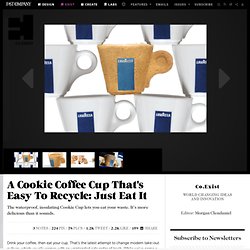
That’s the latest attempt to change modern take-out culture, which usually comes with an unintended side order of trash. While we’ve come a long way from McDonald’s Styrofoam clamshells (phased out in the 1990s), most meals or snacks to go still come with lots of disposable packaging. Not the "Cookie Cup," an edible design cooked up by Venezuelan designer Enrique Luis Sardi for the Italian coffee brand Lavazza. "The cookie cup is made of pastry that is covered with a special icing sugar that works as an insulator making the cup waterproof and sweetening at the same time," explains the website of Italian consulting firm Sardi Innovation, which managed the project. A chocolate version is reportedly on the way.
Laser 'knife' could slice food into any shape using electromagnets. A Russian graduate has entered a laser food cutting design that relies on electromagnets into the annual James Dyson Award.

The award, which has seen more than 500 candidates from 18 countries enter in 2012, provides young designers and engineers with a £10,000 incentive to come up with a problem-solving invention. The Russian entry -- from Ural State Academy of Architecture and Arts graduate Andrey Kokorin -- has focused on replacing unsanitary and unsafe kitchen knives with a fast, clean, time-saving and, let's face it, much more fun kitchen utensil -- a laser. The "Innovative Laser Device For Cutting Of Foodstuff" (luckily, candidates are not judged on the inventiveness of brand names) looks a little like the sleek white helmet of a robot, with a glass food bowl hidden under a visor that swings open and closed. When preparing food, all a user needs to do is open up the lid, pop the food into the two-litre bowl, swing it shut and select a few key options from the menu.