
Appuhamy, R. (Director). (2017, June 25). Social Determinants of Health - an introduction [Video file]. Retrieved June 5, 2019, from. Canadian Centre for Policy Alternatives. (2016, December 19). Study calculates living wage for Halifax and Antigonish. Retrieved June 5, 2019, from. HALIFAX/ANTIGONISH, NS—Two working parents with two children need to each earn a minimum of $19.17 an hour to make ends meet in Halifax, and $17.30 an hour in Antigonish, says a new study released today by the the Canadian Centre for Policy Alternatives–Nova Scotia, in partnership with the Antigonish Poverty Reduction Coalition.

The report, Working for a Living, Not Living for Work, uses the Canadian Living Wage Framework to calculate two local community living wage rates for Nova Scotia. This is the first time the calculation has been done for Antigonish. The living wage for Halifax decreased by almost one dollar, from $20.10 in 2015 to $19.17 in 2016, mainly due to the new Canada Child Benefit. Gore, D., & Kothari, A. (2012). Social determinants of health in Canada: are healthy living initiatives there yet? A policy analysis. International journal for equity in health, 11, 41. doi:10.1186/1475-9276-11-41. Government of Canada. (2019). Social Determinants of Health and Health Inequalities. Retrieved June 05, 2019, from. Determinants of health are the broad range of personal, social, economic and environmental factors that determine individual and population health.
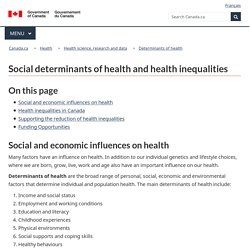
The main determinants of health include: Income and social statusEmployment and working conditionsEducation and literacyChildhood experiencesPhysical environmentsSocial supports and coping skillsHealthy behavioursAccess to health servicesBiology and genetic endowmentGenderCultureRace / Racism Social determinants of health refer to a specific group of social and economic factors within the broader determinants of health.
Kronstein, A. (2017, May 12). The social determinants of health in Nova Scotia. Part 1: Poverty makes you sick. Retrieved June 5, 2019, from. KJIPUKTUK (Halifax) – Health care is always an important public policy issue in Nova Scotia, and indeed the rest of Canada, during election time or otherwise.

We often hear about the rising costs of health care. Things like drugs, technology and equipment, utilization, doctors, nurses, labour agreements continue to drive up the cost. In fact, health care in Nova Scotia currently consumes 46% of the provincial budget. And health care costs go up every year, faster than provincial revenue. Martin D., Miller A.-p., Quesnel-Vallée A., Caron N.-r., Vissandjée B., Marchildon G.-p. (2018). Canada's universal health-care system: Achieving its potential doi: Nova Scotia Department of Health and Wellness. (2014). Nova Scotia public health: Healthy communities protocol. Halifax, N.S.: Dept. of Health and Wellness. Nova Scotia Department of Health and Wellness. (2014). Nova Scotia public health: Healthy development protocol. Halifax, N.S.: Dept. of Health and Wellness. Nova Scotia Labour and Advanced Education. (2019, April 01). Minimum Wage : NS Labour and Advanced Education, Employment Rights. Retrieved June 5, 2019, from.
Changes to the minimum wage As of April 1, 2019, employers must pay experienced employees at least $11.55 per hour.

They must pay inexperienced employees at least $11.05 for each hour of work. Office of Disease Prevention and Health Promotion. (n.d.). Determinants of Health. Retrieved June 2, 2019, from. What makes some people healthy and others unhealthy?
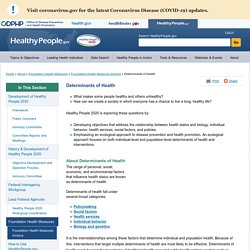
How can we create a society in which everyone has a chance to live a long, healthy life? Healthy People 2020 is exploring these questions by: Research Nova Scotia. (2019). Introducing Research N.S: About. Retrieved June 6, 2019, from.