
Advanced Internet searching Autumn 2012. Internet search techniques. Google Guide Quick Reference: Google Advanced Operators (Cheat Sheet) The following table lists the search operators that work with each Google search service.
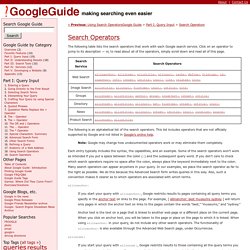
Click on an operator to jump to its description — or, to read about all of the operators, simply scroll down and read all of this page. The following is an alphabetical list of the search operators. This list includes operators that are not officially supported by Google and not listed in Google’s online help. Each entry typically includes the syntax, the capabilities, and an example. Some of the search operators won’t work as intended if you put a space between the colon (:) and the subsequent query word. Allinanchor: If you start your query with allinanchor:, Google restricts results to pages containing all query terms you specify in the anchor text on links to the page.
Anchor text is the text on a page that is linked to another web page or a different place on the current page. Allintext: allintitle: allinurl: In URLs, words are often run together. 3 simple search operators to use with Google. Google Tutor: Tutorials and Tips for Google Users. gSeek, search google easier with a simplifed interface. How Does Google Work? Learn How Google Works: Search Engine + AdWords. The Ultimate Guide to the Invisible Web. Search engines are, in a sense, the heartbeat of the internet; “Googling” has become a part of everyday speech and is even recognized by Merriam-Webster as a grammatically correct verb.
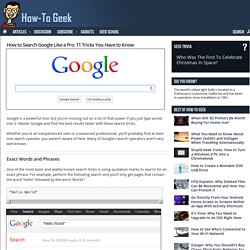
It’s a common misconception, however, that Googling a search term will reveal every site out there that addresses your search. Typical search engines like Google, Yahoo, or Bing actually access only a tiny fraction — estimated at 0.03% — of the internet. The sites that traditional searches yield are part of what’s known as the Surface Web, which is comprised of indexed pages that a search engine’s web crawlers are programmed to retrieve. "As much as 90 percent of the internet is only accessible through deb web websites. " So where’s the rest? So what is the Deep Web, exactly? Deep Web articles, reviews & lists. Google Search 3T. How to Search Google Like a Pro: 11 Tricks You Have to Know. Google is a powerful tool, but you’re missing out on a lot of that power if you just type words into it.
Advanced Scholar Search Tips. Get the most out of Google Scholar with some helpful tips on searches, email alerts, citation export, and more.
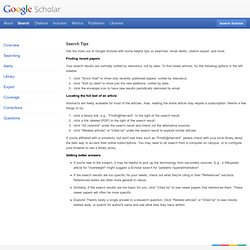
Finding recent papers Your search results are normally sorted by relevance, not by date. To find newer articles, try the following options in the left sidebar: click "Since Year" to show only recently published papers, sorted by relevance;click "Sort by date" to show just the new additions, sorted by date;click the envelope icon to have new results periodically delivered by email. Google making search smarter. To make search smarter, Google is tapping into the virtual brain of a Freebase database of knowledge regarding what things are and how they relate to one another.
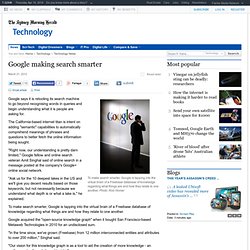
Photo: Rob Homer Google says it is retooling its search machine to go beyond recognising words in queries and begin understanding what it is people are asking for. The California-based internet titan is intent on adding "semantic" capabilities to automatically comprehend meanings of phrases and questions to better fetch the online information being sought. "Right now, our understanding is pretty darn limited," Google fellow and online search veteran Amit Singhal said of online search in a message posted at the company's Google+ online social network. "Ask us for the 10 deepest lakes in the US and we'll give you decent results based on those keywords, but not necessarily because we understand what depth is or what a lake is," he explained.
I think, therefore I Google: search giant's quest to capture knowledge. If you want to find out something these days, you Google it.
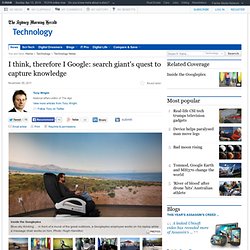
But being the planet's go-to search engine just isn't enough for the booming company, which is fast moving towards a radical new technological frontier, writes Tony Wright for the Good Weekend magazine. A boy - maybe he's in his early 20s - balances in a red hammock in the corner of a cafe, the northern Californian sun streaming through a picture window behind him. Black T-shirt, blue jeans, black sneakers. He has a laptop computer on his knees. A metre or so away a young woman, lime-flavoured mineral water and a box of muffins at hand, perches on a comfortable lounge. Googlers. Right now, however, their Silicon Valley-based employer is drastically readjusting its original mission, laid out in a famously magisterial press release in 1999, "to organise the world's information and make it universally accessible and useful".
Advertisement. Dogpile Web Search. Yometa Visual Search Engine, Search the Web Faster. Ipl2: Information You Can Trust. Search Engine Marketing (SEM), Paid Search Advertising (PPC) & Search Engine Optimization (SEO) Helping you use the Web for your work. Search Engine Showdown: The Users' Guide to Web Searching.