
Myaamia Project Home. Arapaho Archives. Arapaho Language Archives This portion of the website contains a series of narratives and dialogues in Arapaho, as well as sample word lists.

All the material was produced by native speakers. The purpose of this page is to make this material available to Arapaho people everywhere, to others interested in the Arapaho language, and to linguists. All material is copyrighted by Wyoming Indian Schools, Title 5 and Title 7 Educational Programs. Dr. Arapaho Dialogues (from 2 to 20 lines) (HTML and XML format) Arapaho Narratives (from 4 to 69 sentences) (HTML format) Arapaho Word Lists (XML format) The Arapaho Language: Documentation and Revitalization. Dance & Music. Arapaho is a member of the Algonquian family of languages.

Mi'gmaq Mi'kmaq Micmac Online Talking Dictionary - Home page. Arapaho-English dictionary. Aboriginal Language Initiative. Blackfoot Language Group. Technology Review: Saving a Language. In 1992, Jessie Little Doe Baird, SM ‘00, began having a series of puzzling visions.

A citizen of the Mashpee tribe of the Wampanoag Nation, she saw people who appeared to be her ancestors, speaking a language she couldn’t understand. Then one day, she passed a Cape Cod road sign for the village of Sippewisset. Seeing the traditional Wampanoag writing on it, she suddenly realized that her visions were about Wôpanâak, the language that her ancestors had spoken when they encountered the Pilgrims at Plimoth Plantation. According to an old prophecy, Wôpanâak–which the Wampanoags consider a living and animate thing–was destined to go away and then come back. Little more than two centuries after the Mayflower’s arrival, it was, indeed, disappearing; 1833 marks the last documented reference to Wôpanâak’s being spoken. Prairie Band Potawatomi Tribe: Language, Potawatomi History, Cul. Smokey McKinney's Prairie Band (Click on words to listen to them.)
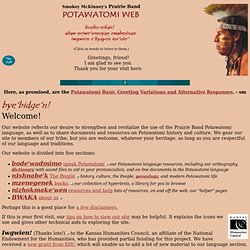
Greetings, friend! I am glad to see you. Thank you for your visit here. Hannahville Culture Language and History. Gatschet MS 615. Gatschet Shawnee MS 615 This material was typed by uquantz@hotmail.com printable copy Index to the Shawnee texts and other material as taken down by Albert S.

Gatschet in 3 quarto volumes. Texts by Thos. Dougherty and others. 1. Shawnee text 184-189 and 192-194 List of the principal dances in use among Shawnees, 22 in list: pg 190-191 hukimáwi hat’thukáka, that is "the principal narrative. " Shawnee pg. 38-43 Text: tahā’dsimusutchí wewilemitá manetú : The story of the horned snake. Skipakákamithagî’ Black Bob Indians, lit. Historic notice on the Chillicothe Indians pg. 552 .
Lenáwe yēsi wakutagî’ nataú’htchikiewenéki wayetchísi. Cree Language Lessons. Potawatomi Language and Culture. Potawatomi Web Language Greeting. Bode'wadmimo speak Potawatomi This introduction to our language pages makes some brief comments on the Potawatomi language, efforts to save and revitalize it, and the contents of these language pages.

The Language The Potawatomi language belongs to the Algonkian language group; as such it is related in structure and vocabulary to the Ojibwe, Menominee, Kickapoo, Miami-Illinois, Shawnee and Cree languages, and most closely resembles Ojibwe and Kickapoo. Linguists classify it as a separate language that became a distinct entity long ago. Most Potawatomi who are involved with the language feel strongly that this is so. The most important characteristic of the language is that it is oral. Potawatomi has been written down from time to time, but a definitive and commonly accepted writing system has never been developed.
Working to Save It First speakers of Potawatomi (that is, people for whom Potawatomi is their first language) are few and elderly. Technology Review: Language Reclamation 101. When the legendary MIT linguistics professor Ken Hale retired in 1999, associate professor Norvin Richards, PhD ‘97, a specialist in Native American and aboriginal Australian languages, was hired to replace the man he considers his mentor.

Today, Richards continues Hale’s work on the Wôpanâak Language Reclamation Project by collaborating with Jessie Little Doe Baird, SM ‘00, and Nitana Hicks, SM ‘06, on the dictionary of this Native American language. Richards classifies the two main tasks of a linguist doing language reclamation as “dictionary work” and “grammar work.” The “dictionary work” using the Eliot Indian Bible involves reading parts of the Bible in search of words that are not yet in the lexicon. “For example,” Richards explains, “I recently finished reading the Book of Isaiah.
When I came to an unfamiliar word, I tried to figure out how it would have been pronounced and what it means. Read the related MIT News feature: “Saving a Language” The Arapaho Project. Online Cree Dictionary, Cree Language, Cree: Words, Alberta Elde. Potawatomi Language Lessons. Choose a Potawatomi Language Lesson from the menu on the left, or the list below.

In each lesson you will find written lessons, video lectures, vocabulary and a quiz to help assess your knowledge. The Basics Learn the basics of Potawatomi in this online language lesson. Learn about spelling and pronunciation. Watch the video lecture for more detail on pronouncing the Potawatomi letters and words. Take the quiz to test your knowledge of the lesson. Animate and Inanimate Nouns This language lesson teaches the basics of Animacy - the difference between animate and inanimate nouns. Verb Conjugation Learn the basics of conjugating Potawatomi verbs. Word Order and Negative Word Order This language lesson contains information on word order, negative word order and variation in how to say no.