
Yemen president says ready to leave power 'with dignity' DUBAI - Yemeni President Ali Abdullah Saleh said he would be prepared to leave power "with dignity" even within hours, Al Arabiya television reported on Saturday.
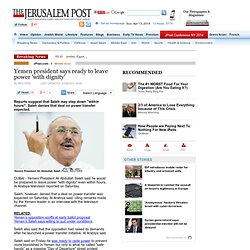
Saleh, however, denied that a deal on power transfer was expected on Saturday, Al Arabiya said, citing remarks made by the Yemeni leader in an interview with the television channel. RELATED:Yemen’s opposition scoffs at early ballot proposalYemen's Saleh says willing to quit under conditions Saleh also said that the opposition had raised its demands after he launched a power transfer initiative, Al Arabiya said. Saleh said on Friday he was ready to cede power to prevent more bloodshed in Yemen but only to what he called "safe hands" as a massive "Day of Departure" street protest against him began. Leading Yemeni tribal figure says Saleh must go. Le Saleh de la peur. (Attention !
Cette vignette est un indice pour découvrir de quoi traitera vraiment cette chronique dans trois paragraphes.) «Oh non ! Pas un énième billet sur le salaire du Président de la république française ! T’as un métro de retard, monsieur Pingouin ! Va voir là-bas si j’y suis.» proteste déjà mon lectorat non-hexagonal. Il y a eu de l’agitation autour de cette augmentation, il ne faut pas en douter. Tout ça pour vous faire entendre qu’au fond le pingouin se moque de l’argent des autres, parce que ce n’est pas la cupidité ou l’avarice qui risquent de lui faire de belles jambes d’autant qu’il a des pattes.
Ce n’est pas pour jaboter mais l’homme dont il est question aujourd’hui n’a rien d’un enfant de chœur et est sans aucun doute un des plus aguerris au monde à la fonction de dirigeant. Vous l’aurez donc reconnu, c’est : le maréchal Ali Abdullah Saleh que j’appelle volontiers le Saleh de la peur. Yemen: The President. What to do when no one trusts you. Having spent the last few days figuring out a way around the facebook and twitter blocks in Egypt, I'm back and ready to blog ..... about Yemen.
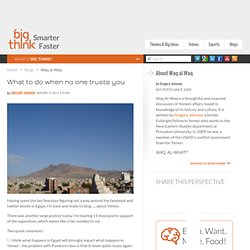
There was another large protest today, I'm hearing 11 thousand in support of the opposition, which seems like a fair number to me. Two quick comments. !. I think what happens in Egypt will strongly impact what happens in Yemen - the problem with Pandora's box is that it never quite closes again. 2. The real problem I see at the moment is what can the Yemeni government and particularly President Salih say or do to appease the widespread anger of the crowds when no one really trusts him to follow through? President Salih has already made two pledges not to run again and, well, you know what happened. So what can the government do? So, we're still left with the original question: what can Salih do with parliamentary elections coming up? His head nod towards contrition (a non-apology apology) the other day didn't seem to do much but energize people.
Ali Abdallah Saleh : Ali Abdullah Saleh. Un article de Wikipédia, l'encyclopédie libre.
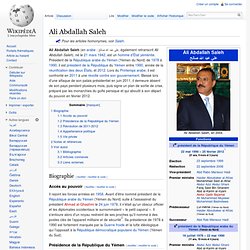
Pour les articles homonymes, voir Saleh. Ali Abdallah Saleh (en arabe : علي عبد الله صالح, également retranscrit Ali Abdullah Saleh), né le , est un homme d'État yéménite. Président de la République arabe du Yémen (Yémen du Nord) de 1978 à 1990, il est président de la République du Yémen entre 1990, année de la réunification des deux États, et 2012. Lors du Printemps arabe, il est confronté en 2011 à une révolte contre son gouvernement. Blessé lors d'une attaque de son palais présidentiel en juin 2011, il demeure absent de son pays pendant plusieurs mois, puis signe un plan de sortie de crise, préparé par les monarchies du golfe persique et qui aboutit à son départ du pouvoir en février 2012. Biographie[modifier | modifier le code] Accès au pouvoir[modifier | modifier le code] Il rejoint les forces armées en 1958.
Présidence de la République du Yémen[modifier | modifier le code] Révolution de 2011-2012[modifier | modifier le code]