
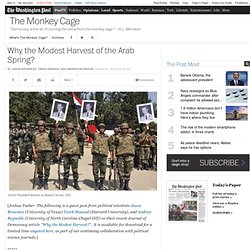
Why the Modest Harvest of the Arab Spring? Syrian President Bashar al-Assad’s forces.
(AP) [Joshua Tucker: The following is a guest post from political scientists Jason Brownlee (University of Texas) Tarek Masoud (Harvard University), and Andrew Reynolds (University of North Carolina-Chapel Hill) on their recent Journal of Democracy article "Why the Modest Harvest? ". It is available for download for a limited time ungated here, as part of our continuing collaboration with political science journals.]
For all of its surprises, perhaps nothing about the Arab Spring has been as surprising as its remarkably modest harvest. The drama, excitement, and sense of possibility created by Bin Ali’s night escape to Saudi Arabia or Mubarak’s resignation have given way to a mournful reality. Our essay in the current issue of the Journal of Democracy offers, what we believe to be, the first regional explanation of regime outcomes from the Arab uprisings of 2010 to 2012. After the Arab Spring: the Gulf monarchies in an age of uncertainty.
Demistifying the Uprisings. The Economics of the Arab Spring. Taking Stock: the uprisings 2 years on. Lawrence of E-rabia: Facebook and the New Arab Revolt. As the growing tide of protest, resistance, and insurrection across the Arab world began to threaten regimes once considered permanent fixtures of the region’s political landscape, it was almost as if everything had been turned upside down.
That which always seemed so fixed and constant suddenly appeared temporary, vulnerable, and fragile—not concrete but conditional, dependent entirely upon the people’s willingness to tolerate it, and tolerate it was precisely what they would do no longer. For a Western audience, long trained to view North Africa and the Middle East through an Orientalist prism, news of the mass upheaval was difficult to fathom. It did not match the preconceived stereotypes. When an ideology runs up against its limits, a choice must be made, and, as is so often the case, many chose to remain wedded to obsolete ways of thinking. People, when pushed hard enough and long enough, will use whatever means are at their disposal to fight back.
The Arab Spring - reading... Political Islam and the Arab Uprisings. The mathematics of the Arab Spring. Egypt and Tunisia are now officially on the international donor community's radar.
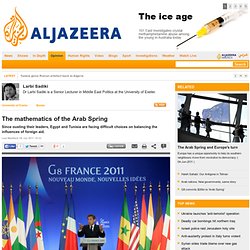
The World Bank and the G8 are already planning different ways to sponsor the so-called Arab Spring. Many Arabs are speaking out against a possible Euro-US "hijacking" or "containment" of the regional movement through this type of "cheque book diplomacy". I will argue here that this position is not intellectually robust, and that the Arab Spring demands dialogue, not political and cultural protectionism. There is a moment of confidence across the Arab geography: Arabs can hold their own. This bodes well for recasting Arab-West relations, as it veers away from a return to hollow views of cultural and socio-political autarchy. Simply crying "US hands off the Arab Spring" is not the answer. From Zoelick to Cameron The British prime minister seems to be right on track for lending support aimed at democratic reconstruction in Egypt and Tunisia.
The sub-text: Funds for what? 2011 in Review: Internet Freedom in the Wake of the Arab Spring. As the year draws to a close, EFF is looking back at the major trends influencing digital rights in 2011 and discussing where we are in the fight for a free expression, innovation, fair use, and privacy.
For several years, discussions about global Internet freedom have focused primarily on what are widely considered the world’s two most restrictive countries: China and Iran. But while China’s ‘Great Firewall’ is indeed the most sophisticated system of censorship and Iran’s persecution of bloggers unprecedented, the Arab world--the 22 Arabic-speaking states and territories stretching from Morocco to Saudi Arabia--is the most Internet-restrictive region on earth. In 2010, four Arab countries (Syria, Tunisia, Egypt, and Saudi Arabia) were named to Reporters Without Borders’ Enemies of the Internet list, while two more (the UAE and Bahrain) were designated as ‘under surveillance.’
A Constant Struggle Egypt is not alone in its struggle.