
Big Think Interview With Howard Gardner. David Lynch Explains How Meditation Enhances Our Creativity. John Cleese on the 5 Factors to Make Your Life More Creative. By Maria Popova “Creativity is not a talent.

Eric Kandel: Creativity, Your Brain, and the Aha! Moment. Need a Creative Boost? Try Lying Down. The Creators Of "Workaholics" On Keeping The Stupid And Weird In Your Creative Process. Often a comedian’s only barometer is his own funny bone.
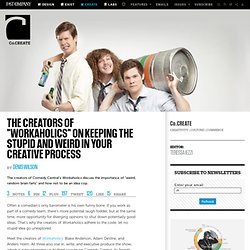
If you work as part of a comedy team, there’s more potential laugh fodder, but at the same time, more opportunity for diverging opinions to shut down potentially good ideas. That’s why the creators of Workaholics adhere to the code: let no stupid idea go unexplored. Meet the creators of Workaholics: Blake Anderson, Adam DeVine, and Anders Holm. All three also star in, write, and executive produce the show, which is now wrapping up its third season on Comedy Central. Why the Best Managers Ask the Most Questions. When your employees ask for help, how you respond can either empower them to find a solution or make them dependent on your input.
One simple response consistently empowers employees: answering with a question instead of a statement. "The most common mistake managers make when helping a direct report solve a problem is a knee-jerk reaction to deliver an answer," says LeeAnn Renninger, director of LifeLabs, a Manhattan-based professional development and research organization, which offers a class on this technique. The problem with advice is that employees don't learn to solve problems independently. Picasso, Kepler, and the Benefits of Being an Expert Generalist. One thing that separates the great innovators from everyone else is that they seem to know a lot about a wide variety of topics.
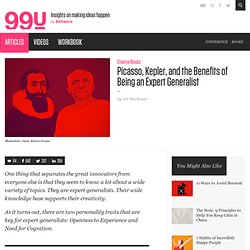
They are expert generalists. Their wide knowledge base supports their creativity. As it turns out, there are two personality traits that are key for expert generalists: Openness to Experience and Need for Cognition. Openness to Experience is one of the Big Five personality characteristics identified by psychologists. In Practice: David Byrne And St. Vincent. Morgan Harris - St Vincent's inspiration from isolation. David Byrne on How Music and Creativity Work. By Maria Popova “Presuming that there is such a thing as ‘progress’ when it comes to music is typical of the high self-regard of those who live in the present.
It is a myth. Creativity doesn’t ‘improve.’”
Steve Jobs. Zen and the Art of Motorcycle Maintenance eBook: Robert M. Pirsig. Zen and the Art of Motorcycle Maintenance. Zen and the Art of Motorcycle Maintenance: An Inquiry into Values (ZAMM), first published in 1974, is a work of philosophical fiction, the first of Robert M.
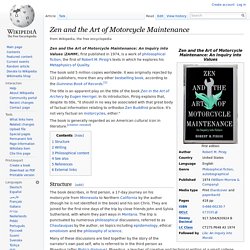
Pirsig's texts in which he explores his Metaphysics of Quality. The book sold 5 million copies worldwide. It was originally rejected by 121 publishers, more than any other bestselling book, according to the Guinness Book of Records.[1] The title is an apparent play on the title of the book Zen in the Art of Archery by Eugen Herrigel. In its introduction, Pirsig explains that, despite its title, "it should in no way be associated with that great body of factual information relating to orthodox Zen Buddhist practice. The book is generally regarded as an American cultural icon in literature. Structure[edit] The Role of Intuition and Imagination in Scientific Discovery and Creativity: A 1957 Guide. By Maria Popova “Those who do not know the torment of the unknown cannot have the joy of discovery.”
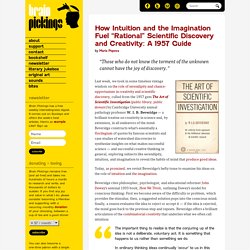
Last week, we took in some timeless vintage wisdom on the role of serendipity and chance-opportunism in creativity and scientific discovery, culled from the 1957 gem The Art of Scientific Investigation (public library; public domain) by Cambridge University animal pathology professor W. I. B. Charles Bukowski: Depression and Three Days in Bed Can Restore Your Creative Juices (NSFW) Pico Iyer once called Charles Bukowski the “laureate of American lowlife,” and that's because he wrote poems for and about ordinary Americans -- people who experienced poverty, the tedium and grind of work, and sometimes frayed relationships, bouts of alcoholism, drug addiction and the rest.
Bukowski could write so eloquently about this because he came from this world. He grew up in a poor immigrant household with an abusive father, took to the bottle at an early age, worked at a Los Angeles post office for a decade plus, and had a long and tumultuous relationship with Jane Cooney Baker, a widow eleven years his senior, who drank to excess and died at 51, leaving Bukowski broken. And then there's the depression. Bukowski experienced that too. Susan Sontag on the Creative Purpose of Boredom. Revised and Expanded (9780465029938): Richard Florida. The Psychology Behind Why Creative People Cluster - Neighborhoods. I’ve long noted how openness to new people and ideas can power innovation and economic growth.
“The Open City,” a new study by Cambridge University psychologist Jason Rentfrow, offers new insight on this issue. A large body of literature shows that highly creative people - artists, scientists, entrepreneurs and the like - are highly likely to be open to new experiences. An earlier study by Rentfrow and his colleague Sam Gosling of the University of Texas, titled "The New Geography of Personality," tracked the five major personality types across states. Aaron Sorkin: The Writer Behind 'The Newsroom' Hide captionOn Aaron Sorkin's latest drama The Newsroom, Will McAvoy (Jeff Daniels) pledges to cover stories because they're important, not because they get ratings. Aaron Sorkin's new HBO drama The Newsroom follows the inner workings of a fictional cable network trying to challenge America's hyperpartisan 24/7 news culture. It's a typical Sorkin drama, complete with fast-paced dialogue, witty scenes and a strong ensemble cast.
Jeff Daniels: Anchoring The Cast Of 'The Newsroom' Hide captionAfter a public meltdown and a wholesale staff defection, Will McAvoy (Jeff Daniels) decides to take a different approach with his nightly news show.
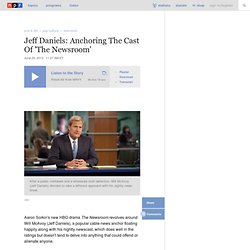
Aaron Sorkin's new HBO drama The Newsroom revolves around Will McAvoy (Jeff Daniels), a popular cable-news anchor floating happily along with his nightly newscast, which does well in the ratings but doesn't tend to delve into anything that could offend or alienate anyone. A creative life is a healthy life. Take solace in the fact that "the creative process is 1% inspiration and 99% perspiration.
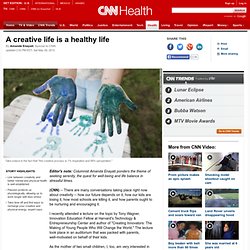
" Link between creativity and better mental and physical health is well established Passion protects us physiologically, allowing us to work longer with less stressTake time off and find ways to recharge your creative and physical energy, expert says Editor's note: Columnist Amanda Enayati ponders the theme of seeking serenity, the quest for well-being and life balance in stressful times.
(CNN) -- There are many conversations taking place right now about creativity -- how our future depends on it, how our kids are losing it, how most schools are killing it, and how parents ought to be nurturing and encouraging it. I recently attended a lecture on the topic by Tony Wagner, Innovation Education Fellow at Harvard's Technology & Entrepreneurship Center and author of "Creating Innovators: The Making of Young People Who Will Change the World.
" 10 Tips for Highly Sensitive People. When I completed Elaine Aron’s Highly Sensitive Person Self-Test, I checked 24 statements. Out of 27. I checked everything from being bothered by bright lights and loud noises to getting startled easily to trying to avoid mistakes to not watching violent movies or TV shows. Why Are We So Afraid of Creativity? Creativity: now there’s a word I thought I wouldn’t see under attack. Don’t we live in a society that thrives on the idea of innovation and creative thought? The age of the entrepreneur, of the man of ideas, of Steve Jobs and the think different motto? Well, yes and no. That is, indisputably yes on the surface. But no in a way that you might not expect: we may say we value creativity, we may glorify the most imaginative among us, but in our heart of hearts, imagination can scare us. We're not always willing to take the risks that come with innovation. As a general rule, we dislike uncertainty.
Sir Ken Robinson: Do schools kill creativity? Aldous Huxley interview-1958 (FULL) The End of Solitude - The Chronicle Review. What does the contemporary self want? The camera has created a culture of celebrity; the computer is creating a culture of connectivity. As the two technologies converge — broadband tipping the Web from text to image, social-networking sites spreading the mesh of interconnection ever wider — the two cultures betray a common impulse. Celebrity and connectivity are both ways of becoming known. This is what the contemporary self wants. It wants to be recognized, wants to be connected: It wants to be visible. So we live exclusively in relation to others, and what disappears from our lives is solitude.
Creative Whack Pack. Listen : John Cage - a buttle of coca-cola -02. An Inspiring Typographic Poster On ‘The Power Of Creativity’ Everything is a Remix. How To Steal Like An Artist by Austin Kleon. Wednesday, March 30th, 2011. Are all new things a mash-up of what came before? A Q&A with Kirby Ferguson. Flow: The Psychology of Optimal Experience (9780061339202): Mihaly Csikszentmihalyi. A Whole New Mind: Why Right-Brainers Will Rule the Future (9781594481710): Daniel H. Pink. 'How Creativity Works': It's All In Your Imagination. iStockphoto.com What makes people creative?
Jonah Lehrer's Bob Dylan quotes lead to resignation. Writer Jonah Lehrer resigned from the New Yorker on Monday after admitting that he had fabricated quotes from Bob Dylan in his nonfiction book "Imagine: How Creativity Works. " The book has been recalled by publisher Houghton Mifflin Harcourt. Published in March, "Imagine: How Creativity Works" has spent 17 weeks on the Los Angeles Times bestseller list. On Bob Dylan And Jonah Lehrer, Two Fabulists : The Record. Hide captionBob Dylan at a press conference at the Savoy Hotel in London in 1966. What's The Big Idea? 5 Books To Inspire Innovation. Jonah Lehrer - The Colbert Report - 2012-17-04. Phaedrus. Elizabeth Gilbert: A new way to think about creativity.
Morgan Harris - John Cleese - a lecture on Creativity. That's All, Folks: Kevin Smith On Leaving Filmmaking.