
Seed funded startups ripe for shakeout, VCs say. Individual seed investors have been an increasingly powerful force in Silicon Valley’s startup funding landscape.
But in an onstage conversation at GigaOM’s Mobilize conference in San Francisco Tuesday, two venture capital heavyweights said that while the VC industry has been shaken up by the increase of seed backers, the current environment will likely lead to a fall. “There will be a day of reckoning, certainly. There are way too many companies getting seed funding,” said Maha Ibrahim, a partner at Canaan Partners. That’s because many of the companies receiving seed funding now are likely to have trouble raising larger amounts of money down the line, she said, since they’ve become used to the kind of terms that only seed investors can offer. Where startups really get (cash) crunched. If startups are facing a cash crunch, it isn't when they start up.
Venture capitalists today are buzzing about a Wall Street Journal story about how Internet startups are facing a "cash crunch. " It's mostly based on AngelList data (or not, see update below), plus venture fund-raising statistics from Dow Jones. I don't dispute either of them, but believe they need to be viewed in a broader context. More importantly, I think the real story they tell was overlooked. First, overall venture capital activity is not decreasing. Moreover, around 49% of completed U.S. venture deals in the past three months were for seed-stage or early-stage companies. Interview with One Kings Lane CEO Doug Mack. Startup Café - Accueil. Fred Wilson: “Marketing Is For Companies Who Have Sucky Products” How much should a startup spend on marketing?
The answer, according to VC Fred Wilson, is zero. The best marketing for a startup when it is just getting off the ground are kick-ass products. Great products market themselves. Venture Hacks - Good advice for startups. Startup information. Stupid Questions VCs Ask. Raising money is never fun for entrepreneurs.
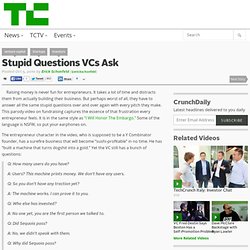
It takes a lot of time and distracts them from actually building their business. But perhaps worst of all, they have to answer all the same stupid questions over and over again with every pitch they make. This parody video on fundraising captures the essence of that frustration every entrepreneur feels. It is in the same style as “I Will Honor The Embargo.” Some of the language is NSFW, so put your earphones on. The guide to getting a base in Silicon Valley for your European startup. In what is possibly the best presented and above all realistic exposition I’ve yet seen on what it’s like to extend a European startup into Silicon Valley, Andy McLoughlin, co-founder with Alastair Mitchell, of Huddle, socked it to the crowd at the annual Future of Web Apps London event this week.
“Fighting and Thriving in the Valley” is a step-by-step look at what it’s like to take a startup from outside the Valley – in this case Huddle’s roots in London – and create a footprint in the US via San Francisco. It was an excellent speech. But since Carsonified, the people behind FOWA, have gone down the road of locking down video for the preserve of their paid-for online conferences (as is their right), we haven’t seen any online video of the talk.
4 questions sur les « me too »? Quand Loic LeMeur vient en France il passe son temps à nous expliquer qu’il faut arrêter de faire des « me too », que c’est pas en copiant les américains qu’on créera des nouvelles success stories.
C’est vrai qu’il y en a pas mal en ce moment, mais que doit en penser? Est ce que ça marche? Est ce que ça crée de la valeur? Comment réussir un me too? Ca serait faux de penser que ce genre de projets sont voués à l’echec. Metrics for social startups - swombat.com. I found a very good presentation on Hacker News which outlines some key metrics that are important for "social games".
If you're building a consumer app these days, adding some social gaming elements can make or break it, so those metrics are very relevant. The presentation breaks down metrics into acquisition , retention and monetisation metrics, and distributes their importance around the lifecycle of a game, which goes through the stages of early , mid-game , and mature development. CAC ( Cost of Customer Acquisition ) (i.e. how much it costs you to generate sticky traffic) is the key metric early on. As you move towards mid-game, virality becomes important. K-factor (also known as viral coefficient ) is the important metric here. The focus then shifts into retention, and the important metrics become: Finally, in the mature stage, monetisation and long-term traffic generation become important, leading to the following key metrics: Action-driven.
StartupHoodlum. Startup School. Startup Weekend- Startup Weekend Events Across the Globe.
Customer Development. Web's Best Advice for Entrepreneurs. Writing a business plan - How to write a business plan - Submit a business plan - Sequoia Capital. Writing a Business Plan At Sequoia we like business plans that present a lot of information in as few words as possible.
The following business plan format, within 15–20 slides, is all that’s needed... read We like business plans that present a lot of information in as few words as possible. The following business plan format, within 15–20 slides, is all that’s needed. Company purpose Define the company/business in a single declarative sentence. ProblemDescribe the pain of the customer (or the customer’s customer). SolutionDemonstrate your company’s value proposition to make the customer’s life better. Why now Set-up the historical evolution of your category. Market sizeIdentify/profile the customer you cater to. Competition List competitors List competitive advantages Product Product line-up (form factor, functionality, features, architecture, intellectual property). TeamFounders & Management Board of Directors/Board of Advisors See also Elements of Enduring Companies.
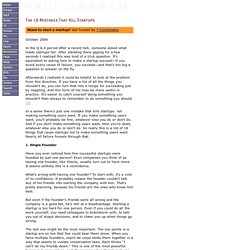
17 Mistakes Start-Ups Make. 17 Mistakes Start-ups Make John Osher has developed hundreds of consumer products, including an electric toothbrush that became America's best-selling toothbrush in just 15 months. He also started several successful companies, including Cap Toys. He built sales to $125 million per year and then sold the company to Hasbro Inc. in 1997. The 18 Mistakes That Kill Startups. October 2006 In the Q & A period after a recent talk, someone asked what made startups fail.
Startups in 13 Sentences. February 2009 One of the things I always tell startups is a principle I learned from Paul Buchheit: it's better to make a few people really happy than to make a lot of people semi-happy.
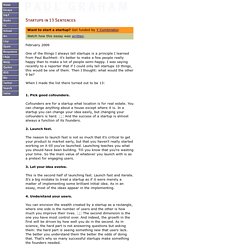
I was saying recently to a reporter that if I could only tell startups 10 things, this would be one of them. Then I thought: what would the other 9 be? When I made the list there turned out to be 13: 1. Startups Or Behemoths: Which Are We Going To Bet On? I knew I would be touching a raw nerve with my last two posts, on patents. But I was really surprised at the divergence of opinion. Entrepreneurs overwhelmingly supported my stance that software patents hamper innovation and need to be abolished, but friends at Microsoft, IBM, and Google were outraged at my recommendation.
Startup Quote. Hey Startups: Don't Launch. Music Start Ups.