
Taoism - Pronunciation Rules. Pinyin to Wade-Giles Table. I Ching (Yi Jing, the Book of Changes) in James Legge's translation. I Ching (Yi Jing, the Book of Changes) was translated by Dr.
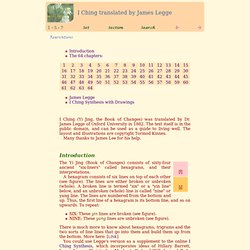
James Legge of Oxford University in 1882. The text itself is in the public domain, and can be used as a guide to living well. The layout and illustrations are copyright Tormod Kinnes. Many thanks to James Lee for his help. The Yi Jing (Book of Changes) consists of sixty-four ancient "six-liners" called hexagrams, and their interpretations. A hexagram consists of six lines on top of each other (see figure). SIX: These yin lines are broken (see figure). There is much more to know about hexagrams, trigrams and the two sorts of line lines that go into them and build them up from the bottom. Taoism and the Arts of China (Art Institute of Chicago) Introduction to the I Ching - By Richard Wilhelm. Introductionby Richard Wilhelm Rendered into English by Cary F.
Baynes HTML Edition by Dan Baruth The Book of Changes -- I Ching in Chinese -- is unquestionably one of the most important books in the world's literature. Its origin goes back to mythical antiquity, and it has occupied the attention of the most eminent scholars of China down to the present day. Nearly all that is greatest and most significant in the three thousand years of Chinese cultural history has either taken its inspiration from this book, or has exerted an influence on the interpretation of its text.
Intro_jung. Comments on the Tao Te Ching. Lao Tzu: "Tao Te Ching" (170+ translations of Chapter 1) The Tao by Lao-tse. A Brief Glossary of Terms in the Dao De Jing. Literally (it is my understanding), "no action.
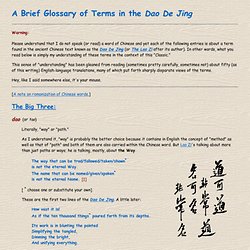
" Functionally this concept, which Lao Zi stresses over and again, holds that whatever one does must be so authentically a part of the person as to feel, to seem, and, indeed, to really be, effortless. It must come from deep within and, no matter how many calories are actually consumed in the process, be of second nature and not the result of decision or effort or anything remotely like effort.
For example, when I decide (as I have any number of times) to make running a part of my life because it is a healthful endeavor and because I want to look better in bathing trunks, I am on the wrong track. From the outset. I will count every stride and curse every pebble I slip on and the shortest jog will not only take an eternity but it will be torturous. Tao Te Ching by Lao Tzu [Dao De Jing by Lao Zi] 修 xiū to decorate, to embellish, to repair, to build, to study, to write, to cultivate YellowTip 去 qù.
![Tao Te Ching by Lao Tzu [Dao De Jing by Lao Zi]](http://cdn.pearltrees.com/s/pic/th/tao-te-ching-lao-tzu-dao-jing-11878734)
Taote_legge. Taoism - Abstract. Taoism Initiation Page - Online Teachings for Home Study and Practice. Iching_wilhelm. Lao-tzu Biography. Who Was Lao-tzu Almost everything we know about Lao-tzu comes from the Historical Records of Ssu-ma Ch'ien.
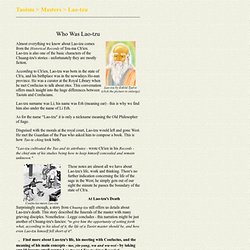
Lao-tzu is also one of the basic characters of the Chuang-tzu's stories - unfortunately they are mostly fiction. According to Ch'ien, Lao-tzu was born in the state of Ch'u, and his birthplace was in the nowadays Ho-nan province. He was a curator at the Royal Library when he met Confucius to talk about rites. This conversation offers much insight into the huge differences between Taoists and Confucians. Lao-tzu surname was Li; his name was Erh (meaning ear) - this is why we find him also under the name of Li Erh. I Ching (Yi Jing, the Book of Changes) in James Legge's translation.
Taoism Origins, Taoism History, Taoism Beliefs. Online religious book publisher seeks growth. By Ramona Turner Posted: 08/11/2009 01:30:08 AM PDT Click photo to enlarge SANTA CRUZ -- When John Bruno Hare first set foot on the UC Santa Cruz campus in 1972 to study linguistics and anthropology, he never thought he'd wind up owning a Web site about world religions.

"It was always one of those side projects I never really had time for," said the former full-time software engineer who lives in Santa Cruz. After leaving the high-tech world in the late 1990s, Hare launched Sacred-Texts.com, a non-denominational site featuring more than 2,000 rare, uncopyrighted religious books, some based on beliefs that date back to 5,000 B.C. Hare finds his work enlightening and hopes visitors to the site will feel the same. "What I've learned is that there are infinite paths to God and that everyone is trying to do the right thing," said Hare, who says he's not a religious person. Sacred-Texts.com is well-read. "Essentially, this is my gift to the world," he said.
Evinity Publishing, Inc. China WWW Virtual Library - Internet Guide for Chinese Studies (WWW VL/ANU/Heidelberg Univ.): Main Page. Internet Sacred Text Archive Home. Taoism Virtual Library. BBC Radio 4 Programmes - In Our Time, Daoism. Taoism.
Taoist rite at the Qingyanggong (Bronze Ram Temple) in Chengdu, Sichuan.
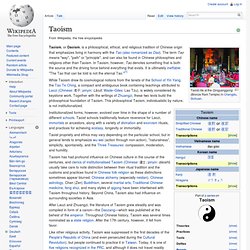
Taoism, or Daoism, is a philosophical, ethical, and religious tradition of Chinese origin that emphasizes living in harmony with the Tao (also romanized as Dao). The term Tao means "way", "path" or "principle", and can also be found in Chinese philosophies and religions other than Taoism. In Taoism, however, Tao denotes something that is both the source and the driving force behind everything that exists. It is ultimately ineffable: "The Tao that can be told is not the eternal Tao. China_map.