
Touchscreen interface for seamless data transfer between the real and virtual worlds #DigInfo. XCOR Announces Significant Propulsion Milestone on Lynx Suborbital Vehicle. Solar-powered 3D printer uses sand to make glass. A three-dimensional (3D) printer powered by sunlight has been developed with the aim of turning desert sand into glass.
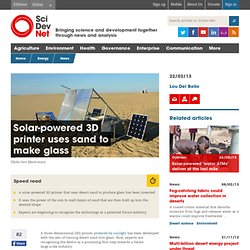
Now, experts are recognising the device as a promising first step towards a future large-scale industry. The machine, developed by German designer Markus Kayser, is called the Solar Sinter. 3D-Printed Skull Implant Ready for Operation. 3D printing technology has helped replace 75 percent of a patient's skull with the approval of U.S. regulators.
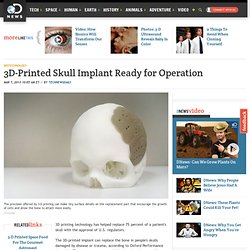
The 3D-printed implant can replace the bone in people's skulls damaged by disease or trauma, according to Oxford Performance Materials. The company announced it had received approval from the U.S. Food and Drug Administration for its skull implant on Feb. 18 — a decision that led to the first U.S. surgical operation on March 4. "We see no part of the orthopedic industry being untouched by this," said Scott DeFelice, president of Oxford Performance Materials. DeFelice's company is already selling 3D-printed implants overseas as a contract manufacturer. 3D printing's advantage comes from taking the digitally scanned model of a patient's skull and "printing" out a matching 3D object layer by layer. About 300 to 500 U.S. patients could use skull bone replacements every month, according to DeFelice. Markus Kayser Builds a Solar-Powered 3D Printer that Prints Glass from Sand and a Sun-Powered Cutter. Industrial designer and tinkerer Markus Kayser spent the better part of a year building and experimenting with two fantastic devices that harness the sun’s power in some of the world’s harshest climates.
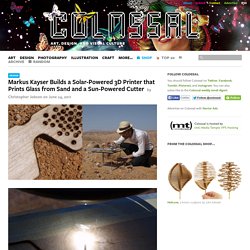
The first he calls a Sun Cutter, a low-tech light cutter that uses a large ball lens to focus the sun’s rays onto a surface that’s moved by a cam-guided system. As the surface moves under the magnified light it cuts 2D components like a laser. The project was tested for the first time in August 2010 in the Egyptian desert and Kayser used thin plywood to create the parts for a few pairs of pretty sweet shades. But he didn’t stop there. Next, Kayser began to examine the process of 3D printing. TED 2013: 4D printed objects 'make themselves' 28 February 2013Last updated at 05:39 ET By Jane Wakefield Technology reporter Video of cube self-folding strand courtesy Self-Assembly Lab, MIT/Stratasys Many are only just getting their heads around the idea of 3D printing but scientists at MIT are already working on an upgrade: 4D printing.
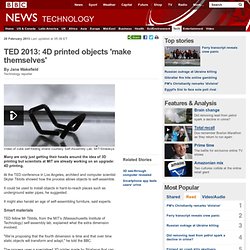
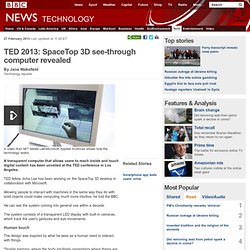
At the TED conference in Los Angeles, architect and computer scientist Skylar Tibbits showed how the process allows objects to self-assemble. It could be used to install objects in hard-to-reach places such as underground water pipes, he suggested. It might also herald an age of self-assembling furniture, said experts. Smart materials. TED 2013: SpaceTop 3D see-through computer revealed. 27 February 2013Last updated at 11:20 ET By Jane Wakefield Technology reporter A video from MIT Media Lab/Microsoft Applied Sciences shows how the technology works A transparent computer that allows users to reach inside and touch digital content has been unveiled at the TED conference in Los Angeles.
A sensational breakthrough: the first bionic hand that can feel - News - Gadgets & Tech. The patient is an unnamed man in his 20s living in Rome who lost the lower part of his arm following an accident, said Silvestro Micera of the Ecole Polytechnique Federale de Lausanne in Switzerland.

The wiring of his new bionic hand will be connected to the patient’s nervous system with the hope that the man will be able to control the movements of the hand as well as receiving touch signals from the hand’s skin sensors. Dr Micera said that the hand will be attached directly to the patient’s nervous system via electrodes clipped onto two of the arm’s main nerves, the median and the ulnar nerves. This should allow the man to control the hand by his thoughts, as well as receiving sensory signals to his brain from the hand’s sensors. Hitachi Invents Waterproof Glass ‘Disk' That Can Store Data Forever. A simple square of glass may hold the key to the vexing problem of storing data indefinitely.

Developed by Hitachi, the technology prints a binary series of dots upon a sliver of quartz glass which can then be easily read with a common microscope. It sounds simple enough, and that is exactly the point – the data can be easily accessed no matter what the future technologies of the digital age bring. Even better, the data is safe from fire, chemicals, and water – almost anything, except perhaps a hammer. As the digital age has discarded physical forms of data storage in favor of more dense and delicate forms that require increasingly sophisticated equipment, it has left many institutions in a quandary.
Media breaks down – and what happens when they archive information which they will not be able to retrieve in the future? Quantum Microscope for Living Biology. A team of Australian scientists has developed a powerful microscope using the laws of quantum mechanics to probe the inner workings of living cells.
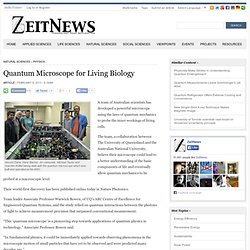
The team, a collaboration between The University of Queensland and the Australian National University, believe their microscope could lead to a better understanding of the basic components of life and eventually allow quantum mechanics to be probed at a macroscopic level. Their world-first discovery has been published online today in Nature Photonics. Team leader Associate Professor Warwick Bowen, of UQ’s ARC Centre of Excellence for Engineered Quantum Systems, said the study relied on quantum interactions between the photons of light to achieve measurement precision that surpassed conventional measurement.
Miniature Star Trek style 'tractor beam' built. What's the big deal with 3D printing? - Features - Gadgets & Tech. If you're aware of 3D printing, but not sure how it works, then you could have done worse than head to the City of London last Friday for the world's first-ever consumer 3D print show, the catchily titled 3D Print Show.
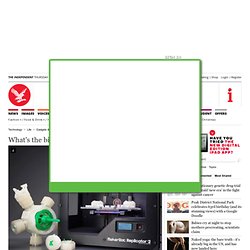
There, you would have met some of the biggest names in what – on the consumer side at least – is a small, but increasingly influential industry. Many of the attendees are watching 3D printing for the first time. The process involves using special printheads that transform computer-aided designs into real objects by adding layer on tiny layer of material to create objects. Think of it as the opposite of chipping away at granite to create a statue. For most of us now, that may mean the ability to tinker around and make little keepsakes. It’s a miracle! World’s first bionic eye gifts blind woman eyesight. Scientists create first-ever virtual germ. Published time: July 24, 2012 04:28 Edited time: July 25, 2012 06:26 Genome of Mycoplasma genitalium is very small and consists of "only" 580,000 nucleotides, or "building blocks" of DNA (Image from Wikipedia) A group from Stanford University in the US has created the first computer simulation that mimics the work of an entire living organism – a primitive parasitic bacterium with a tiny genome.
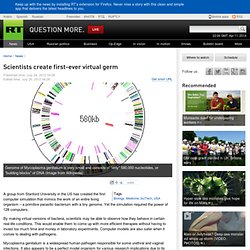
Yet the simulation required the power of 128 computers. By making virtual versions of bacteria, scientists may be able to observe how they behave in certain real-life conditions. This would enable them to come up with more efficient therapies without having to invest too much time and money in laboratory experiments. Mycoplasma genitalium is a widespread human pathogen responsible for some urethral and vaginal infections. No wonder that Markus Covert, an assistant professor of bio-engineering, and his research group chose M. genitalium for their computer model. Home Wi-Fi routers could operate as emergency network, say scientists. German researchers have proposed using home Wi-Fi routers as a backup mesh network in the event that cell and phone systems in cities and towns are overwhelmed during emergencies. In a recently-published paper [PDF], Kamill Panitzek and colleagues at the Technical University in Darmstadt in Germany describe how home routers could be linked to one another to form a huge informal backbone for use by fire, police and ambulance services.
Newcastle's Freeman Hospital gets first robot "surgeon" 19 July 2012Last updated at 14:07 ET The robot called Da Vinci has 3D "vision" and very precise cutting blades A cancer patient has become the first person in the North East and Cumbria to have surgery carried out by a robot. The patient, in his 50s, had his prostate gland removed by £2m Da Vinci, at the Freeman Hospital in Newcastle. Building The Next Internet, 250 Times Faster. The series of tubes that make up the Internet are getting bigger. Tomorrow President Obama will sign an executive order at the White House speeding the way for laying new cable, for example, by letting companies install broadband during highway construction work, which can lower the cost of installation up to 90%.
At the same time, new applications of distributed cloud computing, virtualized networks that use software to simplify the flow of information, and symmetrical gigabit bandwidth connections all the way to your laptop, taken together, have the potential to reach speeds up to 250 times faster than today's Internet. But what will we do with all that Internet? The goal of US Ignite is to get people in 25 cities to build at least 60 new applications in strategic areas--health care, education, clean energy, manufacturing, transportation, and security--all taking advantage of what these Speedy Gonzales networks can do. [Image: Lichtmeister via Shutterstock] A Day Made of Glass 2 HD.
Introducing the Leap. Evacuated Tube Transport could take you around the world in just 6 hours. Imperial College London. National Grid. Use Google To Hack Into A Secrect World - Borntechie. Google is the best answer to any of your search queries 24x7. But do you know Google has a hidden secret world, which can be opened by typing-in a few codes in the Google Search. These Google hacks expose the security loop holes within websites, and much more. Just enter a few secret codes in Google’s search box, and there-after you can have access to security cameras around the world, access to personal & confidential documents or maybe even download in-numerable free stuff from the internet.
Take a jump to see how it’s done. # Hack security cameras. Phi: a wireless re-routing card that puts you in control of the airwaves (video)
Arduino. Arduino - HomePage. Arduino The Documentary (2010) English HD. Building Wireless Sensor Networks. Create distributed sensor systems and intelligent interactive devices using the ZigBee wireless networking protocol and Series 2 XBee radios (available here). By the time you're halfway through this fast-paced, hands-on guide, you'll have built a series of useful projects, including a complete ZigBee wireless network that delivers remotely sensed data.
This resource- and reference-packed book is ideal for inventors, hackers, crafters, students, hobbyists, and scientists. Get ready to create distributed sensor systems and intelligent interactive devices using the ZigBee wireless networking protocol and Series 2 XBee radios. By the time you're halfway through this fast-paced, hands-on guide, you'll have built a series of useful projects, including a complete ZigBee wireless network that delivers remotely sensed data. Radio networking is creating revolutions in volcano monitoring, performance art, clean energy, and consumer electronics.
Top 40 Arduino Projects of the Web. Arduino Powered Remote Control Lawnmower. We’ve seen loads of great Arduino projects and even a few RC lawn mowers, but we’ve never seen the two combined until now. Â This project walks you through the entire build process step by step and includes a thorough guide for creating remote control robotics. You can read the entire build tutorial to perhaps create your own robotic servant.