
First look at the new Raspberry Pi B+ NEW Raspberry Pi B+, NOW with - count them - FOUR USB ports. The Essential Guide to IT Transformation A new Raspberry Pi model has emerged, rectifying one of the most common gripes directed at its predecessors: it now comes complete with four USB 2.0 ports.
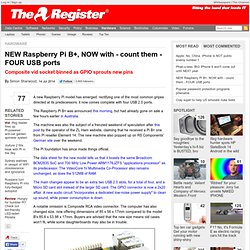
The Raspberry Pi B+ was announced this morning, but had already gone on sale a few hours earlier in Australia. Raspberry Pi: Hands On with Arch Linux and Pidora. In the first post about my new Raspberry Pi, I explored about NOOBS (the New Out Of Box Software package) and Raspbian, the Debian GNU/Linux spin customised for the Pi.
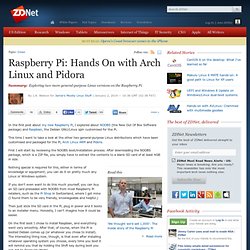
This time I want to take a look at the other two general-purpose Linux distributions which have been customised and packaged for the Pi, Arch Linux ARM and Pidora. First I will start by reviewing the NOOBS boot/installation process. After downloading the NOOBS package, which is a ZIP file, you simply have to extract the contents to a blank SD card of at least 4GB in size. Nothing special is required for this, either in terms of knowledge or equipment; you can do it on pretty much any Linux or Windows system. If you don't even want to do this much yourself, you can buy an SD card preloaded with NOOBS from most Raspberry Pi retailers, such as the Pi Shop in Switzerland, where I got mine (I found them to be very friendly, knowlegeable and helpful.)
You have to admit, that's pretty cool.
Digital Radio Astronomy. 40+ Cool Ideas for your Raspberry PI Project. Why Raspberry Pi can be as vital to the UK as the Spectrum or BBC Micro. David Braben made his name in gaming.
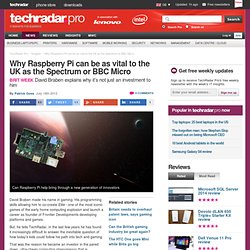
His programming skills allowing him to co-create Elite - one of the most iconic games of the early home computing explosion and launch a career as founder of Frontier Developments developing platforms and games. But, he tells TechRadar, in the last few years he has found it increasingly difficult to answer the inevitable question of how today's kids could follow his path into tech and gaming. In A Nut Shell…Direct Network Connection. Raspberry Pi Remote Connections Without A Network!
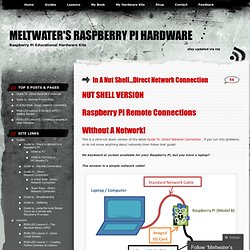
This is a ultra-cut down version of the detail Guide To…Direct Network Connection , if you run into problems or do not know anything about networks then follow that guide! No keyboard or screen available for your Raspberry Pi, but you have a laptop? The answer is a simple network cable! Credit card-sized Raspberry Pi computer gets a video cam! Just when you thought you can no longer squeeze anything else into the tiny Raspberry Pi computer, think again: the puny device is getting a video camera.
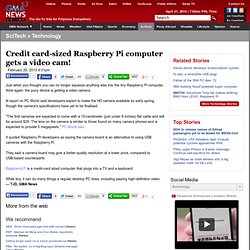
A report on PC World said developers expect to make the HD camera available by early spring, though the camera's specifications have yet to be finalized. "The first cameras are expected to come with a 15-centimeter (just under 6 inches) flat cable and sell for around $25. The lens on the camera is similar to those found on many camera phones and is expected to provide 5 megapixels," PC World said.
Build Your Own Raspberry Pi Portable, The Pi-to-Go Handset. Oh Raspberry Pi, is there no end to the fun and creative projects of which you are a part?
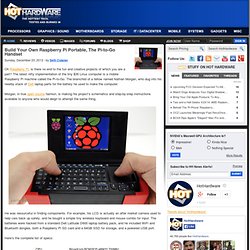
The latest nifty implementation of the tiny $35 Linux computer is a mobile Raspberry Pi machine called the Pi-to-Go. The brainchild of a fellow named Nathan Morgan, who dug into his nearby stack of Dell laptop parts for the battery he used to make the computer. Morgan, in true open source fashion, is making his project’s schematics and step-by-step instructions available to anyone who would deign to attempt the same thing. He was resourceful in finding components. For example, his LCD is actually an after market camera used to help cars back up safely, and he bought a simple tiny wireless keyboard and mouse combo for input.
Here’s the complete list of specs: Setting Up Your Raspberry Pi For Headless Use With SSH. The Raspberry Pi is – as we’ve seen in several previous articles – an extremely flexible piece of hardware.
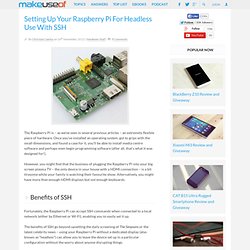
Once you’ve installed an operating system, got to grips with the small dimensions, and found a case for it, you’ll be able to install media centre software and perhaps even begin programming software (after all, that’s what it was designed for!). However, you might find that the business of plugging the Raspberry Pi into your big screen plasma TV – the only device in your house with a HDMI connection – is a bit tiresome while your family is watching their favourite show.
Alternatively, you might have more than enough HDMI displays but not enough keyboards. Getting Started With The Raspberry Pi Is Not As Easy As Pie. The super low cost computer called the Raspberry Pi is mind-blowing and awesome.
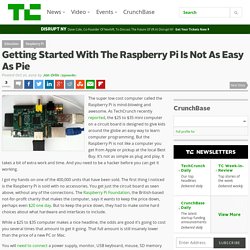
As TechCrunch recently reported, the $25 to $35 mini computer on a circuit board is designed to give kids around the globe an easy way to learn computer programming. But the Raspberry Pi is not like a computer you get from Apple or pickup at the local Best Buy. It’s not as simple as plug and play. It takes a bit of extra work and time. And you need to be a hacker before you can get it working. I got my hands on one of the 400,000 units that have been sold. While a $25 to $35 computer makes a nice headline, the odds are good it’s going to cost you several times that amount to get it going. You will need to connect a power supply, monitor, USB keyboard, mouse, SD memory card, and an Ethernet connection. Raspberry Pi doubles down on RAM, doesn't up its price. The pint-sized development platform better known as Raspberry Pi has gained an onboard RAM upgrade without any typical price increase.
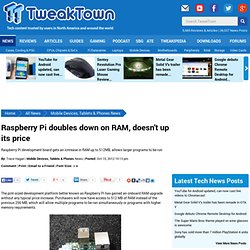
Purchasers will now have access to 512 MB of RAM instead of the previous 256 MB, which will allow multiple programs to be ran simultaneously or programs with higher memory requirements. Good Guy Gregg, err, I mean Raspberry Pi Foundation has decided to keep the pricing at the tiny $35 so that as many people as possible can take advantage of the development board. Even Upton said this was one of the most common suggestions for a "Model C" that would cost more money if produced. "This would be useful for people who want to use the Pi as a general-purpose computer, with multiple large applications running concurrently," he wrote on the official blog. To take advantage of the new RAM that is shipping on boards, users will have to update the firmware running on the system.
What happens when computers are cheaper than LEGO blocks? The cost of a Raspberry Pi computer you can buy today is $25.
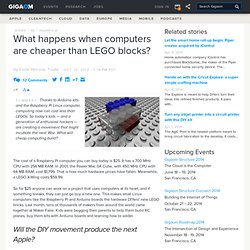
It has a 700 MHz CPU with 256 MB RAM. In 2001, the Power Mac G4 Cube, with 450 MHz CPU with 64 MB RAM, cost $1,799. That is how much hardware prices have fallen. Meanwhile, a LEGO X-Wing costs $59.99. So for $25 anyone can work on a project that uses computers at its heart, and if something breaks, they can just go buy a new one. Many of the kits these kids were using weren’t made by billion dollar corporations – they were made by cottage industry electronics businesses, hobbyists, and “fantrepreneurs.” We have come full circle – back to April 1, 1976 when Steve Jobs, Steve Wozniak, and Ronald Wayne started selling the Apple 1 computer kit.
No More Burnt Raspberry Pi: Safe Supercharging for Super-Small PC. The Raspberry Pi is a $35 computer about the size of a credit card. And it now includes a turbocharger. Photo: Jwrodgers. Here's a simple supercomputer you could build for around $4,000. Technology is obviously catching up to our current definition of "supercomputer.
" I mean, when someone can just buy 64 Raspberry Pi computers, get them all talking to each other in a framework built out of Lego, and then call that "super," it sure seems like we need a new word for these things, doesn't it? Engineers at the University of Southampton, being fans of Moore's Law, noticed how the price of putting together a supercomputer has jumped off of a cliff recently, plummeting from millions of dollars to hundreds of thousands to just tens of thousands. That's pretty cheap, but in an effort to go even cheaper, the engineers decided to take advantage of the most bang for the buck computing power available, the teeny tiny and dirt cheap Raspberry Pi.
For just $35, the Raspberry Pi includes (among other things) a 700 MHz processor, an Ethernet port and expandable storage in the form of an SD card slot. Southampton, via Parity News. Hack Your Kindle to Use It as a Raspberry Pi Screen. How tinkering can bear fruit. The bare essentials ... the Raspberry Pi retails for $40. It's not an Apple. It's not a BlackBerry. But the new, equally fruitily named Raspberry Pi hopes to reintroduce the iGeneration to the joys of tinkering with technology. It comes with a $40 price tag - almost the price of a tray of mangos in high season - but the credit card-size Raspberry Pi is a very different computer proposition. It is stripped down to the bare essentials. TechWeekEurope UKUniversity Of Cambridge Launches Free Raspberry Pi OS Course. The University of Cambridge has launched a free online course designed to help programming enthusiasts write their own operating system for the Raspberry Pi computer.
Called “Baking Pi – Operating Systems Development”, the course consists of twelve lessons, introducing the basics of assembly language programming and OS building to people who don’t have much experience with either. Raspberry Pi, created by the non-profit Raspberry Pi Foundation, is a basic ARM-powered computer that can be connected to a TV or monitor via HDMI. It can be used for many of the things that your desktop PC does, including office work, Internet browsing and high-definition video playback – all possible through a circuit board the size of a credit card – but its real purpose is educational play.
After finishing the course, the students will be able to create their own command line interface and build upon it to produce a unique, if simplistic operating system. How well do you know open-source software? The dark pi rises. Raspberry Pwn: A pentesting release for the Raspberry Pi. 5 Cool Projects for Your Raspberry Pi. 242 Shares Google+ 148 Twitter 48 Facebook 36 LinkedIn 2 inShare2 Reddit 0. ZX Spectrum's chief designers reunited 30 years on. ZX Spectrum engineer backs Raspberry Pi. Good Ideas and Notebooks. Students get their hands on a Raspberry Pi - 6/1/2012. Renesas has teamed with Nomovok to offer its first implementation of the MeeGo Linux-based software platform on its mobile application processor, the SH-Mobile APE4. MeeGo is the co-development of Nokia and Intel.
A demonstration at Mobile World Congress in Barcelona next week will run MeeGo Core OS 1.1 and a Linux BSP (board support package) with fully hardware accelerated video, audio and graphics support. According to Kaj Grönholm, Nomovok’s chief software architect: “The SoC platform combines the productivity of QML language with the performance and graphical freedom of OpenGL shaders.” ”This partnership allows us to exploit our Linux assets by bringing them to the open source community in support of emerging mobile OS’s like MeeGo,” said Manfred Schlett, v-p sales and marketing division at Renesas Mobile. Schlett said that Renesas maintains an open approach to the mobile OS. More news form Mobile World Congress 2011 Related posts. APC. Raspberry Pi review. Raspberry Pi sails through CE tests, ready for sale.
Programming Raspberry Pi. ModMyPi case covers the $35 Raspberry Pi PC for about $13. Designer creating new versions of Raspberry Pi - ZDNet. Raspberry Pi Fedora Remix, our recommended distro, is ready for download! Rasberry Pi. Psst, kid... Wanna learn how to hack? Raspberry Pi Fedora Remix launches. Developers: What Does One Serve With Raspberry Pi? Raspberry Pi, activist tool. Raspberry Pi Forums.com. Raspberry Pi announces the Gertboard expansion board – Computer Chips & Hardware Technology. Setting up a VM for Raspberry Pi development using Virtualbox, Scratchbox2 & qemu (Part 1) « Executing Gummiworms. Raspberry Pi case printed in 3D from Shapeways rev 1. Raspberry Pi computers sell out on launch. Imagine, program, share. Raspberry pi.