
AlanTuring.net. Artificial neural networks for organizing sensor Webs. In Search of..... - TV.com www.tv.com/shows/in-search-of Narrarated by Leonard Nimoy, In search of was a 30 minute syndicated show that covered a wide range of paranormal topics.
It pioneered a lot of the methodology that ... 50 years of AI notes. PhpWiki - ai. Neuromuse.org. Avida. Darwin among the machines. A Presentation By George Dyson In examining the prospects for artificial intelligence and artificial life Samuel Butler (1835-1902) faced the same mysteries that permeate these two subjects today.
"I first asked myself whether life might not, after all, resolve itself into the complexity of arrangement of an inconceivably intricate mechanism," he recalled in 1880, retracing the development of his ideas. "If, then, men were not really alive after all, but were only machines of so complicated a make that it was less trouble to us to cut the difficulty and say that that kind of mechanism was 'being alive,' why should not machines ultimately become as complicated as we are, or at any rate complicated enough to be called living, and to be indeed as living as it was in the nature of anything at all to be?
If it was only a case of their becoming more complicated, we were certainly doing our best to make them so. " [1] Freeman J. Neural Java. Neural Networks Tutorial with Java Applets Introduction Neural Java is a series of exercises and demos.

Each exercise consists of a short introduction, a small demonstration program written in Java (Java Applet), and a series of questions which are intended as an invitation to play with the programs and explore the possibilities of different algorithms. Bio inspired computing tissue. JDK. Welcome!

The Generation5 JDK (Java Development Kit) is part of Generation5's committment to making artificial intelligence and artificial life easy to understand and fun to explore. Take a look at the demonstrations and screenshots to see what the JDK is capable of. Then feel free to download the latest release and develop your own applications or applets. 1 April 2007 If you are running Windows Vista, please update your JRE to 1.6.0-b105 or later to run the JDK applets. 27 December 2004 The latest release of the Generation5 JDK has a lot of new features including: Added support for Hough transforms + demo applet. Brains-N-brawn.com. Generation5. ConceptNet. What is ConceptNet?

[top] NNRG - Project. Joone : Java Object Oriented Neural Engine. Tiberius. Gnod. Weave a neural net with Python. Artificial Life. Artificial Intelligence and Intelligent Search Techniques. Ai.planet. CogNews. Marvin Minsky Home Page. MIT Media Lab and MIT AI Lab Professor of Media Arts and Sciences, MIT Professor of E.E.C.S., M.I.Tminsky at media.mit.edu Abstracts Bibliography Biography People Marvin Minsky has made many contributions to AI, cognitive psychology, mathematics, computational linguistics, robotics, and optics.
In recent years he has worked chiefly on imparting to machines the human capacity for commonsense reasoning. His conception of human intellectual structure and function is presented in two books: The Emotion Machine and The Society of Mind (which is also the title of the course he teaches at MIT). He received the BA and PhD in mathematics at Harvard (1950) and Princeton (1954).
Some Publications The Emotion Machine 2006 (book) draft ( 0 1 2 3 4 5 6 7 8 9 Bib ) Untitled. Pretraining Advice for Neural Network Newbies by Greg Heath. The Outsider's Guide to Artificial Intelligence. The Complexity and Artificial Life Research. An Introduction to Neural Networks. Prof. Leslie Smith Centre for Cognitive and Computational Neuroscience Department of Computing and Mathematics University of Stirling. lss@cs.stir.ac.uk last major update: 25 October 1996: minor update 22 April 1998 and 12 Sept 2001: links updated (they were out of date) 12 Sept 2001; fix to math font (thanks Sietse Brouwer) 2 April 2003 This document is a roughly HTML-ised version of a talk given at the NSYN meeting in Edinburgh, Scotland, on 28 February 1996, then updated a few times in response to comments received. Please email me comments, but remember that this was originally just the slides from an introductory talk!
Neural Network Library project in C# home page. Welcome to my Neural Network project home page.
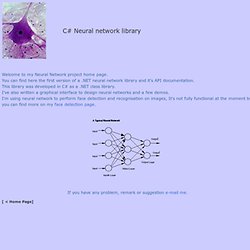
You can find here the first version of a .NET neural network library and it's API documentation. This library was developed in C# as a .NET class library. I've also written a graphical interface to design neural networks and a few demos. I'm using neural network to perform face detection and recognisation on images, It's not fully functional at the moment but you can find more on my face detection page. If you have any problem, remark or suggestion e-mail me. Neural Networks with Java: neural net overview. Java Applets for Neural Network and Artificial Life. (To Japanese version) Artificial Neural Networks Lab Contents.
Essence. ABC++ of Neural Nets. ANNEvolve. Artificial Intelligence and Neural Networks. Fast Artificial Neural Network Library (FANN) Comp.ai.neural-nets. OpenAi. NeuroDimension. OpenEEG-related software. Augmented Reality. Artificial Intelligence Depot. Examining the Society of Mind. To appear in the journal Computing and Informatics.
Push Singh 28 October 2003 push@mit.edu Media Lab Massachusetts Institute of Technology 20 Ames Street Cambridge, MA 02139 United States Abstract This article examines Marvin Minsky's Society of Mind theory of human cognition. The functions performed by the brain are the products of the work of thousands of different, specialized sub-systems, the intricate product of hundreds of millions of years of biological evolution. What is the human mind and how does it work? In seeking answers to these questions, Minsky does not search for a 'basic principle' from which all cognitive phenomena somehow emerge, for example, some universal method of inference, all-purpose representation, or unifying mathematical theory.
Minsky introduces the term agent to refer to the simplest individuals that populate such societies of mind. This article examines the Society of Mind theory. The following essay was written by Scott Fahlman (in 1974 or 1973? K-lines. An Evolutionary Architecture - John Frazer. Electronic version of An Evolutionary Architecture An Evolutionary Architecture was published in January 1995 to coincide with an exhibition of the same name at the Architectural Association.
It concentrates on the work of Diploma Unit 11 run by John and Julia Frazer (with Pete Silver and Guy Westbrook) between 1989 and 1996, but includes formative work by the author dating back to his diploma prize-winning project at the AA in 1969 and related research work at Cambridge University. The book investigates the fundamental form-generating processes in architecture, considering architecture as a form of artificial life, and proposing a genetic representation in a form of DNA-like code-script, which can then be subject to developmental and evolutionary processes in response to the user and the environment.