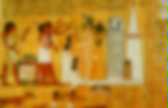
Ancient Egypt: the Mythology and egyptian myths. Ancient Egyptian concept of the soul. Ib (heart)[edit] To ancient Egyptians, the heart was the seat of emotion, thought, will and intention. This is evidenced by the many expressions in the Egyptian language which incorporate the word ib, Awt-ib: happiness (literally, wideness of heart), Xak-ib: estranged (literally, truncated of heart). This word was transcribed by Wallis Budge as Ab. In Egyptian religion, the heart was the key to the afterlife. It was conceived as surviving death in the nether world, where it gave evidence for, or against, its possessor. It was thought that the heart was examined by Anubis and the deities during the Weighing of the Heart ceremony. If the heart weighed more than the feather of Maat, it was immediately consumed by the monster Ammit. Sheut (shadow)[edit] A person's shadow or silhouette, Sheut (šwt in Egyptian), is always present.
Ren (name)[edit] Ba[edit] Ba takes the form of a bird with a human head. Ka[edit] The Egyptians also believed that the ka was sustained through food and drink. Akh[edit] Ancient Egyptian creation myths. The sun rises over the circular mound of creation as goddesses pour out the primeval waters around it Ancient Egyptian creation myths are the ancient Egyptian accounts of the creation of the world. The Pyramid Texts, tomb wall decorations and writings, dating back to the Old Kingdom (2780 – 2250 B.C.E) have given us most of our information regarding early Egyptian creation myths.[1] These myths also form the earliest religious compilations in the world.[2] The ancient Egyptians had many creator gods and associated legends.
Thus the world or more specifically Egypt was created in diverse ways according to different parts of the country.[3] Common elements[edit] Another common element of Egyptian cosmogonies is the familiar figure of the cosmic egg, a substitute for the primeval waters or the primeval mound. Cosmogonies[edit] Hermopolis[edit] Heliopolis[edit] Memphis[edit] The Memphite version of creation centered on Ptah, who was the patron god of craftsmen. Thebes[edit] References[edit] Duat. This article is about the Egyptian underworld. For the evergreen tree, see Jambul. For the aviation weather service, see DUATS. In Egyptian mythology, Duat (pronounced "do-aht") (also Tuat and Tuaut or Akert, Amenthes, Amenti, or Neter-khertet) is the realm of the dead. The Duat is the realm of the god Osiris and the residence of other gods and supernatural beings.
It is the region through which the sun god Ra travels from west to east during the night, and where he battled Apep. It also was the place where people's souls went after death for judgement, though that was not the full extent of the afterlife.[1] Burial chambers formed touching-points between the mundane world and the Duat, and spirits could use tombs to travel back and forth from the Duat.[2] What we know of the Duat principally derives from funerary texts such as Book of Gates, Book of Caverns, Coffin Texts, Amduat and the Book of the Dead. The geography of Duat is similar in outline to the world the Egyptians knew.
Ma'at. Apep. Development[edit] Ra was the solar deity, bringer of light, and thus the upholder of Ma'at. Apep was viewed as the greatest enemy of Ra, and thus was given the title Enemy of Ra. Also, comparable hostile snakes as enemies of the sun god existed under other names (in the Pyramid Texts and Coffin Texts) already before the name Apep occurred. The etymology of his name (ꜥꜣpp) is perhaps to be sought in some west-semitic language where a word root ꜣpp meaning 'to slither' existed. A verb root ꜥꜣpp does at any rate not exist elsewhere in Ancient Egyptian. (It is not to be confused with the verb ꜥpı͗/ꜥpp: 'to fly across the sky, to travel') Apep's name much later came to be falsely connected etymologically in Egyptian with a different root meaning (he who was) spat out; the Romans referred to Apep by this translation of his name.
Apophis was a large golden snake known to be miles long. Battles with Ra[edit] Set speared Apep The sun god Ra, in the form of Great Cat, slays the snake Apep[5] Ammit. Ammit (/ˈæmɨt/; "devourer" or "soul-eater"; also spelled Ammut or Ahemait) was a female demon in ancient Egyptian religion with a body that was part lion, hippopotamus and crocodile—the three largest "man-eating" animals known to ancient Egyptians. A funerary deity, her titles included "Devourer of the Dead", "Eater of Hearts", and "Great of Death". Ammit lived near the scales of justice in Duat, the Egyptian underworld. In the Hall of Two Truths, Anubis weighed the heart of a person against the feather of Ma'at, the goddess of truth, which was depicted as an ostrich feather (the feather was often pictured in Ma'at's headdress).
If the heart was judged to be not pure, Ammit would devour it, and the person undergoing judgement was not allowed to continue their voyage towards Osiris and immortality. Once Ammit swallowed the heart, the soul was believed to become restless forever; this was called "to die a second time". Ammit was also sometimes said to stand by a lake of fire. Thoth. Thoth played many vital and prominent roles in Egyptian mythology, such as maintaining the universe, and being one of the two deities (the other being Ma'at) who stood on either side of Ra's boat.[5] In the later history of ancient Egypt, Thoth became heavily associated with the arbitration of godly disputes,[6] the arts of magic, the system of writing, the development of science,[7] and the judgment of the dead.[8] Name[edit] Etymology[edit] The Egyptian pronunciation of ḏḥwty is not fully known, but may be reconstructed as *ḏiḥautī, based on the Ancient Greek borrowing Θώθ [tʰɔːtʰ] Thōth or Theut and the fact that it evolved into Sahidic Coptic variously as Thoout, Thōth, Thoot, Thaut as well as Bohairic Coptic Thōout.
According to Theodor Hopfner,[12] Thoth's Egyptian name written as ḏḥwty originated from ḏḥw, claimed to be the oldest known name for the Ibis although normally written as hbj. Further names and spellings[edit] Depictions[edit] Attributes[edit] Mythology[edit] History[edit] Sekhmet. In Egyptian mythology, Sekhmet /ˈsɛkˌmɛt/[1] or Sachmis (/ˈsækmɨs/; also spelled Sakhmet, Sekhet, or Sakhet, among other spellings) was originally the warrior goddess as well as goddess of healing for Upper Egypt, when the kingdom of Egypt was divided. She is depicted as a lioness, the fiercest hunter known to the Egyptians. It was said that her breath formed the desert. She was seen as the protector of the pharaohs and led them in warfare. Sekhmet also is a Solar deity, sometimes called the daughter of the sun god Ra and often associated with the goddesses Hathor and Bast.
Etymology[edit] Sekhmet's name comes from the Ancient Egyptian word "sekhem" which means "power or might". History[edit] Bust of the Goddess Sakhmet, ca. 1390-1352 B.C.E. The warrior goddess Sekhmet, shown with her sun disk and cobra crown from a relief at the Temple of Kom Ombo. In order to placate Sekhmet's wrath, her priestesses performed a ritual before a different statue of the goddess on each day of the year. Egyptian mythology. Egyptian mythology is the collection of myths from ancient Egypt, which describe the actions of the Egyptian gods as a means of understanding the world.
The beliefs that these myths express are an important part of ancient Egyptian religion. Myths appear frequently in Egyptian writings and art, particularly in short stories and in religious material such as hymns, ritual texts, funerary texts, and temple decoration. These sources rarely contain a complete account of a myth and often describe only brief fragments. The details of these sacred events differ greatly from one text to another and often seem contradictory. Mythology profoundly influenced Egyptian culture. Origins[edit] The development of Egyptian myth is difficult to trace. Another possible source for mythology is ritual. In private rituals, which are often called "magical", the myth and the ritual are particularly closely tied. Definition and scope[edit] Content and meaning[edit] Sources[edit] Religious sources[edit]