
Bill Nye Boo'd In Texas For Saying The Moon Reflects The Sun - Think... Bill Nye, the harmless children's edu-tainer known as "The Science Guy," managed to offend a select group of adults in Waco, Texas at a presentation, when he suggested that the moon does not emit light, but instead reflects the light of the sun.
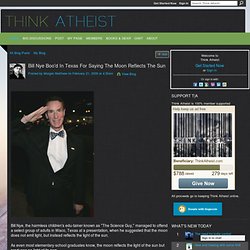
As even most elementary-school graduates know, the moon reflects the light of the sun but produces no light of its own. But don't tell that to the good people of Waco, who were "visibly angered by what some perceived as irreverence," according to the Waco Tribune. Nye was in town to participate in McLennan Community College's Distinguished Lecture Series. He gave two lectures on such unfunny and adult topics as global warming, Mars exploration, and energy consumption. But nothing got people as riled as when he brought up Genesis 1:16, which reads: "God made two great lights -- the greater light to govern the day and the lesser light to govern the night.
The lesser light, he pointed out, is not a light at all, but only a reflector.
The Sacred Geometry Of Music. The Sacred Geometry Of Music by Andrew Lorimer Music uses the laws of vibration to manifest aurally what exists at the center of everything.
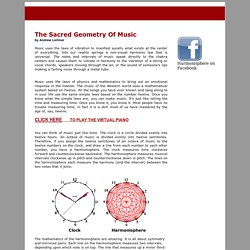
Into our reality springs a non-visual harmonic law that is universal. The notes and intervals of music speak directly to the chakra centers and causes them to vibrate in harmony to the vibration of a string or vocal chords, speakers moving through the air, or the sound of someone’s lips making a farting noise through a metal tube. Music uses the laws of physics and mathematics to bring out an emotional response in the listener.
The music of the Western world uses a mathematical system based on Twelve. All the songs you have ever known and sang along to in your life use the same simple laws based on the number twelve. Clock Harmonisphere. Free Music Theory Worksheets! Material on this page is free.NEW!
You can now consult an index of terms used in these worksheets.Also explore a page of worksheet extras: Worksheet Answers, Test Templates and Flash Presentations. Here are some testimonials from music teachers about these workbook chapters: I have been using your fantastic music theory sheets and PDF downloads to teach high school piano theory to 28 students per class, all of whom are at different levels of study and accomplishment. Your method is comprehensive and easily accessible to students of all ages.
What a great philanthropist and talented musician you are and it is indeed a pleasure to have discovered that I can thank you (in person) on Facebook ... I am excited about the way my students have received this material. Joyce T. Hi, I am a High School teacher in California and I found your Theory Website. Material on this page is free.NEW! The Guitar Wheel: Music Theory Educational Tool. Generic Map For Major Scales. Why the circle of fourths is so important when learning major scales. Pitch Notation. Rhythm Notation. Analyze-o-matic. Harmonic Progression. Diatonic Common Chord Modulation.
Key Signatures. Major Scales. Elements of Music. Universal property of music discovered. Researchers at the Institute for Logic, Language and Computation (ILLC) of the University of Amsterdam have discovered a universal property of musical scales.
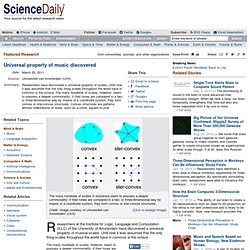
Until now it was assumed that the only thing scales throughout the world have in common is the octave. The many hundreds of scales, however, seem to possess a deeper commonality: if their tones are compared in a two- or three-dimensional way by means of a coordinate system, they form convex or star-convex structures. Convex structures are patterns without indentations or holes, such as a circle, square or oval. Almost all music in the world is based on an underlying scale from which compositions are built. List of electronic music genres - Wikipedia, the free encycloped.
This is a list of electronic music genres, consisting of genres of electronic music, primarily created with electronic musical instruments or electronic music technology.
A distinction has been made between sound produced using electromechanical means and that produced using electronic technology.[1] Examples of electromechanical sound producing devices include the telharmonium, Hammond organ, and the electric guitar. Purely electronic sound production can be achieved using devices such as the Theremin, sound synthesizer, and computer.[2] Genres[edit] See also[edit] Notes[edit] Jump up ^ T. In Bb 2.0 - a collaborative music/spoken word project. Nudge. Theory. MUSIC THEORY. aM laboratory. Pop-up Piano. Online - Music Theory Online - Musical Instrument Ranges & Names. Music Theory. Chord Calculator. Music Theory. The Basics of Musical Pitch. Music theory and art aesthetics. Can melody be rated? I'm not exactly sure of the general consensus, but I have often heard the opinion that with music for example: "There can be no final, or definitive judgement" or that "One person's subjective opinion is just as valid as another - and that it's only a matter of personal preference".
In other words, many believe that music is only good because our minds are individually (and in different ways) - 'programmed' or 'geared' (for whatever reasons) to enjoy it from their perspective. This is called the "Subjective or Relative Aesthetics View" Well, no doubt people's 'taste' is biased (to varying degrees) due to a number of reasons:- what they're 'used to' hearing, 'cultural trend', simply their quality of taste in music, or even 'nostalgia' (though obviously a tune could still be nostalgic to someone and good). For the sake of argument, I'm going to focus on music with a mini-section on what makes the best graphics/pictures near the end of this article. Maybe. Take chess. Difficult question.