
Companies for #edu
Get flash to fully experience Pearltrees
Alcatel-Lucent comptait parmi les 23 entreprises à avoir candidaté à la 1 ère édition des Trophées de l’APEC de l’égalité femme-homme, visant à récompenser des salariés qui participent activement à des actions concrètes en faveur de l’égalité professionnelle; L’équipe d’Alcatel-Lucent Orvault (Loire-Atlantique) a remporté le Trophée d’or dans la catégorie « Grandes Entreprises » avec l’initiative « College@work » dont l’objectif est de favoriser la féminisation des filières technologiques. En effet, force est de constater, que ces filières ne sont pas –ou peu- fréquentées par des jeunes filles (80 % de garçons pour seulement 20 % de filles). Avec son programme « College@work », Alcatel-Lucent a fait le choix d’agir très en amont, dès le collège en fait, pour combattre l’autocensure des jeunes filles.
Le Blog » De l’or pour Alcatel-Lucent !
REDMOND, Wash. — Sept. 8, 2010 — When it comes to education, more is more. That’s the idea behind REDU, a new Bing-powered education emporium that gives students, parents, teachers and people in general a place to learn, talk and take action. The REDU website will help parents, teachers, students and education advocates take action to bring about change. The new site provides links to current events and issues, a forum for discussion, and ways for people to take action as the United States tries to remodel its approach to education, says Cameron Evans, Microsoft’s U.S. Education chief technology officer. Education in the country is at an impasse, Evans says, and discussion around educational issues has reached a crescendo, whether it’s about teacher quality, lack of school funding, or academic performance.
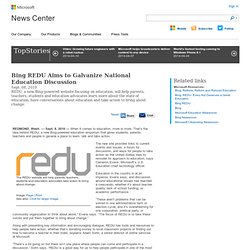
Bing REDU Aims to Galvanize National Education Discussion: REDU, a new Bing-powered website focusing on education, will help parents, teachers, students and education advocates learn more about the state of education, have conversations about education an
MIT Understanding Lasers and Fiberoptics full course by MIT Lasers are essential to an incredibly large number of applications. Today, they are used in bar code readers, compact discs, medicine, communications, sensors, materials processing, computer printers, data processing, 3D-imaging, spectroscopy, navigation, non-destructive testing, chemical processing, color copiers, laser "shows", and in the military. There is hardly a field untouched by the laser. But what exactly is so unique about lasers that makes them so effective?

