
The Mutatuli Project-Bits of Freedom. Bogus NTD. Expeditiously take down. EU/US website blocking. CJEU)decided that Internet Service Providers (ISPs) could be for. Internet copyright notice and take down procedure in Italy! The Failure of the DMCA Notice and Takedown System. Google's copyright notice and takedown process: a model report? Australian High Court rules ISPs need not act on private infring. Lessig's video take down by Liberation Music. Lenz v Universal. Live YouTube de M Obama blocked. Infringing Copyright? Think Twice Before Removing the Copyright Notice. A simple copyright notice (e.g., “© [Year of First Publication] [Owner]”) on a website can imply an assertion of ownership in individual elements of the website and constitute “copyright management information” under the Digital Millennium Copyright Act (DMCA), a Texas district court held.
A Texas investment company learned this lesson the hard way when it removed the copyright notice from an image, used the modified image on its website without authorization, and was subsequently ordered by the court to pay enhanced damages for willful copyright infringement and statutory damages for violating the DMCA. The original image at issue, a graphic juxtaposing two road signs, was created by a graphics company in Texas and federally registered with the U.S. Copyright Office.
Take-Down Guide. Note: you can also request a Take-down.
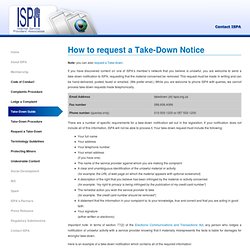
If you have discovered content on one of ISPA’s member’s network that you believe is unlawful, you are welcome to send a take-down notification to ISPA, requesting that the material concerned be removed. This request must be made in writing and can be hand-delivered, posted, faxed or emailed. (We prefer email.) While you are welcome to phone ISPA with queries, we cannot process take-down requests made telephonically.
ESA apologizes for DMCA claim on Dying Light mod files. The Entertainment Software Association (ESA) has apologized for mistakenly issuing Digital Millennium Copyright Act (DMCA) takedown notices for Dying Light mod files shared online this weekend, saying the requests were issued erroneously by a third-party vendor on the organization's behalf.
The controversy began Saturday when at least two MediaFire users were notified that Dying Light modification files they posted online had been taken down for violating the sharing site's Terms of Service. Those takedown notices identified the ESA as the complainant, referred to "copyright infringement" as the reason and directed readers to an "antipiracy" e-mail address. This happened despite the fact that both files had nothing to do with piracy and merely modified the game's visuals. Elsevier Takedown Notices: A Q&A with Peter Suber.
April 17, 2014—In November 2013, Harvard received 23 takedown notices from Elsevier, a publisher of academic journals.
A takedown notice is a request from a copyright holder to remove a work from the internet because of alleged copyright infringement. To comply with the Digital Millennium Copyright Act (DMCA), internet hosts like Harvard must comply with takedown notices even if the recipient may choose to put the work back up again. All 23 of the takedown notices targeted published editions of articles from Elsevier journals posted to websites on the Harvard.edu domain, including for example lab sites, faculty sites, and course websites hosted on iSites. All 23 articles were promptly taken down. YouTube Refuses to Honor DMCA Counter-Notices. Last October, YouTube announced some much needed reforms to its Content ID copyright dispute process.
Bowing to growing public pressure, YouTube ended the practice of allowing copyright claimants to unilaterally deny disputes, leaving users with no further recourse to have non-infringing videos restored. YouTube established a new “appeals” process, which once again gave users whose videos are blocked by Content ID recourse to the DMCA counter-notice process if the copyright owner insists on rejecting their dispute. At the end of the process, the user’s video would be restored unless the copyright claimant actually filed a lawsuit seeking an injunction to keep it offline. No longer. France: The Court of Cassation puts an end to the Notice and Stay Down Rule. 14Aug2012 France: The Court of Cassation puts an end to the Notice and Stay Down Rule By Catherine Jasserand, Institute for Information Law (IViR) Lower courts have shifted from a notice and take down rule (provided by the e-commerce Directive and the LCEN) to a notice and stay down rule (created by the judges).
This interpretation was confirmed in 2011 by the Paris Court of Appeal. However, on 12 July 2012, the Court of Cassation put an end to this judge-made law by issuing its eagerly awaited position on that issue. July has been a busy month for the French Supreme Court. The first decision (Google & Aufeminin.com v. Since 2007, French lower Courts have imposed to online intermediaries (hosting providers and by extension search engines) the obligation to monitor subsequent publications, uploads or re-indexation of materials previously notified as infringing.
Notice-and-action Procedures - Online services. On 4 June 2012, the European Commission launched a public consultation on procedures for notifying and acting on illegal content hosted by online intermediaries.
The Commission wants to collect comments from all stakeholders on how this can best be achieved. The consultation covers the issue of notification of illegal content: for example, should all hosting service providers put in place mechanisms to notify illegal content that are easy to find and easy to use? And if so, should illegal content exclusively be notified by such mechanisms? The consultation also covers the issue of acting on illegal content: for instance, should hosting service providers consult the providers of alleged illegal content? Should they provide feedback to notice providers? Copyright Enforcement Bots Seek And Destroy Hugo Awards.
We have talked repeatedly of automated copyright enforcement, and how it often goes too far.
Recently, we wrote about over enforcement-by-bot when Google's ContentID flagged coverage of the Curiosity landing on Mars. And then there was that time when a recording of some birds got flagged as the content of Rumblefish. These are just a few examples; these stories happen all the time. One thing that sets these examples apart from the following story is that most if not all of those videos were taken down after they were recorded. What happened just recently is a whole new category of insane. But, as with the over-aggressive automated takedowns on recorded content, the live streaming takedowns can be similarly troublesome -- and that situation can be made even worse when people are relying on an official live stream via one of these sites.
This was, of course, absurd. Io9 has it absolutely right. And with that, the broadcast was officially cut off. C&D letter causes UKNova to take down links to television content. TV catch-up service UKNova has just announced that further to receiving a cease and desist letter from the Federation Against Copyright Theft (FACT), it will be taking down all links or access to television content.
NASA's Mars Rover Crashed Into a DMCA Takedown. NASA’s livestream coverage of the Curiosity rover’s landing on Mars was practically as flawless as the landing itself, a refreshing alternative to all that troubled Olympics coverage.
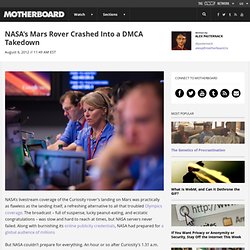
The broadcast – full of suspense, lucky peanut-eating, and ecstatic congratulations – was slow and hard to reach at times, but NASA servers never failed. Along with burnishing its online publicity credentials, NASA had prepared for a global audience of millions But NASA couldn’t prepare for everything. An hour or so after Curiosity’s 1.31 a.m. EST landing in Gale Crater, I noticed that the space agency’s main YouTube channel had posted a 13-minute excerpt of the stream. When I returned to the page ten minutes later, I saw this: Stop the band. MARKT-2011-80072-02-00-EN-TRA-00 (FR) April 2011 Archives. By Eric Goldman Rock River Communications, Inc. v. Universal Music Group, Inc., 2011 WL 1598916 (C.D.Cal. April 27, 2011) We continue to get more cases telling us what 17 USC 512(f), the cause of action for bogus copyright takedown notices,… By Eric Goldman Trademark Litigation Tactics and Federal Government Services to Protect Trademarks and Prevent Counterfeiting, April 2011.
[For background, see my earlier blog post on trademark bullies. Osce. Skip navigation OSCE Secretary General calls for calm in eastern Ukraine. Click here to learn more Organization for Security and Co-operation in Europe Meta Navigation SearchNavigation Search Navigation.