
Paleo-Indians. Paleo-Indians (Paleoindians) or Paleoamericans is a classification term given to the first peoples who entered, and subsequently inhabited, the American continents during the final glacial episodes of the late Pleistocene period.
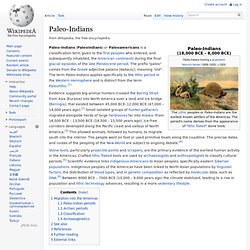
The prefix "paleo" comes from the Greek adjective palaios (παλαιός), meaning "old". The term Paleo-Indians applies specifically to the lithic period in the Western Hemisphere and is distinct from the term Paleolithic.[1] Evidence suggests big-animal hunters crossed the Bering Strait from Asia (Eurasia) into North America over a land and ice bridge (Beringia), that existed between 45,000 BCE–12,000 BCE (47,000 – 14,000 years ago).[2] Small isolated groups of hunter-gatherers migrated alongside herds of large herbivores far into Alaska. From 16,500 BCE – 13,500 BCE (18,500 – 15,500 years ago), ice-free corridors developed along the Pacific coast and valleys of North America.[3] This allowed animals, followed by humans, to migrate south into the interior.
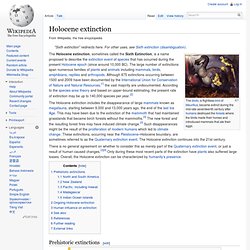
Holocene extinction. The dodo, a flightless bird of Mauritius, became extinct during the mid-late seventeenth century after humans destroyed the forests where the birds made their homes and introduced mammals that ate their eggs.
The Holocene extinction includes the disappearance of large mammals known as megafauna, starting between 9,000 and 13,000 years ago, the end of the last Ice Age. This may have been due to the extinction of the mammoth that had maintained grasslands that became birch forests without the mammoths.[3] The new forest and the resulting forest fires may have induced climate change.[3] Such disappearances might be the result of the proliferation of modern humans which led to climate change. These extinctions, occurring near the Pleistocene–Holocene boundary, are sometimes referred to as the Quaternary extinction event. The Holocene extinction continues into the 21st century. Prehistoric extinctions[edit] North and South America[edit] New Zealand[edit] Pacific, including Hawaii[edit] History of weapons. Japanese cold weapons and other military paraphernalia, c. 1892–95 A Gilbertese shark tooth weapon (late 19th century) The history of weapons is a vast subject and involves a step-by-step account of the various weapons that were invented over the course of time.

Weapons can be defined as: "a tool used to hurt an individual or a group or to threaten or defend". Apart from their employment in warfare and other combat situations, they are also used for hunting-and-gathering purposes, the preservation of law and order, border security, and for the committing of crimes. Weapons have always played a crucial role in society, moulding and changing the course of history. Gunpowder, a Chinese invention, was introduced on to the battlefields of Europe in the Middle Ages, thereby revolutionizing military strategy and introducing a whole new range of propellent-based ordnance. Copper Age[edit] The Sumerians[edit] Bows and arrows[edit] Bows and arrows changed with changing times.