Get flash to fully experience Pearltrees
What if the distinction between business and doing good vanished ? What if all those who engaged in business were committed to a deeper purpose , and all those committed to doing good were entrepreneurial and enterprising ? What would it take for a world of seven billion such people to solve all the world's problems ? If you are one of these people, wondering where to go from here, how to "be the solution" in the twenty-first century, Be the Solution provides an original perspective on how to create a better world.
The reality of security is mathematical, based on the probability of different risks and the effectiveness of different countermeasures. We can calculate how secure your home is from burglary, based on such factors as the crime rate in the neighborhood you live in and your door-locking habits. We can calculate how likely it is for you to be murdered, either on the streets by a stranger or in your home by a family member. Or how likely you are to be the victim of identity theft. Given a large enough set of statistics on criminal acts, it's not even hard; insurance companies do it all the time.
If anyone is seeking a "recipe" for "optimal experience" do not read this book. This book is not a step-by-step self-help guide. Neither is it a pedantic overview of psychological studies replete with statistical analyses, i.e., hard data, proving "flow" exists. The simplest way to summarize this book is, it describes how different people create meaning in life with full intention and focus and thereby achieve an ongoing state of satisfaction and sense of fulfillment. The book begins with an overview of how people define and achieve happiness. Essentially, the author contends, most people are not happy because the universe was not created to make us happy but on the contrary, it serves to frustrate us and help us grow ...
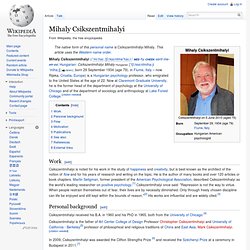
Mihaly Csikszentmihalyi ( / ˈ m iː h aɪ ˌ tʃ iː k s ɛ n t m ə ˈ h aɪ . iː / MEE -hy CHEEK -sent-mə- HY -ee ; Hungarian : Csíkszentmihályi Mihály [ˈtʃiːksɛntmihaːji ˈmihaːj] ; born September 29, 1934, in Fiume , Italy – now Rijeka, Croatia ) is a Hungarian psychology professor, who emigrated to the United States at the age of 22. Now at Claremont Graduate University , he is the former head of the department of psychology at the University of Chicago and of the department of sociology and anthropology at Lake Forest College . He is noted for both his work in the study of happiness and creativity and also for his notoriously difficult name, in terms of pronunciation for non-native speakers of the Hungarian language , but is best known as the architect of the notion of flow and for his years of research and writing on the topic. He is the author of many books and over 120 articles or book chapters.