
I Love This Cutting-Edge School Design. It’s amazing how little the typical classroom has changed over the years.
Picture a teacher standing at a chalkboard, lecturing to 25 or 30 students. The kids all learn at different paces and in different ways, so some are bored while others feel hopelessly behind. This system was designed decades ago, and it doesn’t reflect what educators have learned about helping students and teachers do their best work. What is Positive Education and How To Apply It? What works in education – Hattie’s list of the greatest effects and why it matters. [UPDATE February 2015: Over the past few years, numerous people have commented on my last paragraph as being an overstated and overheated conclusion, unwarranted by the data and of no help in advancing reform.
Fair enough: I have come to think that they are correct. Math and Science Education - Pencils Down. If we could snap our fingers and change the way math and science are taught in U.S. schools, most of us would.
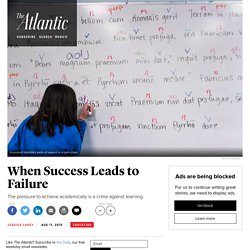
The shortcomings of the current approach are clear. Jessica Lahey’s ‘The Gift of Failure’: A Fear of Risk-Taking Has Destroyed Kids’ Love of Learning. I’ve known the mother sitting in front of me at this parent-teacher conference for years, and we have been through a lot together.
I have taught three of her children, and I like to think we’ve even become friends during our time together. How Pittsfield, New Hampshire's Schools Are Practicing Restorative Justice. PITTSFIELD, N.H.
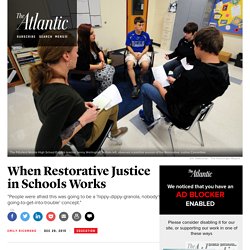
—When the freshman Hope Parent left her cellphone unattended at Pittsfield Middle High School, last year, her classmate Brandon Bojarsky saw his chance for a little fun. Grabbing the device off a windowsill in their Spanish class, he quickly shot off a few obnoxious text messages to people in her contact list—including one to Hope’s mother. By the time Hope figured out what Brandon had done, her phone battery had died. She couldn’t immediately follow up with people to tell them the unkind words hadn’t originated with her. Children today are suffering a severe deficit of pla... When I was a child in the 1950s, my friends and I had two educations.
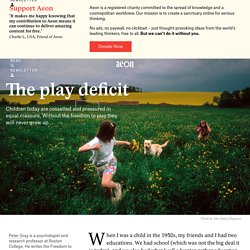
We had school (which was not the big deal it is today), and we also had what I call a hunter-gather education. We played in mixed-age neighbourhood groups almost every day after school, often until dark. We played all weekend and all summer long. “The Disorder Is In The System, Not The Children” Teacher Quits With Epic Rant. Year-round Schools Don't Boost Learning, Study Finds. Students in “year-round” schools don't learn more than their peers in traditional nine-month schools, new research has found.
A sociologist at Ohio State University found that, over a full year, math and reading test scores improved about the same amount for children in year-round schools as they did for students whose schools followed a traditional nine-month calendar. “We found that students in year-round schools learn more during the summer, when others are on vacation, but they seem to learn less than other children during the rest of the year,” said Paul von Hippel, author of the study and research statistician in sociology at Ohio State. The problem with year-round schools may be that they don't actually add more school days to the 180 typically required, von Hippel said.
Instead of a three-month summer vacation, year-round schools typically have several breaks of three to four weeks spread throughout the year. “The results don't support that claim,” von Hippel said. Some Schools Adopting Longer Years to Improve Learning. Year-round school gains ground around U.S. - US news - Life - NBCNews.com. Two days before Thanksgiving, the Indianapolis School Board will make a decision sure to heat up discussion around the turkey in just about every home with young children.
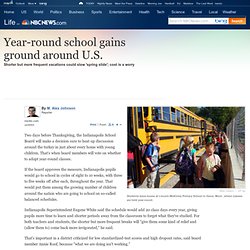
That's when board members will vote on whether to adopt year-round classes. We need year-round school to compete globally. Drop summer vacation, raise test scores? Is Anti-Intellectualism As American As Apple Pie? - Paul Nevins. Cross-posted at politicsofselfishness.com The New York Times reported today that Republican Congressmen in a House sub- committee have voted to strip the EPA of its ability to regulate the emission of greenhouse gasses.
It was also reported that Congresswoman Michele Bachmann introduced a bill last week to roll back efficiency standards for light bulbs, which include a phasing out of incandescent light bulbs in favor of more energy efficient bulbs. Deformed: Authoritarian undercurrents in education. When education scholar Harold Berlak paid a visit to a Knowledge is Power Program (KIPP) charter school in San Francisco he was shocked.
Berlak, an education reform skeptic, found a school that reminded him of a “humane, low security prison or something resembling a locked down drug rehab program for adolescents run on reward and punishments...” Berlak reported that the KIPP school resembled the scene out of Nathaniel Hawthorne's The Scarlet Letter, in which students “...who resisted the rules or were slackers wore a large sign pinned to their clothes labeled 'miscreant.'" Other researchers have noted the authoritarian nature of a KIPP education. Corporate Education Reformers Plot Next Steps at Secretive Meeting. February 5, 2012 | Like this article? Join our email list: Stay up to date with the latest headlines via email. Thursday, hundreds of state legislators from across the nation headed out to an "island" resort on the coast of Florida to a unique "education academy" sponsored by the American Legislative Exchange Council (ALEC).
There were no students or teachers. Gifted Students Deserve More Opportunities. BARACK OBAMA and Mitt Romney both attended elite private high schools. Both are undeniably smart and well educated and owe much of their success to the strong foundation laid by excellent schools. Every motivated, high-potential young American deserves a similar opportunity. But the majority of very smart kids lack the wherewithal to enroll in rigorous private schools. They depend on public education to prepare them for life. Yet that system is failing to create enough opportunities for hundreds of thousands of these high-potential girls and boys.
Current Work « NCEE. NCEE has returned to its original goal of analyzing the world economic and educational scene to identify the best course for American education policy and present its proposals for change in the education system to the American public. Specifically, it decided to follow up on the work of the first Commission on the Skills of the American Workforce by creating another, the New Commission on the Skills of the American Workforce, to examine the workings of the current global economy and their implications for education and training in the United States. That Commission released its report, Tough Choices or Tough Times, that called for a fundamental restructuring of how America educates its people. U.S. Education Reform and National Security. Order Report Publisher Council on Foreign Relations Press Release Date March 2012 Price $15.00 paper. The National Center for Fair & Open Testing.
If students designed their own schools... 5 Things It Turns Out You Were Right to Hate About School. A veteran teacher turned coach shadows 2 students for 2 days – a sobering lesson learned. The following account comes from a veteran HS teacher who just became a Coach in her building. My Daughter’s Homework Is Killing Me - Karl Taro Greenfeld. The Coming Revolution in Public Education.
Chicago Is Focus of National Debate on Schools. How to Fix the Schools. Education solutions from abroad for chronic U.S. school problems. What The US Could Learn From Finland About Education. How Finland Keeps Kids Focused Through Free Play - Tim Walker. 26 Amazing Facts About Finland's Unorthodox Education System. Reinventing Education To Teach Creativity And Entrepreneurship.
Big Study Links Good Teachers to Lasting Gain. Number of the Week: U.S. Teachers’ Hours Among World’s Longest - Real Time Economics. How Computerized Tutors Are Learning to Teach Humans.