
Download Graphic Images from the Hillis/Bull Lab. Return to "Download Files" Page You are welcome to download the following graphic image of the Tree of Life for non-commercial, educational purposes: Tree of Life (~3,000 species, based on rRNA sequences) (pdf, 368 KB) (see Science, 2003, 300:1692-1697) This file can be printed as a wall poster.

Printing at least 54" wide is recommended. Tree of Life tattoo, courtesy of Clare D'Alberto, who is working on her Ph.D. in biology at the University of Melbourne. The organisms depicted in this tattoo are (starting at 4 o'clock and going around clockwise): (1) a cyanobacterium (Anabaena); (2) a radiolarian (Acantharea); (3) a dinoflagellate (Ceratium); (4) an angiosperm (Spider Orchid); (5) a couple species of fungi (Penicillium and a yeast); (6) a ctenophore (comb jelly); (7) a mollusc (nudibranch); (8) an echinoderm (brittle star); and (9) a vertebrate (Weedy Sea Dragon). Here is another great Tree of Life tattoo! Cover of Molecular Systmatics, 2nd ed. Boy discovers microbe that eats plastic. It's not your average science fair when the 16-year-old winner manages to solve a global waste crisis.
But such was the case at last May's Canada-Wide Science Fair in Ottawa, Ontario, where Daniel Burd, a high school student at Waterloo Collegiate Institute, presented his research on microorganisms that can rapidly biodegrade plastic. Daniel had a thought it seems even the most esteemed PhDs hadn't considered.
Plastic, one of the most indestructible of manufactured materials, does in fact eventually decompose. It takes 1,000 years but decompose it does, which means there must be microorganisms out there to do the decomposing. Editor's note: There are two high school students who have discovered plastic-consuming microorganisms. Could those microorganisms be bred to do the job faster? The preliminary results were encouraging, so he kept at it, selecting out the most effective strains and interbreeding them.
Evolution Lab. Biomotion Lab. Lab-Grown Lungs - The 50 Best Inventions of 2010. Growing new body parts has always been more science fiction than science reality, but that balance may quickly be shifting, at least in the lab.
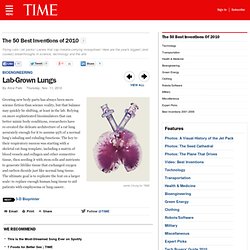
Relying on more sophisticated biosimulators that can better mimic body conditions, researchers have re-created the delicate architecture of a rat lung accurately enough for it to assume 95% of a normal lung's inhaling and exhaling functions. The key to their respiratory success was starting with a skeletal rat-lung template, including a matrix of blood vessels and collagen and other connective tissue, then seeding it with stem cells and nutrients to generate lifelike tissue that exchanged oxygen and carbon dioxide just like normal lung tissue.
The ultimate goal is to replicate the feat on a larger scale: to replace enough human lung tissue to aid patients with emphysema or lung cancer. Next 3-D Bioprinter. Organize-It: Test Yourself on Biology Categories. VIPER. Biology Animation Library. Learn.Genetics™ Learn.Genetics™ Cells. Synthetic Biology. Prométhée, Pandore et Pétri. OpenProcotols.