
CULT OF ZEUS 1 : Ancient Greek religion. ZEUS was the king of the gods, the god of sky and weather, the fate of men and nations, law, justice and moral conduct.

He was widely worshipped in ancient Greece with numerous shrines and sanctuaries. Many of these were located on hill-tops or mountain peaks, founded at sites where offerings were traditionally made to the rain-bringing god. He was also worshipped privately at small household shrines. In classical sculpture, Zeus was portrayed as a regal, bearded man, with bare muscled chest. His attributes were lightning bolt, royal sceptre and eagle. Callimachus, Fragment 114 (from A.P. 13. 10) (trans.
Philostratus the Elder, Imagines 2. 23 (trans. Suidas s.v. Suidas s.v. Suidas s.v. Suidas s.v. Suidas s.v. Suidas s.v. Suidas s.v. I) ATHENS Chief City of Attika Plato, Theages 121a (trans. Pausanias, Description of Greece 1. 2. 5 (trans. Suidas s.v. II) PEIRAIOS Port Town in Attika Strabo, Geography 9. 1. 15 (trans. Zeus. Name The Chariot of Zeus, from an 1879 Stories from the Greek Tragedians by Alfred Church.
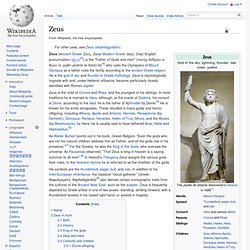
The god's name in the nominative is Ζεύς Zeús /zdeús/. It is inflected as follows: vocative: Ζεῦ / Zeû; accusative: Δία / Día; genitive: Διός / Diós; dative: Διί / Dií. Diogenes Laertius quotes Pherecydes of Syros as spelling the name, Ζάς.[10] The earliest attested forms of the name are the Mycenaean Greek 𐀇𐀸, di-we and 𐀇𐀺, di-wo, written in the Linear B syllabic script.[14] Zeus in myth Zeus, at the Getty Villa, A.D. 1 - 100 by unknown.
Birth When Zeus was about to be born, Rhea sought Gaia to devise a plan to save him, so that Cronus would get his retribution for his acts against Uranus and his own children. Infancy Rhea hid Zeus in a cave on Mount Ida in Crete. King of the gods Zeus and Hera Consorts and children 2The Charites/Graces were usually considered the daughters of Zeus and Eurynome but they were also said to be daughters of Dionysus and Aphrodite or of Helios and the naiad Aegle. Jupiter (mythology) The consuls swore their oath of office in Jupiter's name, and honoured him on the annual feriae of the Capitol in September.
To thank him for his help (and to secure his continued support), they offered him a white ox (bos mas) with gilded horns.[10] A similar offering was made by triumphal generals, who surrendered the tokens of their victory at the feet of Jupiter's statue in the Capitol. Some scholars have viewed the triumphator as embodying (or impersonating) Jupiter in the triumphal procession.[11] During the Conflict of the Orders, Rome's plebeians demanded the right to hold political and religious office. During their first secessio (similar to a general strike), they withdrew from the city and threatened to found their own. The augures publici, augurs were a college of sacerdotes who were in charge of all inaugurations and of the performing of ceremonies known as auguria. The role of Jupiter in the conflict of the orders is a reflection of the religiosity of the Romans.