
Artificial Intelligence: A Modern Approach. Artificial Intelligence Depot. AI Junkie.com. On Intelligence. Outline[edit] Hawkins outlines the book as follows: The book starts with some background on why previous attempts at understanding intelligence and building intelligent machines have failed.

I then introduce and develop the core idea of the theory, what I call the memory-prediction framework. In chapter 6 I detail how the physical brain implements the memory-prediction model—in other words, how the brain actually works. I then discuss social and other implications of the theory, which for many readers might be the most thought-provoking section. A personal history[edit] On Intelligence - Welcome. Numenta - numenta.com.
Artificial Intelligence. After decades of start-and-stop, artificial intelligence is being advanced by major computing firms from Facebook and Google to IBM.

In the left-... The James Martin 21st Century School at the University of Oxford in Oxford, England, founded in 2005, is more commonly known as the Oxford Martin... The Bio-intelligence Explosion – David Pearce. By David Pearce (2012) reproduced from biointelligence-explosion.com“Homo sapiens, the first truly free species, is about to decommission natural selection, the force that made us….

Soon we must look deep within ourselves and decide what we wish to become.” Edward O. WilsonConsilience, The Unity of Knowledge (1999) “I predict that the domestication of biotechnology will dominate our lives during the next fifty years at least as much as the domestication of computers has dominated our lives during the previous fifty years.” Jeff Hawkins on how brain science will change computing. Henry Markram builds a brain in a supercomputer. Redwood Center for Theoretical Neuroscience. Autonomic Computing. The system makes decisions on its own, using high-level policies; it will constantly check and optimize its status and automatically adapt itself to changing conditions.

Kwabena Boahen on a computer that works like the brain. Autonomous agent. An autonomous agent is an intelligent agent operating on an owner's behalf but without any interference of that ownership entity.
An intelligent agent, however appears according to a multiply cited statement in a no longer accessible IBM white paper as follows:
Hierarchical temporal memory. Hierarchical temporal memory (HTM) is an online machine learning model developed by Jeff Hawkins and Dileep George of Numenta, Inc. that models some of the structural and algorithmic properties of the neocortex.
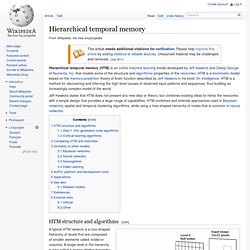
HTM is a biomimetic model based on the memory-prediction theory of brain function described by Jeff Hawkins in his book On Intelligence. HTM is a method for discovering and inferring the high-level causes of observed input patterns and sequences, thus building an increasingly complex model of the world. Jeff Hawkins states that HTM does not present any new idea or theory, but combines existing ideas to mimic the neocortex with a simple design that provides a large range of capabilities.
Hierarchical Temporal Memory. We've completed a functional (and much better) version of our .NET-based Hierarchical Temporal Memory (HTM) engines (great job Rob).

We're also still working on an HTM based robotic behavioral framework (and our 1st quarter goal -- yikes - we're late). Also, we are NOT using Numenta's recently released run-time and/or code... since we're professional .NET consultants/developers, we decided to author our own implementation from initial prototypes authored over the summer of 2006 during an infamous sabbatical -- please don't ask about the "Hammer" stories.
I've been feeling that the team has not been in synch in terms of HTM concepts, theory and implementation. Noam Chomsky on Where Artificial Intelligence Went Wrong - Yarden Katz. An extended conversation with the legendary linguist Graham Gordon Ramsay If one were to rank a list of civilization's greatest and most elusive intellectual challenges, the problem of "decoding" ourselves -- understanding the inner workings of our minds and our brains, and how the architecture of these elements is encoded in our genome -- would surely be at the top.
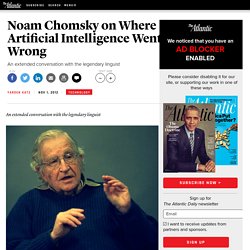
Yet the diverse fields that took on this challenge, from philosophy and psychology to computer science and neuroscience, have been fraught with disagreement about the right approach. Exploring the the Darkside of Artificial Intelligence, thoughts, ideas, rants, and research. Applications of artificial intelligence. Artificial intelligence has been used in a wide range of fields including medical diagnosis, stock trading, robot control, law, remote sensing, scientific discovery and toys.
However, many AI applications are not perceived as AI: "A lot of cutting edge AI has filtered into general applications, often without being called AI because once something becomes useful enough and common enough it's not labeled AI anymore," Nick Bostrom reports.[1] "Many thousands of AI applications are deeply embedded in the infrastructure of every industry. " In the late 90s and early 21st century, AI technology became widely used as elements of larger systems, but the field is rarely credited for these successes.
Computer science[edit] AI researchers have created many tools to solve the most difficult problems in computer science. Many of their inventions have been adopted by mainstream computer science and are no longer considered a part of AI. Finance[edit] Hospitals and medicine[edit] Artificial consciousness. Artificial-brain-project.com. Evolvable hardware. Evolvable hardware (EH) is a new field about the use of evolutionary algorithms (EA) to create specialized electronics without manual engineering. It brings together reconfigurable hardware, artificial intelligence, fault tolerance and autonomous systems. Evolvable hardware refers to hardware that can change its architecture and behavior dynamically and autonomously by interacting with its environment. Introduction[edit] Each candidate circuit can either be simulated or physically implemented in a reconfigurable device. Hugo de Garis.
Hugo de Garis (born 1947, Sydney, Australia) was a researcher in the sub-field of artificial intelligence (AI) known as evolvable hardware. He became known in the 1990s for his research on the use of genetic algorithms to evolve neural networks using three-dimensional cellular automata inside field programmable gate arrays. He claimed that this approach would enable the creation of what he terms "artificial brains" which would quickly surpass human levels of intelligence.[1] He has more recently been noted for his belief that a major war between the supporters and opponents of intelligent machines, resulting in billions of deaths, is almost inevitable before the end of the 21st century.[2]:234 He suggests AIs may simply eliminate the human race, and humans would be powerless to stop them because of technological singularity. Automates Intelligents: Introduction au livre "Un modèle constructible de système psychique, par Jean-Paul Baquiast et Christophe Jacquemin.
23 janvier 2011 par Jean-Paul Baquiast et Christophe Jacquemin Introduction à la lecture de l'ouvrage d'Alain Cardon «Un modèle constructible de système psychique» Les «processus coactivés» et la nouvelle maîtrise du monde Par Jean-Paul Baquiast et Christophe Jacquemin - 23/01/2011 La planète semble être entrée depuis quelques siècles dans une nouvelle ère (aire) géologique marquée par l'empreinte omniprésente des humains sur les phénomènes naturels. Category:Artificial intelligence. From Wikipedia, the free encyclopedia Subcategories This category has the following 32 subcategories, out of 32 total.

Pages in category "Artificial intelligence" The following 200 pages are in this category, out of 256 total. This list may not reflect recent changes (learn more). Artificial General Intelligence in Second Life Virtual worlds are the golden path to achieving Artificial General Intelligence and positive Singularity, Dr Ben Goertzel’s, CEO of Novamente LLC and author of “The Hidden Pattern: A Patternist Philosophy of Mind” explained in his presentation “Artificial General Intelligence in Virtual Worlds” given at the Singularity Summit 2007 earlier this month. According to Goertzel, Singularity is no longer a far future idea.
About a year ago Goertzel gave a talk “Ten Years to a Positive Singularity — If We Really, Really Try.” The slide that opens this post was in Goerzel’s presentation. SI MJ 2010.
Dossier : de l'IA faible à l'IA forte, par Jean-Claude Baquiast et Christohe Jacquemin. Artificial Intelligence. Navigating 50 years of philosophical debate—Robert Horn's Seven Can Computers Think? Maps Full-sized versions of the original maps can be ordered here . The magnificent set of seven 3' x 4' maps created by Robert Horn and his team of researchers focuses on the philosophical debate around Alan Turing's assertion in 1950 that: "by the end of the century... one will be able to speak of machines thinking without expecting to be contradicted" i.e. that a computational system can possess all important elements of human thinking or understanding.
Strong A.I. Bionics. Bionics (also known as bionical creativity engineering) is the application of biological methods and systems found in nature to the study and design of engineering systems and modern technology. [citation needed] The transfer of technology between lifeforms and manufactures is, according to proponents of bionic technology, desirable because evolutionary pressure typically forces living organisms, including fauna and flora, to become highly optimized and efficient.