
Expert tips for improving portraits in Photoshop. Posted in: Tips & Tutorials, by The Advanced Photoshop Team Start by opening your model image and duplicating the layer.
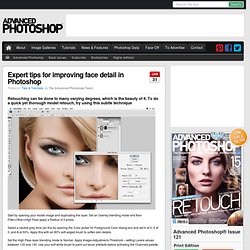
Set an Overlay blending mode and then Filter>Other>High Pass apply a Radius of 3 pixels. Select a neutral grey tone (do this by opening the Color picker for Foreground Color dialog box and set H at 0, S at 0, and B at 50%. Apply this with an 80% soft-edged brush to soften skin details. Set the High Pass layer blending mode to Normal. Cmd/Ctrl-click the RGB Channel and press the Load channel as selection icon. Hide your Threshold layer, and apply a layer mask to your new model layer. Nature - Stock Images. Sign up Forgot password?

Advanced Search. Light Painting Photography. Polixeni Papapetrou // Works // Fairy Tales 2004-2006. Art Gallery Work : Image Galleries : Constance & Eric. Fashion Gone Rogue: The Latest in Editorials and Campaigns. En bruto. Strobist. Photography techniques: Star trail photography. Introduction Since the Earth rotates, the stars are not at fixed places in the sky but appear to move, more or less towards the west.
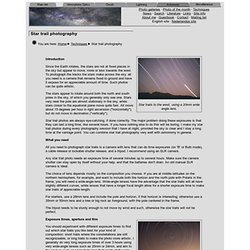
To photograph the tracks the stars make across the sky, all you need is a camera that remains fixed to ground and have it expose for an appreciable amount of time. Such photos can be quite artistic. The stars appear to rotate around both the north and south poles in the sky, of which you generally only see one. Stars very near the pole are almost stationary in the sky, while stars closer to the equatorial plane move quite fast. Star trail photos are always eye-catching, if done correctly. What you need All you need to photograph star trails is a camera with lens that can do time exposures (on 'B' or Bulb mode), a cable release or lockable shutter release, and a tripod. Any star trail photo needs an exposure time of several minutes up to several hours.
The choice of lens depends mostly on the composition you choose. Tips Page. Sorry, no technical support is available for my tips and techniques Please report any web-related problems by sending an email to the address listed below.

Sorry for the inconvenience, but I will not have the chance to respond to questions relating to these tutorials. For immediate response to your issues and questions, check out the Adobe Forum: forums.adobe.com Also be sure to visit the Adobe TV site for a great collection of information and tutorials: tv.adobe.com. Four Flash Photography Basics we must know - Guide Numbers. Guide Numbers If you meter your flash, either via TTL flash automation, or by using a hand held flash meter, or if you just use the camera's rear LCD and histogram to tweak in your manual flash exposure, then maybe you can get by for awhile without this part right now.
It is no big deal if you skip to next page now, you can always come back later. Concursos de fotografía. L'ENFANT EXTERIEUR. Submission Results (Spreadsheet) Kiss-erotic. Tush. Lust ▲ in ▲ you. That’s a problem lots of people are wondering following experiencing this specific weight loss supplement on the Dr Oz display.

In case you’ve recently been asking yourself concerning this specific additionally, permit me to make an effort to help you get started always be of issues through seeing your green bean coffee weight loss evaluation. I believe that will solely as a result may we now have a tendency to cross within the packaging that permeates most web sites along with magazines. What exactly is original green coffee 900? Green infrequent coffee beans tend to be occasional espresso beans that weren’t cooked. Green coffee bean extract pure occasional beans not solely changes the color of the actual green coffee espresso beans however moreover gets rid of a ingredient termed as chlorogenic chemical p. Brooke Shaden : Creating new worlds through images. This week I received an email from a most beautiful soul, asking if I would write about the topic of how to find inspiration when life is getting you down.

I’m extremely empathetic and I take on others pain and joy very easily, and after reading her email, I cried for her. And if I can offer any words of advice that might be even 1% useful, well, that is how to contribute to our community. Pep Ventosa Photographs. PechaKucha 20x20. Sony World Photography Awards 2013. Image-stitching & virtual tour solutions » Lyon 77 Gigapixels: France’s largest photo is now available online! Cada día un fotógrafo / Fotógrafos en la red. PHOTOGRAPHY AND FILM. Ken Kitano- Shadow and light - The Big Picture. So, You Want to Shoot a Rock Show? Part 2.
HDR Photography, Travel Photography and Camera Reviews. Guess the Lighting - A Photography Lighting Blog. DIY-Anleitungen. Alexander Tikhomirov production. 50 Great Photographers You Should Know (with portfolios) Lots of wonderful things happen around us all the time; being able to see is easy, but being able to capture that very moment is probably the hardest part.

A good photo comprise of many things, not only you must hit the shutter at the right time and moment, the perspective, composition and color coordination plays a big role too. Being a good photographer is not easy, let alone getting to that professional level. Christian Saint Photography. Ryan McGinley. 1000 Words Photography Magazine Blog. Multimedia Muse. LightBox - From the photo editors of TIME. The Ultimate Guide to Time-Lapse Photography. Blog home. Ultimate Collection of The Best Adobe Lightroom Presets. All Things Adobe Lightroom!
GRUPO FOTOGRÁFICO ADOFA - Inicio. ALTFoto. Understanding Histograms. Possibly the most useful tool available in digital photography is the histogram.
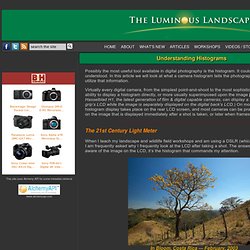
It could also well be the least understood. In this article we will look at what a camera histogram tells the photographer and how best to utilize that information. Virtually every digital camera, from the simplest point-and-shoot to the most sophisticated digital SLR has the ability to display a histogram directly, or more usually superimposed upon the image just taken. (The Hasselblad H1, the latest generation of film & digital capable cameras, can display a histogram on the camera grip’s LCD while the image is separately displayed on the digital back’s LCD.) On most cameras though the histogram display takes place on the rear LCD screen, and most cameras can be programmed to do this both on the image that is displayed immediately after a shot is taken, or later when frames are being reviewed. The 21st Century Light Meter In Bloom.
Canon EOS 1Ds with 16-35mm f/2.8L lens @ 24mm.