
Ubuntu-fr. Fin du pétrole. How to Grow Quinoa. Days to germination: 4 to 5 days Days to harvest: 90 to 120 days Light requirements: Full sun Water requirements: Water occasionally during dry spells Soil: Well-drained and fertile Container: Not suitable for container growing Introduction First of all, the name of this grain plant is pronounced “keen-wa”, and its seeds are high in protein which makes it a nutritious grain to grow.
The protein is considered a “complete” protein, a rarity in the plant world. This makes quinoa a popular food among vegans and vegetarians. It’s not in the same family as the more traditional grasses we grow for grains (like wheat, oats or barley), but it is considered a grain nonetheless. And unlike the grassy grains, quinoa will bloom with gorgeous flowers before going to seed. Quinoa is an annual that prefers cooler weather, and is well-suited for more northern growing. Starting from Seed Dig up your soil beforehand to loosen the earth and to kill any early weeds. Growing Instructions Containers Top of page... How to Grow Mustard. January 23rd, 2009 Email 148 users recommend Phillip Harvey Louisa Rawle Tiné A field of mustard.
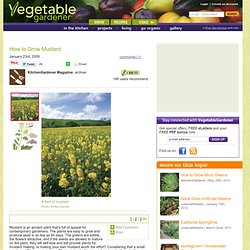
Photo: Phillip Harvey Mustard is an ancient plant that’s full of appeal for contemporary gardeners. Mustard in all its forms—shoots, leaves, flowers, whole seed, powdered, or prepared—is a flavorful, low-fat way to punch up any savory food. If you’ve ever traveled to California’s wine country in early spring, you may have seen the vineyards awash in yellow flowers. Mustard seed contains no cholesterol, only trace amounts of vegetable fat, and about 25 percent protein. Today, mustard is second in demand to pepper among spices in the United States. Over the years, mustard has been imbued with curative powers. All mustards come from the Cruciferae, a family that includes broccoli and cabbage.
Three Sisters Garden - Ecovolution.
Bois Raméal Fragmenté. Pierre Rabhi (et l'agro-écologie) Jardin Bio Solidaire de Jenneret (Durbuy) Institute's Nourishing the Planet. Blog of Danielle Nierenberg Highlighting Innovations in Sustainable Agriculture. Share By Kristen Thiel Iroko trees are native to the west coast of Africa.
Sometimes called Nigerian teak, their wood is tough, dense, and very durable. Their hardwood is so sought after that the trees are often poached and are now endangered in many regions of Africa. But a new scientific discovery may aid in reforestation efforts. Iroko trees can serve as long-term carbon sinks. Oliver de Schutter, the United Nations special rapporteur on the right to food, has found that Iroko trees can serve as long-term carbon sinks and can potentially play a role in the fight against climate change. When the West African Iroko tree is grown in dry, acidic soil and treated with microbes, it produces a very specific mineral.
Normally, biomass (such as trees) does not store carbon dioxide—the gas is used in the process of decomposition. Iroko trees are just one of many species from Africa and the Amazon that can turn carbon in the atmosphere into mineral limestone. Open Source Ecology. Civil Eats.
Semences. Friends of the earth international. Les Amis de la Terre. Permaculture. Bascule en cours > à explorer. Échanges sur la permaculture. Quelques blog permaculture. Culture(s) en herbe(s) FAO Media Centre. Terre de Liens. Food. Agriculture urbaine.