
Pourquoi « logiciel libre » est-il meilleur que « open source » [Traduit de l'anglais] Bien que la liberté d'un logiciel ne soit pas dépendante du nom qu'on lui donne, le nom qu'on lui donne fait une grande différence : des mots différents véhiculent des idées différentes.
En 1998, quelques personnes de la communauté du logiciel libre ont commencé à utiliser le terme « open source » (logiciel ouvert) au lieu de « logiciel libre ». On associa rapidement « open source » à une approche, à une philosophie, à des valeurs, et même à des critères d'acceptabilité des licences, différents. Introduction à l'Open Source et au logiciel libre. Free/Libre Open Source Software (FLOSS) Un article de Wikipédia, l'encyclopédie libre.
Logiciel libre. Un article de Wikipédia, l'encyclopédie libre.
Logo du projet GNU, initiateur du mouvement du logiciel libre. Un logiciel libre est un logiciel dont l'utilisation, l'étude, la modification et la duplication en vue de sa diffusion sont permises, techniquement et légalement[1]. Ceci afin de garantir certaines libertés induites, dont le contrôle du programme par l'utilisateur et la possibilité de partage entre individus[2]. Ces droits peuvent être simplement disponibles (cas du domaine public) ou bien établis par une licence, dite « libre », basée sur le droit d'auteur. Les « licences copyleft » garantissent le maintien de ces droits aux utilisateurs même pour les travaux dérivés. Les logiciels libres constituent une alternative à ceux qui ne le sont pas, qualifiés de « propriétaires » ou de « privateurs »[Note 1].
Logiciel libre : retour sur 5 réussites et leur évolution. La GNU GPL et l'American Way. L'original de cette page est en anglais. par Richard M.
Stallman Microsoft décrit la licence publique générale GNU (GNU GPL) comme une licence « open source » et affirme qu'elle est contraire à l'American Way (la manière de faire américaine). Pour comprendre la GNU GPL et comprendre en quoi elle incarne l'American Way, vous devez d'abord être conscient que la GPL n'a pas été conçue pour l'open source. Le mouvement open source, démarré en 1998, a pour but de développer des logiciels puissants et fiables, ainsi que d'améliorer la technologie en invitant le public à collaborer au développement des logiciels. Le mouvement du logiciel libre a été fondé en 1984, mais son inspiration vient des idéaux de 1776 : la liberté, la communauté et la coopération volontaire.
Nous ne pouvions pas établir une communauté de liberté sur les terres du logiciel privateur, où chaque programme avait son seigneur. Microsoft aimerait sûrement avoir l'avantage de notre code sans les responsabilités. Addendum : Pourquoi les logiciels ne doivent pas avoir de propriétaire. L'original de cette page est en anglais. par Richard Stallman Les techniques numériques de l'information contribuent à l'intérêt général en rendant plus commodes sa copie et sa modification.
Les ordinateurs apportent la promesse de faciliter ces opérations pour chacun d'entre nous. Tout le monde ne veut pas de cette simplification. Le système du copyright attribue aux programmes informatiques des « propriétaires », qui pour la plupart souhaitent en garder pour eux les bénéfices potentiels et non les ouvrir au public. Free Software Foundation. Un article de Wikipédia, l'encyclopédie libre.
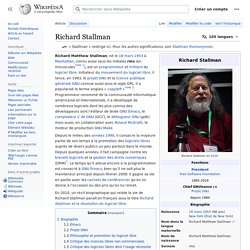
Pour les articles homonymes, voir FSF. Free Software Foundation. Richard Stallman. Richard Stallman en 2019. signature Richard Matthew Stallman, né le 16 mars 1953 à Manhattan, connu aussi sous les initiales rms (en minuscules[1]), est un programmeur et militant du logiciel libre.
Initiateur du mouvement du logiciel libre, il lance, en 1983, le projet GNU et la licence publique générale GNU connue aussi sous le sigle GPL. Il a popularisé le terme anglais « copyleft »[2]. Programmeur renommé de la communauté informatique américaine et internationale, il a développé de nombreux logiciels dont les plus connus des développeurs sont l’éditeur de texte GNU Emacs, le compilateur C de GNU (GCC), le débogueur GNU (gdb) mais aussi, en collaboration avec Roland McGrath, le moteur de production GNU Make.
Depuis le milieu des années 1990, il consacre la majeure partie de son temps à la promotion des logiciels libres auprès de divers publics un peu partout dans le monde. Biographie[modifier | modifier le code] Tout bascula au début des années 1980. Open source. Un article de Wikipédia, l'encyclopédie libre.
La désignation open source, ou « code source ouvert », s'applique aux logiciels (et s'étend maintenant aux œuvres de l'esprit) dont la licence respecte des critères précisément établis par l'Open Source Initiative, c'est-à-dire les possibilités de libre redistribution, d'accès au code source et de création de travaux dérivés. Mis à la disposition du grand public, ce code source est généralement le résultat d'une collaboration entre programmeurs. L’open source a déjà investi tous les grands domaines du système d’information des administrations françaises[1] : environnements serveurs, domaines applicatifs, outils d’ingénierie, solutions de réseaux et sécurité. Définition de l'« Open Source », version 1.0. Open Source Initiative. Un article de Wikipédia, l'encyclopédie libre.
L’Open Source Initiative est une organisation dévouée à la promotion des logiciels open source. Elle a été créée en 1998 à Palo Alto par Todd Anderson, Chris Peterson, John "maddog" Hall, Larry Augustin, Sam Ockman et Michael Tiemann sous l'impulsion de Bruce Perens et Eric S. Raymond. Point de départ et historique[modifier | modifier le code] Né en 1998 d'une scission de la communauté du logiciel libre (communauté d'utilisateurs et de développeurs) afin de conduire une politique jugée plus adaptée aux réalités économiques et techniques, le mouvement open source défend la liberté d'accéder aux sources des programmes qu'ils utilisent, afin d'aboutir à une économie du logiciel dépendant de la seule vente de prestations et non plus de celle de licences d'utilisation.
Open Source Initiative. Eric Raymond. Un article de Wikipédia, l'encyclopédie libre.
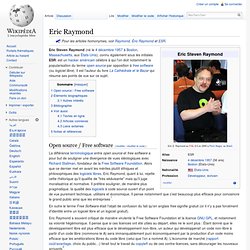
Open source / Free software[modifier | modifier le code] La différence terminologique entre open source et free software a pour but de souligner une divergence de vues idéologiques avec Richard Stallman, fondateur de la Free Software Foundation. Alors que ce dernier met en avant les mérites plutôt éthiques et philosophiques des logiciels libres, Eric Raymond, quant à lui, rejette cette rhétorique qu'il qualifie de "très séduisante" mais qu'il juge moralisatrice et normative. Il préfère souligner, de manière plus pragmatique, la qualité des logiciels à code source ouvert d'un point de vue purement technique, utilitaire et économique. Il pense notamment que c'est beaucoup plus efficace pour convaincre le grand public ainsi que les entreprises[1]. Bruce Perens. Un article de Wikipédia, l'encyclopédie libre.
Bruce Perens Bruce Perens est un ancien leader du projet Debian, le premier à succéder au fondateur Ian Murdock, et un cofondateur de l'Open Source Initiative. Il est détenteur de la marque Open source. Bruce Perens. SourceForge. Framasoft - Logiciels libres.