
Ostroms. Distance. Peer 2 Peer University / Behavioral economics. Why Both Intrinsic and Extrinsic Motivators Matter in Gamification « Strategic Synergy. Dan Ariely, a Professor of Psychology and Behavioral Economics at Duke University wrote a book titled Predictably Irrational where he describes the difference between Intrinsic and Extrinsic Motivators and how these affect management decisions in driving employee behavior .

Ariely suggests that moving from extrinsic motivators or rewards such as money, points or schedules, to intrinsic motivators or internal needs including friendship, commitments , and loyalty, is in essence making a move from a market relationship to a social relationship. An extrinsic or market relationship in this case is defined by the exchange of monetary currency for a product or service. An Intrinsic or social relationship is the exchange of an intangible for a product or service. Ariely illustrates this differentiation in his book with a Thanksgiving dinner scenario, also retold by Jeff Monday in the video below: Imagine you are at your in-laws house for Thanksgiving. Why? Like this: Like Loading... Economists, stories. The Recalculation Story: A Summary. I have had a number of requests for this.

I will put it below the fold. 1. Try not to think of macroeconomics in terms of equations or in terms of aggregate demand. Try to learn to think in a new language, rather than translate from the Recalculation language to something you are used to. 2. 3. 4. 5. 6. 7. 8. 9. 10. 11. 12. 13. 14. 15. Ashraf Laidi - Incisive Global Markets Analysis. Nobel Prize in Economics to Elinor Ostrom “for her analysis of economic governance, especially the commons”
Mike Linksvayer, October 12th, 2009 The 2009 Nobel Prize in Economics was awarded today to Elinor Ostrom and Oliver Williamson for their research on economic governance.

Ostrom’s award is particularly exciting, for it cites her study of the commons. Commons? That sounds familiar! Ostrom’s pioneering work mostly concerns the governance of common-pool resources — resources that are rivalrous (i.e., scarce, can be used up, unlike digital goods) yet need to be or should be governed as a commons — classically, things like water systems and the atmosphere. Historical work by Carla Hesse, Martha Woodmansee, and Mark Rose has been central to my analysis, which also could not have existed but for work on the governance of the commons by Elinor Ostrom, Charlotte Hess, and Carol Rose. Notes, page 264: Notes, page 266: The possibility of producing “order without law” and thus sometimes governing the commons without tragedy has also fascinated scholars of contemporary land use.
Two Good Economics Books: Spin-Free Economics, Animal Spirits - Greg Mankiw's Problem. No, it's not that he's going to get fired by Harvard for casually invoking the Great Unmentionable to explain intergenerational income correlations.

It's that he is teaching a seminar at Harvard for first-year economics students. What 10 books to assign? Two of the books on his list are the two that I thought I would like to have my high school students read--Animal Spirits by Akerlof and Shiller and Capitalism and Freedom by Milton Friedman. But this summer I decided that Friedman's book does not hold up well. [UPDATE: What I mean by "does not hold up well" is that I cannot present it to high school students as something they can relate to. Three Possible Economic Models (Part 1) Time to strap on the Futurist Cap for some serious speculation.
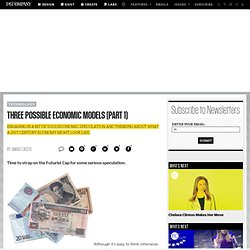
Although it's easy to think otherwise, the structure of the modern global economy is not terribly old, arguably dating back to the collapse of the gold standard in 1971, or the post-World War II "Bretton Woods" conference in 1944. Earlier versions of what we would nonetheless still call "capitalism" had very different degrees (and kinds) of government intervention, roles for labor and capital, even rules about currencies. Add to that the mention more extreme variants such as socialism and communism, corporatism (fascism), and the sundry experiments in anarchism, and you have quite a menagerie of all-but-extinct economic models.
Speaking as a social futurist, not an economist, the three emerging conditions that ride high on my list of potential breaking points for the modern economy are as follows: All exaggerations, to be sure, but indicative of where trends seem to be heading. Pro: This is what we all want, ultimately. Castronova tackled by prokofy. BUT AREN'T YOU A TROLL YOURSELF? Why all the nasty stuff about Ted, you ask? Isn't this mere "trolling"? Of course, the provincials of Second Life aren't used to anything like a Valleywag or Gawker tone being used on events and people, and that's all I've done -- but there's more to it than that. Nobody is criticizing this stuff. People don't even seem to understand its implications.