
DIY video glasses translate languages in real-time (powered by Raspberry Pi) The folks at Google aren’t the only ones working on head-mounted computers that can do some science-fiction level stuff.
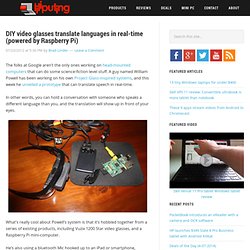
A guy named William Powell has been working on his own Project Glass-inspired systems, and this week he unveiled a prototype that can translate speech in real-time. A Solar Grill Prototype for a Greener Tomorrow. Students at MIT are working on a case study for a new type of solar powered outdoor grill. Based on the technology from MIT professor David Wilson, this grill would collect thermal energy from the sun and store it to allow cooking times for up to twenty five hours at temperatures above 450 degrees Fahrenheit. The study is being conducted by Derek Ham, Eric Uva, and Theodora Vardouli, all part of an entrepreneurship course called “iTeams.” I-Teams, (short for “Innovation Teams”) is a unique MIT course that assembles cross-disciplinary teams of students from across MIT. The goal of i-Teams is to teach students the process of science and technology commercialization focusing on how to judge a technology’s commercial potential.
Each team has access to faculty, practitioners, business mentors, and fellow students throughout their project. Tour of the new 3D Robotics factory. I was in San Diego on Thursday to speak at the AUVSI's Unmanned Systems Interoperability Conference and to do a Bloomberg TV segment on 3D Robotics/DIY Drones. Microbial Home by Philips Design. The Microbial Home is viewed as a cyclical biological machine where wastes like sewage, effluent, garbage, wastewater are filtered, processed and recycled to be used as inputs for the various home functions.
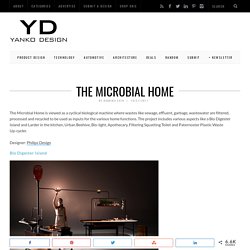
The project includes various aspects like a Bio Digester Island and Larder in the kitchen, Urban Beehive, Bio-light, Apothecary, Filtering Squatting Toilet and Paternoster Plastic Waste Up-cycler. Designer: Philips Design Bio Digester Island Central hub in the Microbial Home system.Consists of a methane digester, which converts bathroom waste solids and vegetable trimmings into methane gas that is used to power a series of functions in the home.The hub is designed as a repositionable kitchen island, including a chopping surface with vegetable waste grinder, a gas cooking range, a glass tank that shows energy reserves and glass elements showing pressure, volume and readiness of compost sludge.Materials used in the design are copper, cast iron, glass and bamboo.
Der Öko-Campingbus der Zukunft: Ecco. Das Schweizer Design-Kollektiv NAU hat mit dem Elektromobil Ecco seine Vorstellung eines Campingmobils des Zukunft präsentiert.
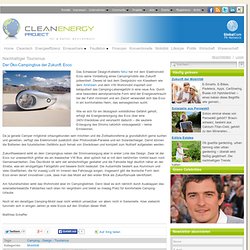
Dieses ist laut dem Designbüro von Klassikern wie dem Airstream und dem VW Wohnmobil inspiriert und katapultiert das Camping-Lebensgefühl in eine neue Ära. Durch eine besonders aerodynamische Form wird der Energieverbrauch bei der Fahrt minimiert und am Zielort verwandelt sich das Ecco in ein komfortables Heim, das seinesgleichen sucht. Wie es sich für ein ökologisch vorbildliches Gefährt gehört, erfolgt die Energieversorgung des Ecco über eine 240V-Steckdose und verursacht dadurch – die saubere Erzeugung des Stroms natürlich vorausgesetzt – keine Emissionen. Human_power_empirically_explored.pdf (application/pdf-Objekt) Cellbots: Using Cellphones as Robotic Control Platforms. Hardware and Software Platform for Mobile Manipulation R&D. Modular Open interfaces let you use different grippers, forearms, whole arms or sensors.
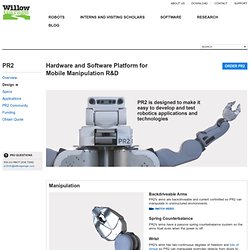
Modularity Specs Power to Go The 1.3 kWh battery system can run the servers and robot at full tilt for 2 hours. Onboard chargers let PR2 run while plugged in and charging. EtherCAT A single EtherCAT bus gives you real time, deterministic control of all your motors at 1 kHz while also providing accurate triggering of all your cameras. Ethernet + WiFi With a 32 gigabit backplane and multigigabit connection to each server, the gigabit Ethernet network handles all the camera data and the dual radio WiFi with ease. Safety From the counterbalance {*style:<br>*} to the power system, {*style:<br>*}PR2‘s hardware and {*style:<br>*}software are designed to minimize risks {*style:<br>*}while retaining the power {*style:<br>*}of an open platform. Your Personal Avatar. Wooden Gear Clock Plans from Hawaii by Clayton Boyer. Grid Beam Building System. Media & Demos. SixthSense - a wearable gestural interface (MIT Media Lab)
'SixthSense' is a wearable gestural interface that augments the physical world around us with digital information and lets us use natural hand gestures to interact with that information.
We've evolved over millions of years to sense the world around us. When we encounter something, someone or some place, we use our five natural senses to perceive information about it; that information helps us make decisions and chose the right actions to take. But arguably the most useful information that can help us make the right decision is not naturally perceivable with our five senses, namely the data, information and knowledge that mankind has accumulated about everything and which is increasingly all available online. Although the miniaturization of computing devices allows us to carry computers in our pockets, keeping us continually connected to the digital world, there is no link between our digital devices and our interactions with the physical world. . . . some more pictures are coming soon.
DIY SixthSense.