
The Murders in the Rue Morgue by Edgar Allan Poe. By: Edgar Allan Poe (1809-1849) The Murders in the Rue Morgue” is a short story written by Edgar Allan Poe in 1841.
Poe referred to it as a “tale of ratiocination” featuring the brilliant deductions of C. Auguste Dupin; it is today regarded as one of the first detective stories and is almost certainly the first locked room mystery. Feminism 101: Read Books, Become a Better Womyn. In response to our first in a series of three Autostraddle Roundtables about feminism, several of you requested a “reading list” to introduce you to some of the basic literature grounding the feminist movement.

Simple enough, right? Well, we knocked our heads together and came up with about 5 billion books, which is probs the difference between bloggers and people with PhDs? : they know how to write concise, clear, focused syllabi? So here’s your list ladies. Get in your hammock, lie on your porch, hide in your emo cave and READ SOME MOTHERFUCKING BOOKS, IDIOTS! This list focuses primarily on the American feminist movement. We’ve also included some “Team Picks” from our friends and from us! Everything is listed in order of publication date. Purple: Women of ColorPink: LGBTBlue: SexGreen: Body Image & Women’s HealthOrange: Pop Culture. The Project Gutenberg eBook of The Young Visiters or, Mr. Salteena's Plan, by Daisy Ashford. Etiquette in Society, in Business, in Politics and at Home by Emily Post. Paradise Lost by John Milton. By: John Milton (1608-1674)
The Devil’s Dictionary by Ambrose Bierce. By: Ambrose Bierce (1842-1914?)
Ambrose Bierce (1842 – 1914?) , satirist, critic, poet, short story writer and journalist. His fiction showed a clean economical style often sprinkled with subtle cynical comments on human behaviour. In the Devil’s Dictionary, he let his sense of humour and his cynical outlook on life colour a collection of dictionary-like definitions.
The Antichrist by Friedrich Nietzsche. By: Friedrich Nietzsche (1844-1900) Save for his raucous, rhapsodical autobiography, Ecce Homo, The Antichrist is the last thing that Nietzsche ever wrote, and so it may be accepted as a statement of some of his most salient ideas in their final form.
Of all Nietzsche’s books, The Antichrist comes nearest to conventionality in form. It presents a connected argument with very few interludes, and has a beginning, a middle and an end. (Summary from the translator’s Introduction). Ten Days in a Madhouse by Nellie Bly. The Tao Teh King, or the Tao and its Characteristics by Laozi. By: Laozi Lao-Tze’s Tao Teh King illuminates The Tao: a guiding principle of the universe and all within it.
By exploring the nature of dualities and complements, Lao-Tze dissects strength and weakness; presence and absence; life and death. The Tao Teh King has served as a foundation for centuries of philosophy and wisdom. (Summary by Eric S. Piotrowski) First Page: Carlo Collodi - opera omnia - the adventures of pinocchio - letteratura italiana. Tarzan of the Apes, Summarized. Copyright 1998 by David Bruce Bozarth, Editor.
Illustration Copyright 1998 by Lou Malcangi. Individual author contributions Copyright 1998. All Rights Reserved. Tarzan Dreams by David A. Adams I recently learned that the works of Twain have been summarized by chapters. Hans Christian Andersen : The Little Mermaid. Far out in the ocean the water is as blue as the petals of the loveliest cornflower, and as clear as the purest glass.
But it is very deep too. It goes down deeper than any anchor rope will go, and many, many steeples would have to be stacked one on top of another to reach from the bottom to the surface of the sea. It is down there that the sea folk live. Now don't suppose that there are only bare white sands at the bottom of the sea. No indeed! The sea king down there had been a widower for years, and his old mother kept house for him. The Online Literature Library. The Top 10 Banned books of all time - ShortLists. Print - The 75 Books Every Man Should Read. Free Classic AudioBooks. Digital narration for the 21st Century.
Book recommendations from readers like you. Collected Quotes from Albert Einstein. [Note: This list of Einstein quotes was being forwarded around the Internet in e-mail, so I decided to put it on my web page.
I'm afraid I can't vouch for its authenticity, tell you where it came from, who compiled the list, who Kevin Harris is, or anything like that. Still, the quotes are interesting and enlightening.] "Any intelligent fool can make things bigger, more complex, and more violent. It takes a touch of genius -- and a lot of courage -- to move in the opposite direction. " "Imagination is more important than knowledge. " Copyright: Kevin Harris 1995 (may be freely distributed with this acknowledgement) 30DrSeuss_quotes.jpg (JPEG Image, 620x1900 pixels) - Scaled (33%) BookMooch: trade your books with other people. Megara. Megara, Hercules' First Wife Acropolis of Minyan Orchomenos from the south Photograph courtesy of the Department of Archaeology, Boston University, Saul S.
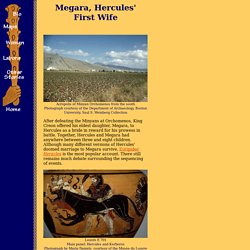
Weinberg Collection After defeating the Minyans at Orchomenos, King Creon offered his eldest daughter, Megara, to Hercules as a bride in reward for his prowess in battle. Together, Hercules and Megara had anywhere between three and eight children. Although many different versions of Hercules' doomed marriage to Megara survive, Euripides' Heracles is the most popular account. The Hunchback of Notre Dame by Victor Hugo: Preface. A few years ago, while visiting or, rather, rummaging about Notre-Dame, the author of this book found, in an obscure nook of one of the towers, the following word, engraved by hand upon the wall:-- ANArKH. Explore the Summer Reading Flowchart.